Lessons · Lesson 1 of 3
Denim: what the ounce weight actually decides
Price two denim qualities against each other for a real order, and see what the weight, the spinning and the dyeing do to the metres, the wash and the buyer's limits.
Lesson 1 of 3 · 40 min
The situation
Denim is described by a weight in ounces. That one figure carries more of the garment than any other number in the specification. But it does not decide how the trousers will look after washing. That comes from two other choices: how the yarn was spun, and how the blue dye was put on. This lesson uses a real choice between three cloths to show what the weight decides — and what it does not.
14 March, 08:40, a jeans unit in Mahalla al-Kubra. PO LK-4471 is for the Danish retailer Larsen & Kro: 6,200 women's straight-leg jeans, style WJ-207, indigo, one stone wash. FOB USD 14.20, order value USD 88,040. Fabric booking closes on Friday, and the mill wants an answer.
Three quotations are on the desk. All are from Ceylan Denim in Kayseri. All are 152 cm usable width.
| Quote | Construction | Weight | Elastane | Price per metre |
|---|---|---|---|---|
| 1 | Open-end warp, slasher-dyed, 3/1 right-hand twill | 11 oz | 2 percent | USD 3.20 |
| 2 | Ring-spun warp, rope-dyed, 3/1 right-hand twill | 11 oz | 2 percent | USD 3.95 |
| 3 | Ring-spun warp, rope-dyed, broken twill | 12.5 oz | 1 percent plus T400 recovery | USD 4.35 |
A merchandiser who has never costed denim looks at that table and sees USD 1.15 a metre between the cheapest and the dearest. That is the wrong number to look at. By the end of this lesson, quote 1 will have dropped off the shortlist entirely. Not on price — because it cannot pass a test the buyer has already written into the PO.
The ounce is a weight per area, and it is the fabric's whole personality
Denim weight is quoted in ounces per square yard — never in ounces of anything else. One ounce per square yard is 33.906 grams per square metre. So the conversion is one multiplication.
| Weight | gsm | Where it belongs |
|---|---|---|
| 9.5 oz | 322 | Jeggings, summer women's, shirt-weight denim |
| 10.5 oz | 356 | Women's skinny and super-skinny with elastane |
| 11 oz | 373 | Mainstream women's five-pocket, comfort stretch |
| 12.5 oz | 424 | Mainstream men's five-pocket, the volume weight of the trade |
| 13.5 oz | 458 | Heavier men's, raw and rigid, workwear-leaning |
| 14.5 oz | 492 | Selvedge, raw, jackets, true workwear |
Two things follow from the weight. Neither is obvious.
The first: weight moves with shrinkage, and shrinkage moves consumption. A heavier, denser, ring-spun rope-dyed denim loses more warp tension in dyeing and gets less of it back in finishing. So it shrinks more after wash. Ceylan's own test reports say 1.8 percent warp shrinkage on the 11 oz qualities and 3.8 percent on the 12.5 oz. Two points of shrinkage is not a rounding error. It is two points added to every length dimension of the pattern, because the garment has to measure right after the wash, not before it.
The second: weight changes almost nothing about the marker efficiency, and everything about the pattern size. (The marker is the cutting layout — the plan of how the pattern pieces sit on the cloth.) People expect a heavy fabric to eat more metres because it is thicker. It does not. A marker is an area calculation, and thickness only limits how many plies you can lay. What eats the metres is the bigger pattern.
The consumption, worked
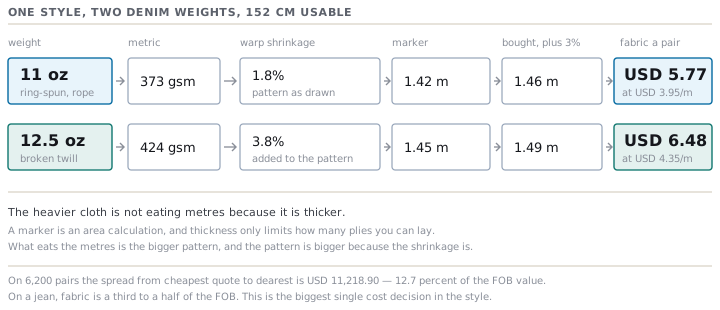
WJ-207 markers at 1.42 m per pair on the 11 oz patterns, at 152 cm width, with the sizes in the buyer's ratio. Add the cutting-room allowance of 3 percent for roll ends, splices and shade lots, and you buy 1.46 m a pair.
On the 12.5 oz, the pattern length dimensions carry two extra points of shrinkage allowance. The marker comes back at 1.45 m. With the same 3 percent allowance, you buy 1.49 m a pair.
| Quote | Metres per pair | Price per metre | Fabric per pair | Metres for the order | Fabric for the order |
|---|---|---|---|---|---|
| 1 | 1.46 | USD 3.20 | USD 4.67 | 9,052 | USD 28,966.40 |
| 2 | 1.46 | USD 3.95 | USD 5.77 | 9,052 | USD 35,755.40 |
| 3 | 1.49 | USD 4.35 | USD 6.48 | 9,238 | USD 40,185.30 |
The spread from quote 1 to quote 3 is USD 11,218.90. That is 12.7 percent of the whole FOB value of the order. On a jean, fabric is between a third and a half of the FOB, so the denim decision is the single biggest cost decision in the style. This is why denim is costed differently from any other woven. On a poplin shirt you argue about cents a metre. On a jean you are arguing about the margin.
Ring, open-end, rope and slasher — and why it shows up only after the wash
Ring spinning twists the fibres into a yarn with a soft, irregular surface and real slub character. Open-end (rotor) spinning is three to five times faster. It produces a yarn that is regular, slightly weaker, and visually flat. Unwashed, on a roll, under a mill's lights, the two can look near enough identical. After a stone wash they do not.
Rope dyeing runs the warp as a twisted rope through six to twelve indigo baths, with an air passage between each bath so the indigo oxidises before the next dip. Slasher (sheet) dyeing runs the warp as a flat sheet, in fewer dips, on one machine that also sizes it. Slasher is cheaper and gives a level, well-matched shade. Rope gives deeper, more varied penetration.
Both processes produce ring dyeing: the indigo sits on the outside of the yarn and leaves a white cotton core. That single fact is the whole reason denim fades. Abrasion in the wash takes the indigo off the surface of the raised yarn and shows the white core underneath. A ring-spun yarn has an irregular surface with more raised places to abrade, so it fades with contrast. A flat open-end yarn fades evenly — which reads as grey and dead.
The mill washed one metre of each quality to the buyer's approved wash recipe: 45 minutes stone, one rinse, softener. The results:
| Quote | Warp shrink after wash | Contrast | Leg twist at hem, 3 home washes | Growth at knee, 30 min at 20 percent extension |
|---|---|---|---|---|
| 1 | 1.8 percent | Flat, grey cast | 2.4 cm | 8.2 percent |
| 2 | 1.9 percent | High, white core showing | 2.2 cm | 7.9 percent |
| 3 | 3.8 percent | High, sharp whisker definition | 0.9 cm | 3.1 percent |
The PO carries two performance clauses that most merchandisers skip. Growth — how much the stretched fabric fails to spring back — no more than 5.0 percent, measured to ASTM D3107. Leg twist no more than 2.0 cm. Read the table again against those two numbers.
Quote 1 fails both. Quote 2 fails both. The USD 11,218.90 saving was never available. It was a saving on a fabric the buyer had already refused in writing. The merchandiser who books it discovers this at the pre-production sample, six weeks later, with the fabric woven.
Left-hand, right-hand and broken twill
The twill line in denim runs one of three ways. It is the reason quote 3's leg twist is 0.9 cm while the others are over 2 cm.
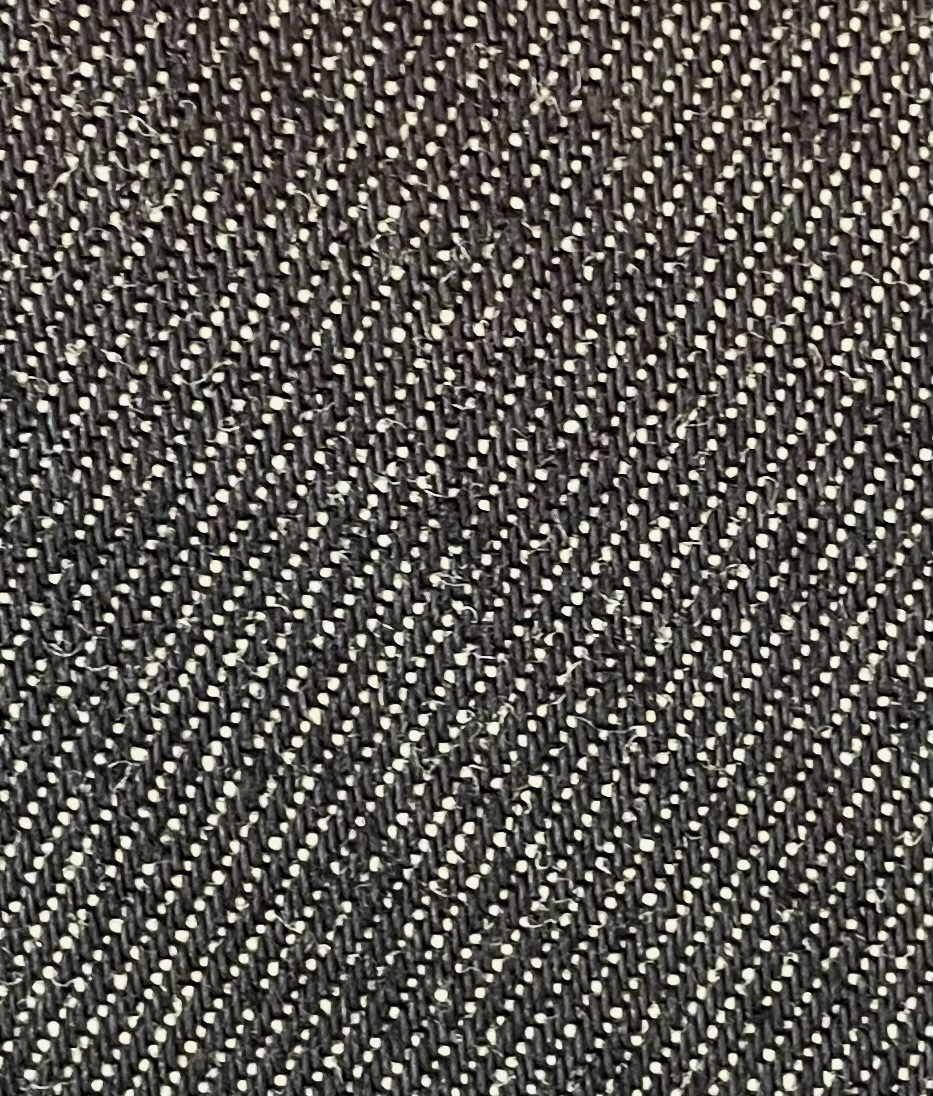
- Right-hand twill (Z) — the diagonal runs from lower left to upper right. The standard construction. A firm hand, a clear diagonal — and it twists.
- Left-hand twill (S) — the diagonal runs the other way, against the twist direction of the ring-spun yarn. It relaxes in the wash into a flatter, softer, fuller hand.
- Broken twill — the direction reverses every few ends, so no continuous diagonal exists. It was invented precisely to kill leg twist, and it does.
Leg twist, or torque, is the side seam moving around the leg after washing. It happens because the yarn twist and the twill line pull in the same rotational direction. It is worst on a 3/1 right-hand twill in a heavy wash. On a straight-leg women's jean, a buyer's tolerance is typically 2 cm at the hem. A customer sees 2.4 cm as a fault and returns the jeans.
Selvedge, and why it costs what it costs
Selvedge denim is woven on a shuttle loom. The shuttle carries the weft across and turns it back on itself, closing the edge of the fabric with a clean self-finished band. There is nothing magical in the cloth. What is different is the machine.
A shuttle loom runs at roughly 30 metres an hour and weaves 76 to 90 cm wide. A modern projectile or air-jet loom runs many hundreds of metres an hour at 150 to 165 cm. So selvedge costs USD 12 to USD 18 a metre, where the same construction on a wide loom costs USD 4 to USD 5.
Then the width hits you a second time. Re-mark WJ-207 at 84 cm usable instead of 152 cm, and the marker goes from 1.45 m a pair to about 2.86 m a pair, because the leg pieces no longer sit side by side. At USD 14 a metre, that is USD 40.04 of fabric in a garment whose entire FOB was USD 14.20. Selvedge is not a jean you cost. It is a different product at a different price point, and the moment a designer writes it on a tech pack, the costing starts again.
Prompt · Choose between two denim qualities before you book the fabric
The day the mill's quotations land, when the cheapest metre is not obviously the cheapest garment.
Act as a senior denim merchandiser. I have to book fabric this week and I want the decision written down before I do. Order facts: buyer [BUYER], PO [NUMBER], style [STYLE], quantity [QTY] pcs, FOB USD [FOB], wash recipe [DESCRIBE THE WASH]. My marker at the current pattern is [X] m per garment at [WIDTH] cm usable, and my cutting-room allowance is [Y] percent. The quotations are: [PASTE EACH QUOTE — weight in oz, warp spinning ring or open-end, dyeing rope or slasher, twill direction, elastane and any recovery yarn, usable width, price per metre, and the mill's tested warp and weft shrinkage]. The buyer's performance clauses are: growth maximum [NUMBER] percent to [METHOD], leg twist maximum [NUMBER] cm, plus [ANY OTHER CLAUSE]. Do the following. First, convert every weight to gsm and say what each weight is normally used for, so I can see whether the range being offered even suits this garment. Second, for each quote, carry its warp shrinkage into the pattern and tell me the marker length and the metres per garment you would expect, showing the step from shrinkage to pattern to marker. Third, build a table of fabric cost per garment and for the whole order for each quote, and give me the spread as a percentage of FOB value. Fourth — and do this before you recommend anything — check each quote against the buyer's performance clauses and strike out any quote that cannot pass them, saying which clause it fails and why the construction fails it. Fifth, tell me what I should ask the mill to change on the cheapest surviving quote to close the gap. Do not recommend a fabric on price alone, and if a quote is quoted greige rather than finished, say so and adjust it.
AI can make mistakes — check anything you act on.
Check yourselfYour marker on an 11 oz denim is 1.42 m a pair at 152 cm. The buyer switches you to a 12.5 oz with 3.8 percent warp shrinkage instead of 1.8 percent. Why does your consumption go up, and roughly by how much?Show the answer
Because the garment has to measure correctly after the wash. So two extra points of warp shrinkage go into the pattern as two extra points of length allowance, on every length dimension. The marker grows with the pattern — to about 1.45 m a pair here, a little under 2 percent. It is not the thickness of the fabric doing this. A marker is an area calculation. Thickness only limits ply height, which costs you cutting hours rather than metres.
Check yourselfA mill offers you the same 11 oz construction open-end at USD 3.20 and ring-spun at USD 3.95. The garment is a dark rinse with no abrasion at all. Which do you take?Show the answer
On a dark rinse with no abrasion, the open-end yarn is defensible. There is no wash-down for the ring-spun surface to show its character in, so you would be paying USD 0.75 a metre for something the finished garment will never display. Check three things first. The buyer's fabric spec may name ring-spun outright. Open-end yarn is weaker, so the seam strength and tear tests need to pass. And if the same fabric is planned for a washed version later in the season, you have just built two qualities where you wanted one.