Lessons · Lesson 2 of 3
Performance fabrics: the claim has to survive a test report
Read a waterproof and breathable specification the way a lab reads it, and cost a DWR failure on an order that is already cut.
Lesson 2 of 3 · 38 min
The situation
Outdoor clothing is sold on claims printed on a swing tag. Every one of those claims has to be backed by a laboratory report that says the same thing. This lesson explains what the two headline numbers measure. A breathability figure quoted without its test method is not evidence, because one cloth can honestly carry four different numbers. And the layer that usually fails is not the waterproof one. It is a thin repellent finish on the outside.
6 November, 11:20. The lab report for PO NS-3308 arrives by email while 1,900 of the 3,400 jackets are already sewn.
The buyer is Nordvik Sport, Trondheim. Style SJ-42 is a men's three-layer softshell. FOB USD 31.80, order value USD 108,120. The hangtag artwork — approved, printed, sitting in the carton store — says 10,000 mm / 10,000 g/m2/24h, waterproof, seam sealed.
The report says three things:
- Hydrostatic head, ISO 811 — how tall a column of water the fabric holds: 11,400 mm as received, 8,200 mm after 20 home washes.
- Moisture vapour transmission, JIS L1099 B-1 — how much sweat vapour can escape: 9,100 g/m2/24h.
- Water-repellency spray test, AATCC 22 — how well the outer face sheds water: 90 as received, 70 after 5 home washes.
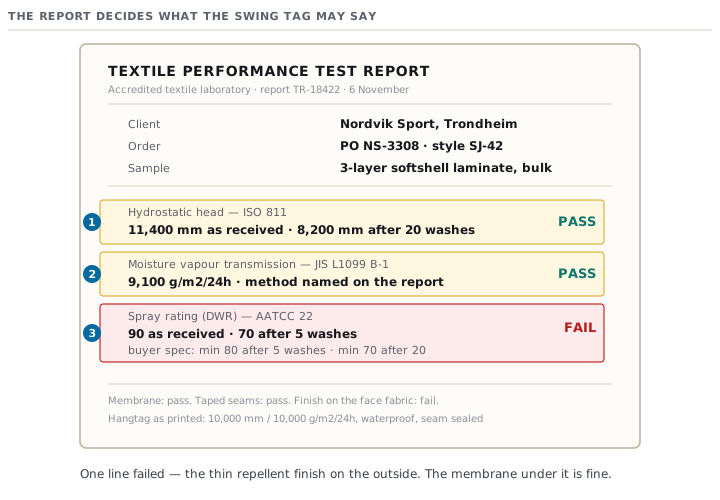
The buyer's specification requires a spray rating of at least 80 after 5 washes, and at least 70 after 20. The jacket fails on the third line — and only the third line. The membrane is fine. The seams are fine. The finish that sits on the outside of the face fabric is not.
Water-resistant, waterproof, and the finish everyone confuses with both
A performance jacket carries two entirely different things. They are made by different suppliers, at different points in the chain.
A membrane or coating is a layer bonded to the face fabric. It is what stops liquid water. It is measured in millimetres of water column: how tall a column of water the fabric holds before the third drop appears on the other side.
A DWR — durable water repellent — is a finish padded or sprayed onto the face fabric's outer surface. It stops the face fabric wetting out, meaning soaking up water. It is not waterproofing, and it never was.
The consequence is the single most misunderstood thing in technical outerwear. When the DWR is gone, no water passes the membrane. The jacket is still, technically, exactly as waterproof as the day it was made. But the face fabric soaks. The soaked layer blocks vapour from escaping. The wearer's sweat condenses on the inside of the membrane. The wearer arrives wet, and reports that the jacket leaks. It did not leak. It stopped breathing, because breathability depends on a dry face.
| Hydrostatic head | What it survives |
|---|---|
| Below 1,500 mm | Water-resistant only. EN 343 will not classify it as protective against rain |
| 1,500 to 5,000 mm | Light rain, short exposure, no rucksack straps |
| 5,000 to 10,000 mm | Steady rain, moderate pressure, a day out |
| 10,000 to 20,000 mm | Hard driving rain, kneeling, sitting, pack straps |
| Above 20,000 mm | Technical mountain and marine |
The pressure points matter more than the rain. A rucksack strap, a knee on wet ground and a seated backside all press water against the fabric far harder than falling rain does. That is why a number that looks generous for a shower is the number that fails under a strap.
The breathability number is meaningless without its method
This is where merchandisers get beaten in a negotiation. So it is worth being exact.
MVTR — moisture vapour transmission rate, in grams per square metre per 24 hours — is not one test. It is at least four, and they do not produce comparable numbers on the same fabric. The laminate in SJ-42 was tested four ways by the same lab:
| Method | Result | What it does |
|---|---|---|
| ASTM E96 procedure B (upright cup) | 4,600 g/m2/24h | Water below the fabric, still air above |
| JIS L1099 A-1 (calcium chloride) | 8,900 g/m2/24h | Desiccant in a cup, sealed under the fabric |
| JIS L1099 B-1 (inverted potassium acetate) | 21,000 g/m2/24h | Salt solution, membrane, water — the highest reading of the four |
| ISO 11092 (sweating guarded hotplate) | RET 9 | Resistance to evaporative heat transfer, in units the wearer feels |
A supplier quoting 21,000 and a supplier quoting 4,600 may be selling you the identical laminate. Whenever a breathability figure appears without a method beside it, it is not data.
RET is the honest one, because it measures resistance rather than throughput. Under 6 is extremely breathable. 6 to 13 is very breathable. 13 to 20 is breathable. Above 20 is not breathable in any useful sense. The value on our laminate is 9.
Seam sealing is where a waterproof jacket usually leaks
An 80/12 needle leaves a hole around 0.7 mm across, and SJ-42 has about 11.4 metres of seam that has to be waterproof. A laminate holding 11,400 mm of water column with unsealed seams is a jacket with several thousand holes in it.
Sealing means a tape bonded over the stitch line with hot air at 420 to 480 degrees Celsius, running at 3.5 to 4.5 metres a minute. The tape is usually 20 mm wide for straight seams, and 13 mm for curved and complex ones. It is a separate operation, with its own machine and its own trained operator. It is not fast.
A taped seam has its own tests to pass:
- Hydrostatic head across the taped seam — typically at least 5,000 mm, and typically retested after 20 washes.
- Peel strength of at least 8 N per 25 mm, so the tape does not lift at the edge.
- A visual check that no tunnel or channel remains under the tape at a seam intersection. That is where nearly every real leak starts.
Costed, on SJ-42: 11.4 metres of sealed seam at USD 0.11 a metre is USD 1.25 a jacket, or USD 4,250 on the order. That is 3.9 percent of the FOB — for an operation many cost sheets forget entirely, until the sample comes back with a wet lining.
Wicking is a construction, or it is a finish that washes away
On the knit side of performance, the claim is moisture management rather than waterproofing, and it is tested differently. One test is vertical wicking height in millimetres after a set time. The other is AATCC 195, the moisture management test, which grades the way liquid spreads and moves through the two faces of the fabric.
Hold on to the same distinction as with DWR: a hydrophilic finish is a chemical on the yarn, and it leaves. A wicking construction does not leave, because it is geometry rather than chemistry — a channelled or profiled polyester filament, a double-knit with a water-hating inner face and a water-loving outer face, a capillary difference between the two layers. Ask which one you have been sold. And ask for the test after 20 washes, not as received.
What the failure cost, in dollars
Back to the report. The DWR is C0 — a fluorine-free chemistry the industry moved to as C8 was withdrawn and C6 restricted. C0 repels water well and oil badly, and it depends more on heat reactivation than the fluorinated finishes it replaced.
Three options were costed on the day the report landed.
| Option | Direct cost | Time | What it does to the claim |
|---|---|---|---|
| Re-treat all 3,400 at the finishing plant, C0 at a higher add-on, retest | USD 3,230 plus USD 480 retest | 9 days | Claim stands as printed |
| Reprint hangtags without the repellency claim, accept the buyer's price reduction | USD 748 relabelling plus USD 6,494 price reduction | 3 days | Claim withdrawn, the style is repositioned |
| Re-treat and air freight to hold the original date | USD 3,710 plus USD 11,383.20 freight | 2 days | Claim stands, the margin does not |
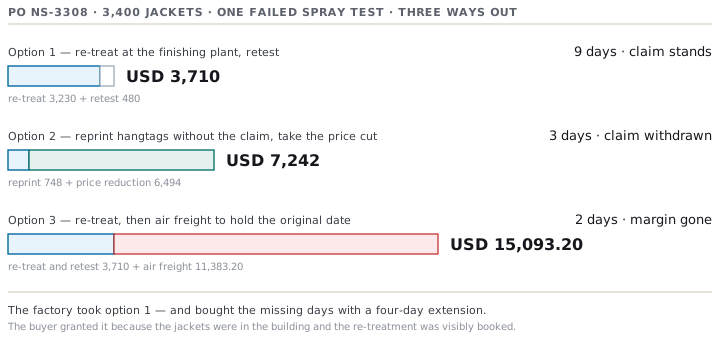
The price reduction in option 2 is 6 percent of FOB — USD 1.91 a jacket on USD 31.80, across 3,400 jackets. The air freight in option 3 is 3,400 jackets at 0.62 kg each: 2,108 kg at USD 5.40 a kilo.
The factory took option 1 and asked the buyer for a four-day extension. The buyer granted it, because the jackets were physically in the building and the re-treatment was visibly booked. Total damage: USD 3,710 and nine days. Against a possible USD 11,383.20 for the same outcome shipped on time, and USD 7,242 for giving the claim up.
Prompt · Audit a performance claim against the test reports behind it
Before hangtag artwork is approved, or the moment a lab report comes back below a printed claim.
Act as a technical outerwear quality manager. I need to know whether the claims we are about to print can be defended. Style facts: buyer [BUYER], PO [NUMBER], style [STYLE], quantity [QTY] pcs, FOB USD [FOB], construction [2-LAYER / 2.5-LAYER / 3-LAYER / SOFTSHELL], face fabric [DESCRIBE], membrane or coating [DESCRIBE], DWR chemistry [C6 / C0 / OTHER]. The hangtag and the marketing copy say: [PASTE EVERY CLAIM WORD FOR WORD]. The test reports say: [PASTE EACH RESULT WITH ITS METHOD AND WHETHER IT WAS AS RECEIVED OR AFTER WASHES]. Do the following. First, take each claim in turn and tell me which specific test result supports it, or state plainly that nothing in the reports supports it. Second, for every breathability figure, name the method and tell me what the same fabric would read on the other common methods, so I know whether we are comparing like with like. Third, check the durability side: which results are as received only, and what the buyer's specification requires after washes. Fourth, tell me whether the seams are covered — taped seam hydrostatic head, peel strength, and whether they were retested after washes. Fifth, where a claim is not supported, give me the options in order of cost: reword the claim, re-treat the goods, or retest, and say what each is likely to cost and how long it takes. Be conservative: if a claim cannot be evidenced from a report in front of you, treat it as unsupported rather than probable.
AI can make mistakes — check anything you act on.
Check yourselfA customer says a jacket leaks. The membrane tests at 11,400 mm hydrostatic head and the seams pass at 5,000 mm. What is almost certainly happening?Show the answer
The DWR has worn off. The face fabric is wetting out, and the wet face has stopped vapour escaping. No liquid water is passing the membrane — the wearer is wet from their own condensed sweat, which has nowhere to go. It presents exactly like a leak, and it is a repellency failure. That is why the spray rating after washes is the durability number that matters most in the field, even though it is the least impressive one on a hangtag.
Check yourselfTwo mills quote the same softshell. One says 20,000 g/m2/24h breathability, the other says 5,000. Which is more breathable?Show the answer
You cannot tell, and that is the answer. Ask each of them for the method. JIS L1099 B-1 routinely reads three to four times higher than ASTM E96 procedure B on the same laminate, so 20,000 by B-1 and 5,000 by E96 B can be the same cloth. Ask for RET to ISO 11092 if you want one number that is comparable between suppliers. And put the method into the fabric specification, so the next quotation cannot be quietly restated on a different scale.