Lessons · Lesson 3 of 3
Specialty fabrics and the metres a one-way marker costs you
Recognise the fabrics that force a one-way marker, cost the extra metres before the order is confirmed, and handle pile, nap and coating in the cutting room.
Lesson 3 of 3 · 37 min
The situation
Some cloths can only be cut one way up. A raised surface catches the light differently depending on which way it faces. So two panels cut head to toe from the same roll read as two shades in one garment. This lesson shows why forbidding the cutter to turn a piece around costs real metres. The second half covers what these fabrics do to the rest of the factory.
3 February, 07:15, the marker room. PO MC-9120 is for Maison Cerra of Lyon: 2,800 children's corduroy trousers, style CT-31, 8-wale cotton corduroy, 145 cm usable, USD 3.10 a metre. FOB USD 7.45, order value USD 20,860.
The cost sheet was built in October, from a marker the CAD room ran on a plain cotton twill — because in October the fabric was a plain cotton twill. In December the designer changed it to corduroy, and nobody re-ran the marker. This morning the marker maker does. The number comes back different.
| Marker | Efficiency | Metres per garment | Metres for 2,800 | Fabric cost |
|---|---|---|---|---|
| Two-way, pieces interlocked head to toe | 84.2 percent | 1.18 | 3,304 | USD 10,242.40 |
| One-way, every piece facing the same way | 79.1 percent | 1.26 | 3,528 | USD 10,936.80 |
USD 694.40 was not in the cost sheet. On this order that is 3.3 percent of the entire FOB value. On a children's trouser at USD 7.45, it is most of what was left of the margin. Nobody did anything wrong — except forget that some fabrics can only be cut one way up.
Why a one-way marker costs metres
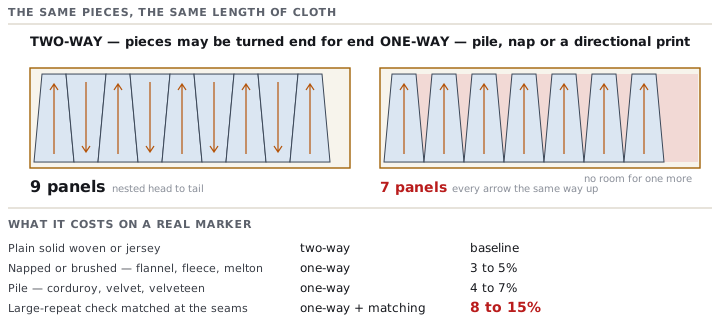
A two-way marker is the efficient one. The marker maker rotates pieces 180 degrees and nests the wide part of one piece into the narrow part of the next: a trouser front against a trouser back, a sleeve head into a sleeve hem. That interlocking is where marker efficiency above 80 percent comes from.
A one-way marker — also called a nap marker — forbids the rotation. Every piece must lie with its top towards the same end of the table. So only half the nesting is available. The efficiency loss is typically 4 to 7 percent of the marker. On most garments, that is 3 to 8 metres in every hundred.
Three families of fabric force it.
Pile fabrics — corduroy, velvet, velveteen, moleskin, plush. The pile is a raised surface of cut fibre ends, and it lies in one direction. Light entering with the pile reflects differently from light entering against it. So two panels cut opposite ways read as two different shades in the same garment. This is not subtle. On a mid-tone corduroy, the apparent difference between pile-up and pile-down is bigger than a full grade on the grey scale. It is the defect a final inspection finds most often on cord.
Napped and brushed fabrics — flannel, brushed twill, fleece, melton. The raised fibre has been brushed in one direction by the machine. The same shading effect applies, more mildly.
Directional patterns — a one-way print, an asymmetric check, a stripe that is not symmetric about its repeat, a logo jacquard. Here the problem is not shade but sense: half the garments come out upside down.
| Fabric behaviour | Marker rule | Typical consumption penalty |
|---|---|---|
| Plain solid woven or jersey | Two-way, either direction | Baseline |
| Napped or brushed — flannel, fleece, melton | One-way | 3 to 5 percent |
| Pile — corduroy, velvet, velveteen | One-way | 4 to 7 percent |
| One-way print or directional check | One-way | 3 to 6 percent |
| Large-repeat check or stripe that must be matched | One-way plus a matching allowance | 8 to 15 percent |
The last row is the one that ruins costings. Matching a check across a side seam, a pocket and a placket means the marker maker has to park each piece on a repeat, rather than where it fits best. And a 12 cm repeat costs far more than a 3 cm one.
Corduroy: wales, and which way the pile runs
Corduroy is a cut-pile fabric. Extra weft yarns float over several warp ends, and a cutting machine slits those floats open to make the pile. The ridges are called wales, counted per inch. The wale count is the fabric's identity, in the way that the ounce is denim's.
| Wales per inch | Trade name | Typical weight | Where it belongs |
|---|---|---|---|
| 1.5 to 3 | Jumbo or elephant cord | 380 to 450 gsm | Outerwear, heavy trousers, upholstery-weight |
| 4 to 6 | Wide wale | 330 to 380 gsm | Men's trousers, overshirts |
| 8 to 11 | Standard cord | 280 to 330 gsm | Mainstream trousers, children's wear |
| 14 to 16 | Pinwale, babycord | 200 to 260 gsm | Shirts, children's dresses, linings |
| 18 to 21 | Pincord | 160 to 200 gsm | Shirting |
Then the direction. The trade convention is that corduroy is cut pile-down — stroke the fabric from the neck towards the hem and it feels smooth. It wears and brushes better that way, and shows less shading in wear. Velvet is cut pile-up — stroke from hem to neck and it feels smooth. Looking into the pile gives the deeper, richer colour that is the reason anyone buys velvet.
Those are conventions, not laws. The only thing that binds you is what the buyer approved. So the cutting-room rule is written differently: whatever the approved sample does, an arrow goes on every pattern piece, on the marker, and on the spreading instruction. And the first ply of every lay is checked against the approved sample before the second is spread.
Flannel, canvas and the numbering that lies to you
Flannel is not a construction. It is a finish: a plain or twill fabric put through a napping machine, whose wire-covered rollers pull fibre ends out of the yarn. Each pass raises more nap, and takes something away. A 180 gsm greige cotton twill, after four napping passes and a shear, comes out near 165 gsm. Tear strength drops about 18 percent, and the pilling grade will sit around 3 to 3.5 on the five-point scale. Both of those are the fabric doing what it was asked to do. Both belong in the specification as pass marks — not discovered later in a test report.
Brushed cotton also shrinks. Unless it is compacted or sanforised, expect 4 to 6 percent in the warp. Specify the finish and a maximum of 3 percent, and test it. A child's flannel shirt that comes out two sizes down after one wash is a recall conversation.
Canvas and duck carry a numbering system that actively misleads. Numbered duck runs the wrong way round: a lower number is a heavier fabric. Number 12 duck is around 11.5 oz per square yard. Number 10 is around 14.75 oz. Number 8 is around 18 oz. The numbers are a legacy scale, and no arithmetic converts them — you cannot reason from the number to the weight. Ask the mill for grams per square metre, and write that on the fabric purchase order, keeping the duck number only as a description.
Coated and PU fabrics: no second chances in the cutting room
A PU-coated fabric is a base cloth with a polyurethane layer applied wet and cured — typically 20 to 30 grams per square metre of coating for a light waterproof, more for a heavy one. Three things change in the factory.
Needle holes are permanent. There is no unpicking a coated fabric. The hole stays, and on anything claiming water resistance, it leaks. That means no repairs, a higher reject rate, and a fabric allowance of 4 to 5 percent instead of the usual 3.
Heat is a limit, not a setting. Most PU coatings distort above about 110 degrees Celsius. So pressing, fusing and steam tunnels all have to be re-specified. Fusible interlinings that need 150 degrees Celsius are simply not available to you.
Sewing needs different everything. Use a roller or Teflon foot, because the coating drags. Use a longer stitch, at 3.0 mm instead of 2.5 mm, because a dense stitch line perforates the coating into a tear line. And use a sharp 90/14 needle, changed on a schedule, because a blunt needle punches rather than pierces.
And the coating ages. Polyester-based polyurethane breaks down in heat and humidity — the coating goes tacky, then lifts. That is why a jacket stored three years in an unconditioned warehouse in a hot climate can fail before it is ever worn. The accelerated test is ISO 1419 method C: seven days at 70 degrees Celsius and 95 percent relative humidity. It belongs in the fabric specification for anything that will sit in stock.
Prompt · Re-cost an order when the fabric turns out to be directional
The moment a plain fabric becomes a corduroy, a velvet, a nap or a one-way print, and the cost sheet has already been signed.
Act as a cutting-room manager and a costing merchandiser at the same time. A fabric change has made my marker directional and I need the full cost of that, not just the metres. Order facts: buyer [BUYER], PO [NUMBER], style [STYLE], quantity [QTY] pcs, FOB USD [FOB], size ratio [PASTE], fabric now [DESCRIBE — pile, nap, one-way print, check with a repeat of X cm], usable width [WIDTH] cm, price USD [PRICE] a metre. My existing two-way marker is [X] m per garment at [E] percent efficiency, and it was costed on [DATE]. Do the following. First, estimate the one-way marker efficiency and the metres per garment, and show the relationship you used between efficiency and marker length. Second, give me the extra metres and the extra fabric cost for the whole order, and express it as a percentage of FOB value. Third, tell me the maximum ply height you would spread this fabric at and why, then convert that into the number of spreading sections and the spreading hours, against what a plain fabric would have taken. Fourth, if the fabric is a check or a stripe that has to be matched, add the matching allowance separately and say which seams drive it. Fifth, list what has to change on the paperwork: pattern piece arrows, marker instruction, spreading instruction, shade banding by roll, and the revised cost sheet. Finish with the single sentence I should send to the buyer explaining why the price has to be reopened.
AI can make mistakes — check anything you act on.
Prompt · Write the cutting and sewing handover for a difficult fabric
Before the first lay of a pile, napped or coated fabric goes on the table.
Act as an industrial engineer who has run pile and coated fabrics in bulk. Write me the handover sheet the cutting room and the sewing floor will actually work from. Fabric: [DESCRIBE — construction, weight in gsm, composition, finish, coating and its weight if any]. Garment: [STYLE], quantity [QTY] pcs, buyer [BUYER]. The approved sample [SAYS / DOES NOT SAY] which direction the pile or nap runs, and the direction I have determined is [DIRECTION]. Cover these in order. First, relaxation: how long the fabric must lie on the table before spreading and why. Second, spreading: maximum ply height, face-to-face or face-up, whether the plies may be cut on a stack at all, and what damage appears if the limit is exceeded. Third, marker and direction: exactly what marking the pattern pieces and the marker must carry, and the check to be made on the first ply of every lay. Fourth, shade: how rolls are banded, grouped and tracked so no single garment takes panels from two shade groups. Fifth, sewing: needle type and size, stitch length, presser foot, thread, and anything that must not be unpicked. Sixth, pressing and finishing: maximum temperature, whether steam is allowed, and what happens above the limit. Seventh, the fabric allowance you would set instead of the usual one, and the reason. Write it as instructions a supervisor can follow, not as background, and flag any point where getting it wrong cannot be repaired.
AI can make mistakes — check anything you act on.
Check yourselfA costing was built on a two-way marker at 1.18 m a garment. The fabric becomes an 8-wale corduroy. What do you change, and what does it cost on 2,800 pieces at USD 3.10 a metre?Show the answer
Re-run the marker as a one-way nap marker. Efficiency falls from about 84.2 percent to about 79.1 percent, so consumption goes to about 1.26 m a garment — 3,528 metres instead of 3,304, USD 694.40 more fabric. Then re-cost the cutting room too: the ply height halves because the pile crushes, so the spreading time roughly doubles. Both belong in a revised cost sheet before the order is confirmed — not in a variance report afterwards.
Check yourselfA buyer sends an approved velvet sample, and the tech pack says nothing about pile direction. What do you do?Show the answer
Determine the direction from the approved sample itself, by stroking it from hem to neck and from neck to hem. Write what you found back to the buyer for confirmation in writing. Then put an arrow on every pattern piece and on the marker before anything is spread. Do not assume the convention. Velvet is usually cut pile-up for the deeper colour, and corduroy pile-down. But the approved sample is the only thing you will be judged against, and a whole cut in the wrong direction is not a defect that can be repaired.