Lessons · Lesson 3 of 3
Bulk against the approval
Judge a bulk delivery against an approved standard — shade, roll-to-roll variation and 4-point defects — and write the report that makes a rejection stand up.
Lesson 3 of 3 · 24 min
The situation
Deciding a delivery is wrong is only half the job. The other half is writing it down, so that the mill and the buyer act on one document. This lesson judges a bulk delivery against the approved standard — which is not the small dyed sample everybody remembers. It explains why two cloths can match under one light and fail under another. It ends with the report itself, and four honest ways out.
It is 18 March, 08:00. The laboratory report has landed, and it says what the bench said: mass per unit area to ISO 3801 is 119.6 grams per square metre, against a specification of 130. Composition to ISO 1833 comes back as declared. Nobody substituted a fibre. This is a loom setting, exactly as the pick count suggested.
Two other things happened while everyone waited. The fabric inspection finished on seven rolls, and the store noticed that rolls 20 to 34 — dye lot B, 4,500 metres — are a different ecru from the rest. And the cutting room, with a marker ready and a line standing idle, spread and cut 3,000 metres of lot B on the 15th. That is 1,935 shirts: cut, bundled, and now sitting in trolleys in a shade nobody has approved.
This lesson is the second half of the skill. Hand found the problem in five minutes. The laboratory proved it in three days. Now somebody has to write it down, so that a mill in Bursa and a buyer in Germany both act on the same document.
What "approved" actually refers to
A fabric approval involves three different reference standards. People confuse them constantly.
- The lab dip is a small dyed sample, submitted to hit a colour standard. It is approved before bulk dyeing. It is the mill's target.
- The bulk shade band is a set of swatches cut from real bulk production, submitted and approved together. It spans the range the buyer will accept. Normally it is three swatches: the standard, the light side and the dark side. Once the band is approved, the band is the specification.
- The approved bulk swatch is the copy the factory keeps, for cutting and inspection.
Bulk is judged against the band. Never against the lab dip. A roll that sits between the light-side and dark-side swatches is in specification, even if it does not match the lab dip. A roll outside them is out of specification, even if it looks fine on its own. This is why a factory that never asked for a shade band cannot accept or reject anything: it has an opinion, and the mill has a different opinion.
The light box, and the trap
On the 14th, Nadia compared lot B against the band at the fabric store window, under the store's own 4000 K fluorescent tubes. She passed it. On the 18th, the buyer's technologist put the same swatch in a light box and rejected it. Neither of them was careless. This is metamerism, and it is the single most expensive thing in this lesson.
Two samples are a metameric pair when they match under one light source and do not match under another. It happens when different dyes were used to reach the same colour — a different recipe at the mill, or a different dyestuff for a re-dye. The two cloths then reflect light differently across the spectrum. The eye reads them as the same colour under one light, and as different colours under another.
A light box removes the argument by fixing the light. The light sources — illuminants — that matter in apparel are:
- D65: artificial daylight at 6500 K. The usual primary standard in Europe.
- TL84: a European store fluorescent at 4000 K. Common as the secondary.
- CWF or UL30: the American store equivalents.
- Illuminant A: incandescent at 2856 K, a warm home light.
- UV: reveals optical brightening agents. This is how you catch a mill whitening a cloth instead of dyeing it correctly.
Assessment is against a grey scale for change in shade, graded 5 down to 1, with grade 4 the usual minimum. Lot B graded 4 under TL84 and 3 to 4 under D65. Kaltenbach's primary illuminant is D65. The lot fails.
Roll to roll, and within a roll
Shade is not one number per delivery. Check it in three directions, and record all three.
- Side to centre to side. Cut swatches from both selvedge sides and the centre, at the same place in the roll. A dyeing or finishing fault often shows as listing: the edges differ from the middle.
- Beginning to middle to end. Continuous dyeing drifts along the length. A roll can start inside the band and finish outside it.
- Roll to roll within a dye lot, and lot to lot. Sort the rolls into shade groups. Record them on a shade continuity card: a physical card carrying a swatch from every roll, in roll-number order, so any drift is visible as a run.
The consequence lands in the cutting room, and it is absolute. Rolls are spread by shade group, and never mixed in one lay. A garment with a front from one shade group and a sleeve from another is a shading defect. It is classed major at final inspection, and there is no repair. If lot B has to be used, every piece of every garment made from it comes from lot B — and those garments are packed and shipped as their own group.
The 4-point system
This is the industry's standard fabric grading method, published as ASTM D5430. Every defect found on the face of the cloth scores points, by its length in the warp direction:
| Defect length | Points |
|---|---|
| Up to 3 inches | 1 |
| Over 3 and up to 6 inches | 2 |
| Over 6 and up to 9 inches | 3 |
| Over 9 inches | 4 |
Holes and openings score 2 points up to one inch, and 4 points above it. Some buyers simply score every hole at 4 — read the buyer's manual rather than assuming. No single linear yard may score more than 4 points, however many defects it carries. Inspect at least 10 percent of the rolls, chosen at random, with a minimum of one roll per dye lot.
The result is normalised, so that rolls of different lengths and widths can be compared:
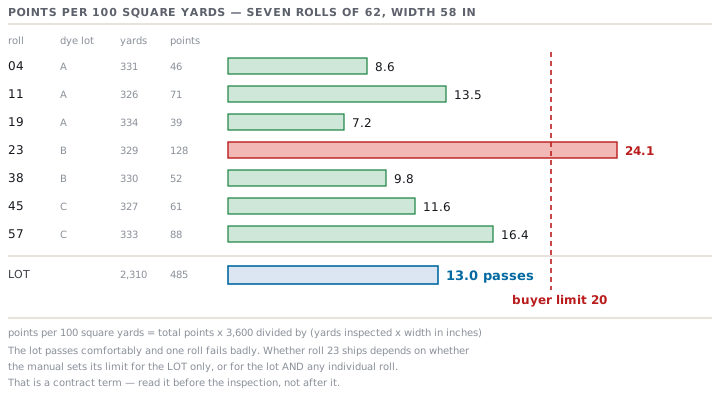
points per 100 square yards = total points × 3,600 divided by (yards inspected × width in inches)
| Roll | Dye lot | Yards inspected | Points | Points per 100 square yards | Result |
|---|---|---|---|---|---|
| 04 | A | 331 | 46 | 8.6 | Pass |
| 11 | A | 326 | 71 | 13.5 | Pass |
| 19 | A | 334 | 39 | 7.2 | Pass |
| 23 | B | 329 | 128 | 24.1 | Fail |
| 38 | B | 330 | 52 | 9.8 | Pass |
| 45 | C | 327 | 61 | 11.6 | Pass |
| 57 | C | 333 | 88 | 16.4 | Pass |
| Lot | 2,310 | 485 | 13.0 | Pass |
Read roll 23 and the bottom row together. This is the row that decides the argument. Roll 23 scores 128 × 3,600 divided by (329 × 58), which is 24.1 points per 100 square yards. The whole inspected sample scores 485 × 3,600 divided by (2,310 × 58), which is 13.0. The lot passes comfortably on average. One roll fails badly.
Kaltenbach's manual sets the limit at 20 points per 100 square yards for the lot and for any individual roll. Many buyers set only a lot limit — and under that wording, roll 23 would ship. The rule you are inspecting to is a contract term, not a technical fact. Read it before the inspection, not after the argument has started.
The report that makes a rejection defensible
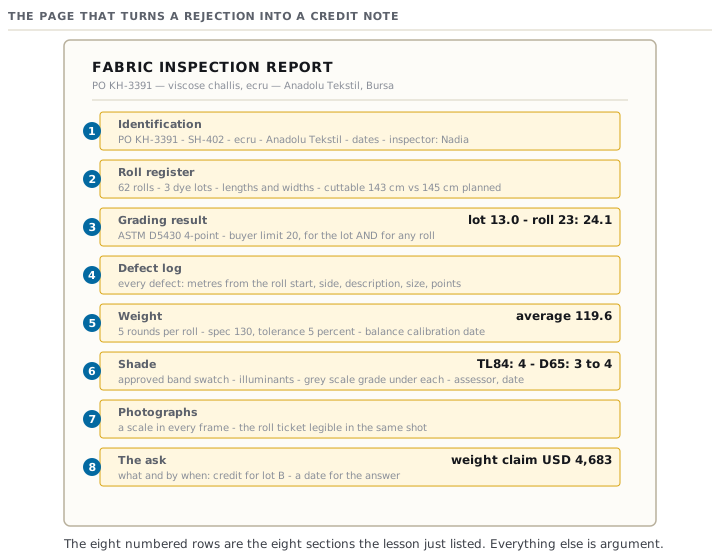
A rejection email that says the fabric is light and off-shade produces an argument. A report produces a credit note. The difference is entirely in what is written down. Eight sections:
- Identification. PO, style, colour, supplier, invoice, container, date of arrival, date of inspection, inspector's name.
- Roll register. For each roll: roll number, dye lot, ticketed length, measured length, measured full width, and cuttable width at three points along the roll. On this delivery, the cuttable width measured 143 cm against a planned 145 cm — its own problem for the marker.
- The grading result. The standard used and its edition, the points per roll and for the lot, the buyer's stated limit, and the accept-or-reject decision against that limit.
- The defect log. Every defect: distance in metres from the roll start, side, description, size, and the points assigned. This is what lets the mill find its own fault on its own loom.
- Weight. Number of rounds, where each was cut, the individual weights, the average, the specification and its tolerance, the balance and its calibration date.
- Shade. Which approved band swatch, which illuminants, the grey scale grade under each, who assessed it, and when.
- Photographs. Every one with a scale in the frame, and the roll ticket legible in the same shot.
- The ask. What you want and by when — replacement, credit, allowance, or authority to use — with a date for the answer.
The four options, costed
By 18 March there are four honest paths. The merchandiser's job is to put them in front of the decision-maker with numbers, not adjectives. The 1,935 shirts already cut from lot B — USD 9,450 of fabric plus USD 484 of cutting and bundling, USD 9,934 in all — are lost in any option that does not use lot B.
| Option | Direct cost | Delivery | What you are betting on |
|---|---|---|---|
| A. Reject lot B, the mill re-supplies 4,500 metres | USD 9,934 written off, plus late-delivery exposure to USD 16,020 | 28 days late | That Kaltenbach waive the late clause because the mill caused the delay |
| B. Ship lot-B garments as one complete separate delivery under a written concession, at a 4 percent allowance | USD 1,033 | On time | That the buyer signs a two-shade concession before another metre is cut |
| C. Overdye lot B to the dark edge of the approved band | USD 1,890, plus nine days | 9 days late | That a re-dye on viscose lands inside the band without moving shrinkage or hand |
| D. Buy 4,500 metres of a matched substitute in Egypt at USD 3.85 | USD 3,150 extra, plus a ten-day approval cycle | 10 days late | That a second mill's cloth passes the approval the first one failed |
Now set those against the margin. At FOB USD 8.90 and a factory cost of USD 7.95, this order carries USD 0.95 a piece — USD 11,400 in total, 10.7 percent. Option A costs up to USD 25,954. That is more than twice the entire margin. Option B costs about nine percent of it. Option B is nearly always the right answer. It is also nearly always the one nobody has prepared for, because it needs a signed concession, and most factories start asking for one on the day they need it.
And there is a claim running the other way. The mill delivered 8 percent light across all 18,600 metres. Priced by the metre, that is invisible on the invoice. So convert it. At 130 grams per square metre and 147 cm wide, 18,600 metres is 3,554 kg of cloth. At 119.6, it is 3,270 kg. The mill delivered 284 kg less fibre than the specification. At the USD 16.49 a kilo the invoice implies, that is USD 4,683 — and it is now supported by an ISO 3801 report on a numbered roll. That claim does not pay for option A. It covers option B and the allowance, with change.
Prompt · Write the fabric report so a rejection stands up
When a delivery has failed and the difference between an argument and a credit note is what is written on the report.
Act as a fabric quality manager writing a fabric inspection report that a mill and a buyer will both act on. Facts: buyer [BUYER], PO [NUMBER], style [STYLE], colour [COLOUR], mill [MILL], invoice [NUMBER], container [NUMBER], arrival date [DATE], inspection dates [DATES], inspector [NAME]. Delivery [METRES] metres in [NUMBER] rolls across [NUMBER] dye lots. Grading standard [ASTM D5430 4-POINT OR OTHER], buyer's limit [POINTS] points per 100 square yards, stated as [LOT ONLY / LOT AND PER ROLL]. Roll data, one line each, as roll number, dye lot, ticketed length, measured length, width in inches, total penalty points: [PASTE THE TABLE]. Defect log: [PASTE]. GSM: rounds cut per roll [NUMBER], individual weights [PASTE], specification [GSM] with tolerance [TOLERANCE], balance and calibration date [DETAILS]. Shade: approved band reference [REFERENCE], illuminants assessed [LIST], grey scale grade under each [LIST], assessor [NAME]. Laboratory reports available: [PASTE OR NONE]. Do the following. First, compute points per 100 square yards for each roll and for the inspected sample, showing the formula, and mark each roll pass or fail against the limit as it is actually worded. Second, write the report itself, section by section, in the order a mill can act on. Third, for every conclusion, name the evidence line it rests on, and flag any conclusion that rests on a hand judgement rather than an instrument. Fourth, write the covering message to the mill: what is being rejected, on what ground, what I am asking for, and by when. Fifth, list what is missing from my data that a mill could use to refuse the claim, and tell me how to close each gap today. Do not soften a finding and do not state a figure I have not given you.
AI can make mistakes — check anything you act on.
Prompt · Cost the options on an off-specification fabric lot
The morning somebody has to choose between rejecting a lot, shipping it under concession, re-dyeing it and buying a replacement — with cloth already cut.
Act as a senior garment export merchandiser. A bulk fabric lot is off specification and part of it has already been cut. Facts: buyer [BUYER], PO [NUMBER], style [STYLE], [QTY] pcs, FOB [PRICE] per piece, order value [VALUE], my cost per piece [COST], margin per piece and in total [VALUE AND PERCENT]. Fabric: [DESCRIPTION], [METRES] metres at [PRICE] per metre, consumption [METRES] per piece, delivered in [NUMBER] rolls across dye lots [LIST]. The problem, stated precisely with its evidence: [PASTE THE INSPECTION AND LABORATORY FINDINGS]. Already cut from the affected lot: [METRES] metres, [PIECES] pieces, cutting and bundling cost [VALUE]. Dates: on board [DATE], port cut-off [DATE], today [DATE]. Mill re-supply lead time [DAYS] plus [DAYS] shipping. Local substitute available at [PRICE] per metre with an approval cycle of [DAYS]. Overdye quotation [PRICE] per metre and [DAYS]. Late-delivery clause, exact wording: [PASTE]. Do the following. First, separate the problems — a weight or construction shortfall against the mill is not the same claim as a shade failure against the approved band — and say who owns each one. Second, price the mill claim in its own right: convert any weight shortfall into kilograms and into money at the price the invoice implies, and say what evidence it needs to be payable. Third, set out every option with its direct cost, its delivery date, its exposure under the late clause, and the single assumption it rests on. Fourth, express each option as a percentage of the order margin. Fifth, say which option you would take and what has to be signed, by whom at the buyer, before anybody cuts another metre. Do not recommend shipping under concession without stating what it costs me if the distribution centre finds the same fault, and do not treat the sunk cost of the cut pieces as a reason to keep using the lot.
AI can make mistakes — check anything you act on.
Check yourselfYour seven inspected rolls average 13.0 points per 100 square yards against a limit of 20, but roll 23 alone scores 24.1. Can you reject roll 23?Show the answer
Only if the buyer's manual sets a per-roll limit as well as a lot limit. And you have to read the manual before you write the report, not after. Kaltenbach's manual does set both, so roll 23 is rejected on its own, while the delivery as a whole passes. Under a buyer who states only a lot average, roll 23 is contractually acceptable, and your remedy is different: accept it, cut it last, and plan for a lower usable yield from it. Then raise it with the mill as a performance issue, not a rejection. The technical reading of the fabric is identical in both cases. The commercial outcome is opposite. The thing that decides it is one sentence in a contract.
Check yourselfLot B matched the shade band under the fabric store's own lighting and failed in the buyer's light box. Who was wrong, and what do you change?Show the answer
Nobody was wrong about what they saw. That is what makes metamerism expensive. The two cloths genuinely match under a 4000 K store tube, and genuinely do not match under D65, because the dye recipes differ across the spectrum. What was wrong was the process. The primary illuminant was never agreed in writing, so the factory assessed under one light and the buyer under another. A shade passed on the 14th was rejected on the 18th, with 3,000 metres already cut. Fix it once, for the whole account: the primary illuminant, the secondary, the minimum grey scale grade and the approved band, written into the specification. Keep a light box in the fabric store. Record every shade assessment against a named illuminant.