Lessons · Lesson 2 of 3
Where hand stops and the laboratory starts
Run the field tests that are worth running, know exactly what each one proves, and book the laboratory work for every claim that hand cannot support.
Lesson 2 of 3 · 28 min
The situation
Some things about a cloth can be settled at a bench in twenty minutes. Others can only be settled by a laboratory. Mixing the two up is how a factory loses an argument it was right about. This lesson covers the quick tests worth doing, and the exact limit of each one. Then it covers the claims that need a number — because a care label is a legal statement.
It is 08:20 on the same morning. Nadia has a roll that is 8 percent light, and a pick count that explains why. Now she has to write something a mill in Bursa will act on. The difference between a paragraph the mill argues with and a paragraph the mill pays against is simple: which sentences have an instrument behind them.
Before the report goes anywhere, she does two things. First, she runs the field tests she can run in twenty minutes with what is on the bench. Second, she books — by name and by standard — every test she cannot run. And she books them on the bulk fabric, not on the approval.
That second step is the whole lesson. Hand is how you catch a problem in five minutes. A test report is how you prove it. Neither replaces the other. Using one in the other's place is how factories lose arguments they were right about.
The burn test, and its exact limit
Pull a yarn out of the warp. Twist it, hold it in tweezers, and bring it slowly to the edge of a flame. Watch three things: what it does near the flame, what it does in the flame, and what is left afterwards. Then do the same with a weft yarn, separately.
| Fibre family | In the flame | Smell | Residue |
|---|---|---|---|
| Cotton, viscose, linen, lyocell | Burns fast and steadily, keeps burning after the flame is removed | Burning paper | Soft grey ash that crushes to nothing |
| Wool, silk | Burns slowly, tends to go out by itself | Burning hair | Brittle black bead that crushes between the fingers |
| Polyester | Shrinks away, melts, then burns with black smoke | Faintly sweet, chemical | Hard round dark bead that cannot be crushed |
| Nylon | Shrinks away sharply, melts, burns with difficulty | Like boiled celery | Hard grey or tan bead |
| Acrylic | Melts and burns quickly at the same time | Acrid, sharp | Hard irregular black bead |
| Elastane | Melts and burns | Chemical | Soft sticky residue |
Now the limits. They matter more than the table.
- It identifies a family, not a fibre. Cotton, viscose, modal and lyocell all burn like paper and leave grey ash. Nothing in this test separates the viscose Kaltenbach ordered from a cotton the mill might have used instead. Nothing separates either from a cheaper man-made cellulosic.
- It gives no percentage. Burn a yarn from a polyester-cotton blend and you see both behaviours at once: a flame, black smoke, and a bead with ash around it. That proves the blend exists. It cannot say whether it is 65/35 or 50/50 — and the label must say which.
- It tests one yarn. A cloth can be cotton in the warp and polyester in the weft. That is a different fabric — different shrinkage, different dyeing — from a blend of the same overall mix. Always burn warp and weft separately, and write down which was which.
- A finish changes it. A flame-retardant finish makes a cotton go out by itself and look like wool for a moment. A heavy silicone softener adds its own smoke.
So the burn test earns its place for exactly one job: catching a gross substitution fast, on the bench, before anyone spreads. It is a screen. It is never evidence.
The wet crock rub, and the other bench tests
Cut a strip of white cotton. Wet it, lay it over a fingertip, and rub the fabric ten times, firmly, in one direction. Look at the white cloth. If a lot of colour has come across, the dye is not fixed. The garment will mark a handbag, a car seat, and every white top worn under it.
What you have established is that there is a gross problem. What you have not established is a grade. ISO 105-X12 rubs with a machine called a crockmeter: a 16 mm finger under a 9 N load, 10 cycles. Then the stain on the rubbing cloth is graded against a grey scale, from 5 down to 1, under a controlled light. Your finger is not a 9 N load. Your eye at a store window is not a grey scale under D65. A buyer will accept a grade. Nobody has ever accepted a thumb.
The same shape holds for the rest of the bench tests.
| Field test | How | What it honestly proves | What it cannot give you |
|---|---|---|---|
| Burn, warp and weft separately | Tweezers, flame, watch and smell | The fibre family, and whether warp and weft differ | The fibre, the percentage, the label claim |
| Wet crock rub | White cotton, wet, ten firm strokes | That the dye is or is not grossly unfixed | A rubbing fastness grade to ISO 105-X12 |
| Stretch and recovery | Mark 10 cm, stretch to a working limit, release, measure again after 30 seconds | That a knit does or does not come back, and roughly how much growth is left | A percentage stretch and growth figure a buyer can specify against |
| Seam slippage tug | Sew a short seam in the bulk, grip either side, pull across it | That an open, slippery construction is obviously at risk | The force at a 6 mm seam opening under ISO 13936-2 |
| Water drop | One drop on the surface, time how long it sits | Whether a repellent finish is present, or the cloth is unscoured | A spray rating or a wetting time to a standard |
| Crease recovery | Fold, press under the hand for ten seconds, release, watch | That the bulk creases worse or better than the approval | A recovery angle to ISO 2313 |
Read the last column from top to bottom. Every field test answers a yes-or-no question about something obvious. None of them produces a number. That is not a weakness. A yes-or-no answer in twenty minutes at the bench is worth having. It tells you where to spend the laboratory budget, and whether to stop the spreading.
What hand cannot tell you at all
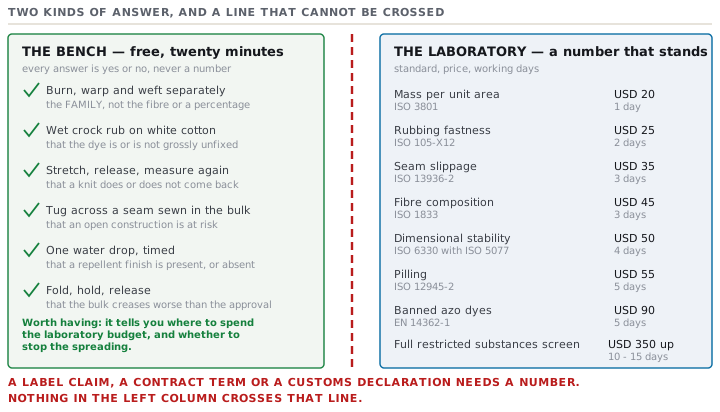
There is a second group of questions, and it is the one that gets factories into trouble. These are the claims that appear on labels, in contracts, and in customs declarations.
Fibre percentage. In the European Union, the composition on the care label is a legal claim under Regulation 1007/2011, with a tolerance of three percentage points against the declared figure. It is proved by quantitative chemical analysis to ISO 1833 — one fibre is dissolved away and what remains is weighed — or by AATCC 20A. No hand method, no burn method, and no factory microscope supports a label. A merchandiser who writes "100% viscose" on a label because the yarn burned like paper has made a legal declaration based on a smell.
Colour fastness. Washing to ISO 105-C06. Rubbing to ISO 105-X12. Perspiration to ISO 105-E04. Light to ISO 105-B02. Each one ends in a grey scale grade, and buyers specify minimum grades — commonly grade 4 for change of shade and staining on a shirt.
Dimensional stability. This means shrinkage. Mark the cloth, wash it to ISO 6330 at the stated cycle and temperature, dry it by the stated method, and measure it to ISO 5077. Viscose moves. A challis that shrinks four percent in the warp turns a size 38 shirt into a size 36 in one wash. No amount of handling the cloth predicts the figure.
Pilling. Graded on a Martindale machine to ISO 12945-2 at a set number of rubs — often 2,000, 5,000 and 7,000 — and judged against photographic standards.
Restricted substances. Banned azo dyes that can release listed aromatic amines are tested to EN 14362-1. Beyond that sits the buyer's restricted substances list, or a certificate such as OEKO-TEX Standard 100. These are chemistry. There is no factory version of them, and no buyer will take your word for them.
| The claim | Standard | Typical cost | Turnaround |
|---|---|---|---|
| Mass per unit area, certified | ISO 3801 | USD 20 | 1 working day |
| Rubbing fastness, dry and wet | ISO 105-X12 | USD 25 | 2 working days |
| Seam slippage | ISO 13936-2 | USD 35 | 3 working days |
| Perspiration fastness | ISO 105-E04 | USD 35 | 3 working days |
| Washing fastness | ISO 105-C06 | USD 40 | 3 working days |
| Fibre composition | ISO 1833 | USD 45 | 3 working days |
| Dimensional stability | ISO 6330 with ISO 5077 | USD 50 | 4 working days |
| Pilling | ISO 12945-2 | USD 55 | 5 working days |
| Banned azo dyes | EN 14362-1 | USD 90 | 5 working days |
| Full restricted substances screen | Buyer list or OEKO-TEX Standard 100 | USD 350 and upwards | 10 to 15 working days |
What Nadia actually books
She does not book the whole table. A laboratory booking is a question. A question you already know the answer to is money spent on paper.
She books four tests. ISO 3801, to certify the weight — the whole claim rests on it, and a mill will not settle against a factory's own balance. ISO 1833, the composition — a cloth this much lighter than approval could be a fibre substitution as easily as a loom setting, and she wants to know before she accuses anyone of the wrong thing. ISO 13936-2, seam slippage — a plain weave 8 percent lighter than approval is the classic risk at a shirt side seam, and the buyer requires a stated force at a 6 mm opening. ISO 105-X12, rubbing — because the wet rub on the bench was not clean.
Twenty, forty-five, thirty-five and twenty-five dollars come to USD 125, plus USD 35 to courier the samples, and three working days. That is USD 160 against a fabric lot worth USD 58,590 — about 0.3 percent of it — to turn a technician's opinion into a document.
Prompt · Turn a hand assessment into a laboratory booking
After the bench tests, when you have to decide which laboratory tests are worth paying for and which are money spent on paper.
Act as a textile testing manager. I have a hand and bench assessment of a bulk fabric and I need to convert it into the smallest laboratory booking that answers the questions actually in front of me. Fabric and order: [DESCRIPTION], buyer [BUYER], PO [NUMBER], [METRES] metres at [PRICE] per metre, total value [VALUE], end use [GARMENT]. The buyer's fabric requirements, pasted from the specification: [PASTE]. What I found by hand: burn behaviour of a warp yarn [DESCRIBE], burn behaviour of a weft yarn [DESCRIBE], wet crock rub result [DESCRIBE], stretch and recovery if a knit [DESCRIBE], seam slippage tug [DESCRIBE], water drop [DESCRIBE], crease recovery against the approval [DESCRIBE], measured GSM [NUMBER] against a specification of [NUMBER], thread count [ENDS] by [PICKS] against [ENDS] by [PICKS]. Do the following. First, for each hand finding, state in one line what it honestly proves and what it does not — I want the second half to be blunt. Second, list every claim I would need to make in a report or a rejection that hand cannot support, and name the standard that supports each one, with the typical cost and turnaround at a commercial laboratory. Third, split those tests into three groups: book now because the claim rests on them, book only if the mill disputes the first result, and do not book because nobody has asked the question. Fourth, total the cost of the first group and express it as a percentage of the fabric value, so I can see what the evidence costs. Fifth, write the sample submission instruction — how many samples, cut from where, what identification must be written on each one, and who should witness or countersign. Do not invent a fastness grade, a shrinkage figure or a composition percentage from anything I have described, and say so explicitly if my notes imply one.
AI can make mistakes — check anything you act on.
Check yourselfA yarn burns fast, smells like paper and leaves a soft grey ash. The tech pack says 100% viscose. What have you proved?Show the answer
That the yarn is a cellulosic. That is all. Cotton, linen, viscose, modal and lyocell all behave exactly this way. So the burn fits viscose — and fits just as well a cotton or a cheaper man-made cellulosic the mill swapped in. It also says nothing about the other yarn direction, and nothing about a percentage. The composition on a European care label is a legal claim under Regulation 1007/2011, with a three percentage point tolerance. The only thing that supports it is a quantitative analysis to ISO 1833. What the burn genuinely bought you is a screen: had the yarn melted to a hard bead, you would have stopped the spreading at once. That is worth twenty minutes of anybody's morning.
Check yourselfYour wet crock rub marks the white cotton clearly. The mill asks what grade you are claiming. What do you answer?Show the answer
That you are not claiming a grade, because you cannot produce one. And that you are asking for a rubbing fastness test to ISO 105-X12, on a sample cut from a named roll. This is not word-splitting. It is the difference between a claim that survives and one that collapses. A grade comes from a crockmeter: a 16 mm finger under a 9 N load, 10 cycles, judged against a grey scale under controlled light. A finger rub proves that something is wrong, and it justifies spending USD 25 to find out how wrong. Say the first sentence, and the mill sends a technician. Say "it is a grade 2", and the mill sends a lawyer.