Lessons · Lesson 1 of 3
The five-minute examination
Work out from a swatch and a roll what a fabric really is — construction, grain, thread count and weight — and catch a wrong delivery before it is spread.
Lesson 1 of 3 · 28 min
The situation
A delivery of cloth arrives. Somebody must decide whether it is the fabric that was approved. There are a few minutes to do it, before the cutting room wants the cloth. This lesson is that check, in the order a technician does it. Do all of it, not one part. The readings confirm each other. At the end come the judgements that have no instrument behind them.
It is 14 March, 07:40, in the fabric store of a shirt factory in El Obour, north-east of Cairo. The container from Anadolu Tekstil in Bursa was unloaded on Thursday: 62 rolls, 18,600 metres of viscose challis in ecru — a pale, natural off-white. It is for PO KH-3391 from the German brand Kaltenbach. Style SH-402 is a women's long-sleeve shirt: 12,000 pieces at FOB USD 8.90, order value USD 106,800. The cloth was bought at USD 3.15 a metre. So USD 58,590 of fabric is standing on eight pallets.
Nadia is the fabric technician. She has the approved swatch stapled inside the tech pack, a pick glass, a steel rule, a round cutter of 100 cm², and a balance that reads to 0.01 g. The cutting room has a marker ready — the cutting plan — and wants to start spreading the fabric at 09:00.
Five minutes with a swatch answers one question honestly: is the roll in front of you the fabric you approved? It is not a substitute for a test report. It is how you decide in the time you actually have. On roll 23, the answer was no.
Ten seconds: woven or knitted, and which face
Pull the swatch on the bias — at forty-five degrees to the edges. A woven fabric gives a little, then stops hard. A knit keeps stretching, then springs back. Now cut a small square and let it go. A single jersey curls: the cut edges roll towards the face at top and bottom, and towards the back at the sides, because its loops are unbalanced. An interlock or a rib lies flat.
Then find the face — the side of the cloth meant to show. On a twill, the face is the side where the diagonal line is sharper and the colour cleaner. On a plain weave with a finish, the face is usually the smoother, less hairy side. It is also the side the mill folded outwards on the roll. Get this wrong and you cut a whole marker with the back of the cloth showing. Nobody notices until the pressing table.
Under the pick glass, the base construction is clear. Plain weave: every warp yarn passes over one weft and under one. Twill: the yarn floats over two or three, stepping one yarn sideways at each pick. That step makes the diagonal. Satin: a long float over four or more, with the crossing points scattered so no diagonal forms. The challis on this order should be a plain weave. Under the glass, it is one. That much agrees with the tech pack.
Warp, weft and the grain
The selvedge is the finished edge the loom made. The warp yarns run parallel to it, along the roll. The weft yarns run across. If the selvedge has been cut off, three signs still tell you which is which. Warp yarns are usually more numerous per inch, more tightly twisted, and stretch less. Pull the fabric along one direction, then the other: the direction with less give is almost always the warp. And a small snip plus a sharp pull along the warp of a plain weave tears the straighter line.
Grain means cutting along the yarns, not at an angle to them. It matters more than most cutting rooms behave as though it does. A shirt front cut a few degrees off the warp will twist at the side seam after the first wash. The customer will call it a sewing fault. Check two things with the steel rule at the end of the roll. Bow: the weft curves, so its centre sits ahead of or behind its edges. Skew: the weft crosses at an angle instead of square to the selvedge. Most buyers allow up to about two percent of the width for either. Write the measured figure on the fabric report, not the word "acceptable".
Counting ends and picks
A pick glass is a folding magnifier with a window of a known size — normally one inch square. Lay it on the fabric. Count the warp yarns crossing the window: those are the ends. Turn it and count the weft yarns: the picks. Do it in three places, well away from the selvedge, and take the average. A single count on a fine cloth is easily two or three yarns wrong.
The tech pack for SH-402 asks for 132 ends and 72 picks per inch. The approved swatch reads exactly that. Roll 23 reads 128 ends and 68 picks. Nadia counted it three times to be sure, because that difference is the whole of what follows.
Fewer picks per inch means the loom put less weft into the same length of cloth. Less yarn per square metre means less weight. This is not a defect you argue about with a supplier. It is arithmetic, and it is visible through a five-dollar magnifier.
The GSM round
GSM is grams per square metre — the weight of the cloth. Weight is the one hand judgement with a cheap instrument behind it, so it is never left as a judgement. A round cutter punches a disc of exactly 100 cm². Weigh the disc in grams, multiply by 100, and you have the GSM.
Cut five rounds, not one. Space them across the width. Never cut within about 10 cm of a selvedge, and never in the first three metres of the roll — selvedges are woven denser, and roll ends get handled. Average the five. On a balance that reads to 0.01 g, one disc gives the weight to the nearest whole gram. Five discs averaged give a tenth of a gram. That is the precision you need when the tolerance is a few percent.
| Round | Position across the width | Weight | Grams per square metre |
|---|---|---|---|
| 1 | 20 cm from the left selvedge | 1.19 g | 119 |
| 2 | 55 cm | 1.21 g | 121 |
| 3 | 74 cm, the centre | 1.18 g | 118 |
| 4 | 100 cm | 1.20 g | 120 |
| 5 | 127 cm | 1.20 g | 120 |
| Total of five | 5.98 g | ||
| Average | 1.196 g | 119.6 |
The approved specification is 130 grams per square metre, plus or minus 5%. So anything from 123.5 to 136.5 is, by contract, the fabric that was ordered. Roll 23 averages 119.6. That is 10.4 grams under the nominal weight — 8 percent light — and it is below the tolerance floor by far more than any measuring error can explain.
Now put the two findings together. The specification says 132 ends and 72 picks. The roll has 128 and 68. The yarns per square inch dropped from 204 to 196, and the weft dropped more than the warp — and in a challis, the weft yarns are the heavier ones. Scale the approved weight by the ratio of the yarn counts and you predict about 119.1 grams per square metre. The balance says 119.6.
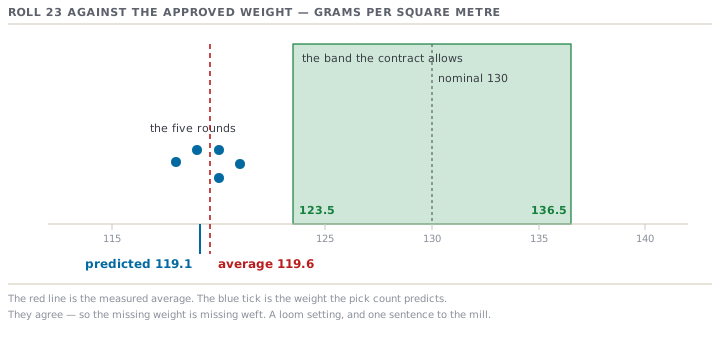
That agreement is the point of this lesson. Hand did not just notice that the cloth felt thin. It found the cause, and the cause matches the measurement. A roll that weighed light with the correct pick count would point at a finer yarn or a different fibre — a different conversation. This one is a loom setting. The mill can be asked about it in one sentence.
The judgements that have no instrument
Everything else in the five minutes is comparison. And comparison only works against the approved swatch physically in your hand. Not a photograph. Not last season. Not memory.
- Drape — how the cloth falls. Hang both over the edge of the table: same overhang, same direction, warp-way and then weft-way. The lighter roll falls in narrower folds, closer to the vertical.
- Hand — how the cloth feels. Squeeze both in a fist and release. Name what you actually feel: stiffness, smoothness, coolness, a softener sitting on the surface. A silicone finish can make an under-weight cloth feel better than the approval. That is exactly why feel alone can never be the verdict.
- Crease recovery. Fold a strip, press it under your hand for ten seconds, let go, and watch for thirty seconds. Viscose recovers badly. If the bulk recovers clearly worse than the approval, the finish has changed.
- Opacity — how much shows through. Lay both over a printed page in the same light. On a light shirting this is not cosmetic. The buyer approved a fit sample at 130 grams per square metre, and 119.6 shows more of what is underneath.
- Surface. Look across the cloth at a low angle towards a window. Slubs, thin places, weft bars, warp streaks and reed marks all show at a grazing angle. They disappear when you look straight down.
Prompt · Work a bulk roll against the approved swatch
In the fabric store, with the roll open and the approved swatch in your hand, before anything is sent to the cutting room.
Act as a senior fabric technologist in a garment factory. I am checking a bulk delivery against an approved swatch and I want a disciplined five-minute sequence plus the arithmetic done for me. Order facts: buyer [BUYER], PO [NUMBER], style [STYLE], fabric description [DESCRIPTION], supplier mill [MILL], quantity delivered [METRES] metres in [NUMBER] rolls, price [PRICE] per metre. Approved specification from the tech pack: construction [ENDS] ends and [PICKS] picks per inch, mass per unit area [GSM] grams per square metre with a tolerance of [TOLERANCE], full width [CM] cm, cuttable width [CM] cm, weave [WEAVE], composition [COMPOSITION]. What I measured on roll [NUMBER]: pick glass count [ENDS] by [PICKS], counted at [NUMBER] places; GSM rounds cut with a 100 cm² cutter, individual weights in grams [PASTE THE WEIGHTS]; measured full width [CM] cm and cuttable width [CM] cm; bow [MM] and skew [MM] measured across the width. My hand notes against the approved swatch, for drape, hand, crease recovery, opacity and surface: [PASTE]. Do the following. First, compute the average GSM from my weights, show the arithmetic, and state whether the roll is inside or outside the tolerance and by how much in grams and as a percentage. Second, tell me whether the thread count is consistent with the weight I measured — scale the approved weight by the ratio of the counts and compare. Third, from that comparison, say which of these the evidence points at: a loom setting, a finer yarn, a fibre substitution, or a finishing difference, and say how confident that is. Fourth, list what I have genuinely established and what I have not, and be strict about the second list. Fifth, tell me whether to release this roll to cutting, hold it, or hold the whole delivery, and give me the one sentence I should send to the mill today. Do not describe any hand judgement as a measurement, and do not give me a fastness or shrinkage figure of any kind.
AI can make mistakes — check anything you act on.
Check yourselfA roll feels lighter than the approved swatch. Your five GSM rounds average 119.6 against a specification of 130 plus or minus 5%. What is the next thing you measure, and why that?Show the answer
The ends and picks per inch, with a pick glass, in three places. The weight tells you there is less yarn in the cloth. The thread count tells you why — and the why decides who is responsible and what the remedy is. Fewer picks is a loom setting, and the mill can correct it on the next weaving run. The specified count with a lighter cloth points at a finer yarn or a different fibre. That is a substitution, and a much more serious conversation. The same weight reading with the same construction points at a finishing difference. One measurement gives you a number to complain about. Two give you a cause to negotiate about.
Check yourselfWhy cut five GSM rounds instead of one, and why not near the selvedge?Show the answer
Because a fabric is not uniform across its width, and a single 100 cm² disc is a very small window on a cloth 147 cm wide. Weft-way weight varies with tension across the loom. One round, taken from wherever the roll happened to be open, can sit a gram either side of the true average. That is enough to move a reading from inside a tolerance to outside it. Five rounds averaged also buy precision: a balance reading to 0.01 g gives whole grams per square metre on one disc, and tenths on five. The selvedge is excluded because it is woven denser and often carries a different finish. A round cut there reads heavy and flatters the roll.