Lessons · Lesson 3 of 3
The machine as a maintained asset
Trace a needle, a feed dog, a throat plate and a tension setting to the fault each one puts on the QC table, price a needle-change policy against the damage it has to prevent, and separate a machine that is broken from one that is merely standing.
Lesson 3 of 3 · 38 min
The four parts that decide what quality comes off the machine
A fault found in inspection is written down as something about the garment. A puckered seam. A row of small holes. A stitch that jumped. Behind each one is a machine part, worn or wrongly chosen. The inspector and the mechanic use different words for it, so the note rarely reaches the person who could stop it.
This lesson lines the two vocabularies up. Then it costs the hours a machine spends not working.
Same line, same order. First the basis for this lesson. A finished polo carries USD 5.90 of Ruwanwella's money: fabric USD 2.65, trims USD 0.72, cut-and-make USD 2.01, finishing and packing USD 0.28, and overhead USD 0.24. The FOB is USD 6.85, so the margin is USD 0.95 a polo. A polo that cannot be shipped as a first is sold locally as a second for USD 1.80, which loses USD 4.10.
A sewing machine has hundreds of parts. Four of them decide what the quality table finds.
The needle. Its size is a trade convention rather than a name. The metric number, written Nm, is the width of the blade in hundredths of a millimetre. So an Nm 80 needle has a blade 0.80 mm across. Its point is the other half of the story. A ball point is rounded, so it pushes a knit loop aside and slips between the yarns. A sharp point is made to pierce, which is what a woven fabric wants and what a jersey does not. Put a sharp point in a jersey machine and it will cut loops. Nothing about the machine will complain. The seam will look right on the line. Then a row of small holes opens along it after the first wash.
A needle also blunts and heats. A blunt tip stops parting yarns and starts pushing them. A needle running fast through a thick seam gets hot enough to soften a polyester sewing thread. That is one of the two common causes of a skipped stitch that comes and goes.
The feed dog. This is the toothed bar that rises through the throat plate and walks the fabric along, one stitch length at a time. When the teeth are worn flat on one side, the top ply and the bottom ply no longer travel the same distance. What you see is a puckered seam, and, at the end of a long side seam, one ply longer than the other by enough to notice.
The throat plate. This is the plate the needle passes through. Its hole should be barely larger than the needle. Once the hole is worn oval, or once somebody has fitted a plate meant for a heavier needle, a light jersey gets pushed down into the hole instead of being supported against it. That is called flagging. The result is a skipped stitch, and often a hole at the very start of the seam.
The tension. On a lockstitch the needle thread and the bobbin thread should lock in the middle of the plies. If the bobbin is too loose, the lock rises to the face and the seam grins open when it is pulled. Too tight, and the seam puckers and the thread breaks.
| Part | What it does when it is right | What the inspection finds when it is not |
|---|---|---|
| Needle point, matched to the fabric | pushes the loop aside instead of piercing it | cut yarn: a line of small holes along the seam, opening after wash |
| Needle blade, sharp and cool | parts the yarns cleanly | skipped stitches that come and go; melted or fused sewing thread |
| Feed dog, teeth square | moves both plies the same distance | puckered seam; one ply longer than the other at the seam end |
| Throat plate, hole matched to the needle | supports the fabric at the needle | flagging: a skipped stitch and a hole at the seam start on light knits |
| Tension, locked mid-ply | balances the two threads | the lock shows on the face; the seam grins open under load |
A needle policy, priced against the damage it has to prevent
Ruwanwella's rule for years was the one most factories run: change a needle when it breaks, or when an operator says it is dragging. Damith proposed the other kind of rule. Change every needle on the line at the start of every shift, whether or not anything is wrong with it.
Count the needles first. The policy is bought by the needle, not by the machine.
| Machine class | Machines | Needles each | Needles |
|---|---|---|---|
| Single-needle lockstitch | 16 | 1 | 16 |
| Overlock | 12 | 2 | 24 |
| Coverstitch, flatbed | 4 | 3 | 12 |
| Bartack | 2 | 1 | 2 |
| Buttonhole | 1 | 1 | 1 |
| Button attach | 1 | 1 | 1 |
| Line 4 | 36 | 56 |
So 36 machines carry 56 needles. Now the cost of the policy.
- Needles: 56 at USD 0.16 each, which is USD 8.96 a shift.
- Time: 35 seconds a needle, so 56 needles is 1,960 seconds, or 32.67 minutes, at USD 0.095, which is USD 3.10.
- One shift: USD 12.06. Over 26 shifts a month: USD 313.56. Over the three months Nilanthi measured: USD 940.68. Over the 21 working days of the 24,000-polo order: USD 253.26.
Now the damage. Over the same three months Line 4 produced 68,400 garments. The end-of-line audit found needle damage, meaning cut yarn or a hole along a seam, on 418 of them. That is 0.61%.
- 297 could be repaired by unpicking and re-sewing the seam, at an average of 9 minutes each: 2,673 minutes at USD 0.095, which is USD 253.94.
- 121 were not worth repairing and went out as seconds, losing USD 4.10 each: USD 496.10.
- Subtotal: USD 750.04.
And one event that is not a rate. In the same window a shipment reached Thornapple's distribution centre, failed the buyer's own audit on needle damage, and 1,800 polos were held. Thornapple charged USD 1,450 in handling and re-inspection. Ruwanwella air-freighted the replacement 1,800 at USD 2,900 to hold the launch date. That is USD 4,350, from one event.
Total observed cost of needle damage in the window: USD 5,100.04.
Say what you do not know, then state the break-even
The tempting next step is to subtract. The policy costs USD 940.68 and the damage cost USD 5,100.04, so the policy saves USD 4,159.36. That subtraction is wrong. It is wrong in the way that matters most, because it assumes a needle policy takes needle damage to zero.
It does not. Some of the 418 came from a blunt needle that a shift-change policy would have caught. Some came from a sharp point fitted to a jersey machine. Some from a worn throat plate. Some from a needle bent by an operator pulling the fabric. Ruwanwella does not know the split, and it did not measure it. Writing a saving as though all 418 were blunt needles is inventing a number in the comfortable direction.
So state what is actually known, which is a break-even.
The policy costs USD 940.68 over three months. The damage cost USD 5,100.04. So the policy pays if it removes more than 940.68 divided by 5,100.04 of the damage, which is 18.4%.
That is a question a factory can answer without more data. It is a judgement about how something works, not an estimate of a number. Is more than about a fifth of our needle damage the kind a blunt needle causes? Damith's answer was yes and Kavinda accepted it. But the honest record says approved on a stated break-even of 18.4%, not on a measured saving. And it names the measurement that would settle it: record the cause against each needle-damage fault for one month. That costs a column on a form.
Standing is not broken, and the difference is the size of the number
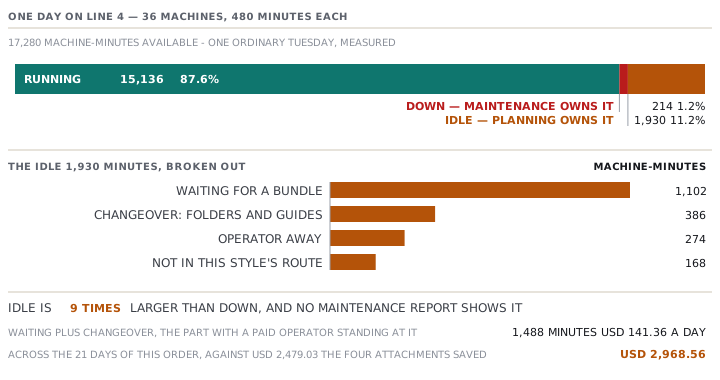
The last part of owning a machine is knowing what it does with its time. Line 4 ran a normal Tuesday during the polo order. That is 36 machines and 480 minutes, so 17,280 machine-minutes available.
| What the machine was doing | Machine-minutes | Share | Who owns it |
|---|---|---|---|
| Running | 15,136 | 87.6% | nobody, this is the good one |
| Down: cannot run until somebody fixes it | 214 | 1.2% | maintenance |
| Idle: could run, nothing at it | 1,930 | 11.2% | planning and line balance |
The 214 minutes of downtime were six events: 78 minutes re-timing a looper on a coverstitch, 52 minutes on a motor fault, and four short ones averaging 21 minutes. That is a normal day, and Damith would call it a good one.
The 1,930 idle minutes were four things.
| Why the machine was idle | Machine-minutes |
|---|---|
| Waiting for a bundle from the previous operation | 1,102 |
| Changeover: swapping a folder, resetting a guide | 386 |
| Operator away from the machine | 274 |
| Machine not in this style's route at all | 168 |
Idle is nine times bigger than down. A factory that reports downtime as its equipment number is reporting on 1.2% of its capacity and calling the result maintenance performance. Damith's 214 minutes is a genuinely good figure, and it is also the small one. The 1,930 belongs to whoever balances the line, and nothing in a maintenance report will ever show it.
Cost only the part you can defend. The 1,102 minutes of waiting and the 386 of changeover have an operator standing at a paid machine. So they cost 1,488 minutes at USD 0.095, which is USD 141.36 a day, or USD 2,968.56 across the 21 days of the order. The 274 minutes of operator absence and the 168 minutes of a machine outside the route are a different kind of cost, and are not priced here. The absent operator is not being paid to stand at the machine, and the out-of-route machine is the option lesson 1 described.
Set that against lesson 2. Fitting four attachments earned a net USD 2,479.03 on this order. The waiting cost more than the attachments saved, from the same line, in the same three weeks, and nobody had to buy anything to fix it.
That is the closing argument of this course. The machine list decides what you can sell. The attachments decide what a garment costs. And the minutes a machine spends waiting decide how much of both you actually get.
Check yourselfAn inspector reports skipped stitches on the shoulder seam of eleven polos in one day, all from the same line. Damith changes the needles on every overlock and the fault continues. What are the next two things to check, and why in that order?Show the answer
The throat plate, then the thread path. The order is set by how much each one explains. Flagging from an oversized or worn throat-plate hole produces exactly this pattern: the fabric is pushed into the hole instead of being supported, so the loop is not formed. And the skips cluster where the number of plies changes, which is what a shoulder seam is. It also survives a needle change, which is a piece of evidence you already have. After that, check the thread tension and the thread path, because a thread that is snatching also produces skips that come and go. Note what has already been ruled out: it is not the needles, because changing them changed nothing. That negative result is a real measurement, not a dead end.
Check yourselfA factory has no chargeback history at all. Its needle-damage repairs and seconds cost 750.04 dollars over three months, and the same shift-change policy would cost 940.68 dollars. Should it run the policy?Show the answer
Not on this arithmetic, and it should say so plainly. The policy costs more than the whole of the damage it could possibly prevent. Its break-even is above 100%, so no share of the damage removed can repay it. What that argues for is a cheaper version of the policy, not no policy. Change needles on the machines and the fabrics where the damage actually happens, which on most lines is a small group. Leave the rest on change-on-failure. It is also worth naming what the absence of a chargeback is. No chargeback yet is not evidence that one cannot happen. So the figure the factory is really working with is a cost it has measured, plus a risk it has not.
Prompt · State my maintenance policy as a break-even, not a saving
When somebody proposes a preventive routine, such as needles, belts, oiling or a service interval, and the case for it is a subtraction.
Somebody has proposed a preventive maintenance policy and I want it costed honestly.

I will give you: the part's unit cost, how many of them the line carries (count them per machine, not per line), the time each replacement takes, my minute cost, how often the policy runs, and the window I am measuring over. Separately I will give you the damage that happened in that same window: the number of garments affected, how many were repaired and the average repair time, how many were downgraded and the loss on each, and any chargeback or freight cost from a shipment that failed at the buyer.

Produce, in this order:

1. The cost of running the policy over the window.
2. The observed cost of the damage over the same window, item by item.
3. Then do NOT subtract the two. Give me the break-even instead: what share of the damage the policy must remove before it repays itself, as a percentage. Say that this is the number to argue about.

Then tell me three things plainly. First, that the policy cannot be assumed to take the damage to zero, and that the split between causes is unknown unless I have recorded it. Second, that a one-off chargeback is an observed cost inside the window and not a frequency, so it must not be turned into a yearly rate. Third, what single measurement would settle the question, which is usually recording the cause against each fault for a month.

If the break-even comes out above one hundred per cent, say so directly. The policy costs more than the whole damage it could prevent, and the right answer is a narrower version of it, on the machines and fabrics where the damage actually happens.
AI can make mistakes — check anything you act on.