Lessons · Lesson 2 of 3
Where the seconds are
Cost a folder, a binder, a guide and a puller from the standard minute each one changes: into money a garment, into operators on the line, and into the batch size below which the attachment loses money.
Lesson 2 of 3 · 40 min
An attachment is a motion the operator no longer has to make
Hem a pair of trousers at home and you turn the raw edge under, then press it flat. A factory doing that tens of thousands of times cannot afford the folding. So it bolts a shaped piece of metal to the machine, and the metal folds the cloth before the needle reaches it.
This lesson looks at four such devices. It turns what they save into money and into people. It also asks when fitting one is not worth the trouble.
Same factory, same line, same order: 24,000 polos, style RWA-118, on Line 4 at Ruwanwella. The loaded minute is unchanged at USD 0.1762. The polo's basic time is 11.41 minutes across 22 operations.
An attachment is not a faster machine. The needle bar goes up and down at the same rate whether or not there is a folder bolted to the bed. What an attachment removes is the part of the cycle where nothing is being sewn: the operator lining the edge up, turning the hem under with her fingers, sighting along a chalk line, easing the fabric so it does not drag. Those motions are most of the difference between a good operator and a slow one. They are also exactly the motions a piece of shaped metal can do the same way, all shift.
Four attachments matter on a polo line. Each removes a different motion.
A hemming folder is a shaped funnel bolted in front of the needles. The raw edge goes into the wide end. The metal turns it under twice as it travels. It arrives at the needles already folded to a set width. The operator's hands do nothing but guide the panel forward. On Line 4 the folder is set for a 20 mm double-turned hem.
A binder does the same trick with a separate strip. Binding tape is fed from a reel through a scroll, which folds it around the raw edge of the panel, so both reach the needle together. Nobody pre-folds the tape and nobody holds it in place.
An edge guide is the simplest of the four. It is often a presser foot with an adjustable blade. It is a wall for the edge to run against. The seam allowance is whatever the wall is set to, and nobody has to sight it. It removes an eye motion rather than a hand motion. That is why the saving is smaller, and why the effect on quality is larger.
A puller is a small driven roller behind the needles. It pulls the sewn fabric through at a set rate. On a long overlock seam the operator would otherwise be steering and tensioning a metre of jersey with both hands. With a puller she feeds the start and lets go.
Four attachments, priced from the standard minute
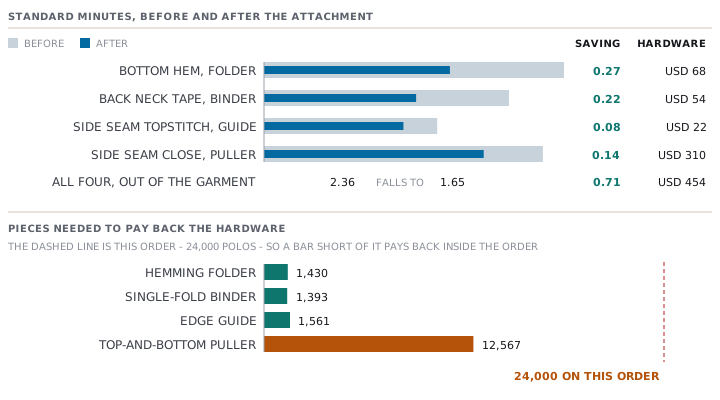
Nilanthi timed each of the four operations twice. Once as Line 4 was running it. Once with the attachment fitted and the operator given two days to settle. These are her figures.
| Operation and machine | Attachment | SAM before | SAM after | Saving | Attachment cost, in dollars |
|---|---|---|---|---|---|
| Bottom hem, coverstitch | right-angle hemming folder | 0.71 | 0.44 | 0.27 | 68 |
| Back neck tape, lockstitch | single-fold binder | 0.58 | 0.36 | 0.22 | 54 |
| Side seam topstitch, lockstitch | edge guide | 0.41 | 0.33 | 0.08 | 22 |
| Side seam close, overlock | top-and-bottom puller | 0.66 | 0.52 | 0.14 | 310 |
| All four | 2.36 | 1.65 | 0.71 | 454 |
The prices come from Ruwanwella's own dealer quotation and are only an example. What is not an example is the shape of the table. Three of the four cost less than a day of the line's output. The fourth costs five times the other three together, because it has a motor in it.
Now turn the same handle as lesson 1.
- Saving in standard minutes: 0.71 a polo.
- Saving in money: 0.71 times USD 0.1762, which is USD 0.1251 a polo.
- On 24,000 polos: USD 3,002.45.
- The garment's basic time falls from 11.41 to 10.70 minutes. Its SMV falls from 13.12 to 12.31. Its CM falls from USD 2.01 to USD 1.89. That is the same saving again. A cost sheet kept to the cent shows it as a fall of USD 0.12 a polo, or 6.0% of the cut-and-make price.
The same saving in people, which is the number the line manager reads
Money a garment is the costing answer. Imalka runs a line, and her question is different: how many operators does the hem take?
The hem operation's SMV is its SAM plus the 15% allowance. That is 0.8165 minutes by hand and 0.506 with the folder. One operator on a 480-minute day at 62% efficiency delivers 297.6 standard minutes.
- By hand: 297.6 divided by 0.8165 is 364 polos an operator a day.
- With the folder: 297.6 divided by 0.506 is 588 polos an operator a day.
Line 4's target is 1,150 polos a day.
- By hand: 1,150 divided by 364 is 3.16. You cannot staff a fraction of an operator, so the hem takes 4 people.
- With the folder: 1,150 divided by 588 is 1.96, so the hem takes 2.
Two operators come off the operation. Be careful what that means. It is capacity, not cash, until somebody is given something to do. Whether Line 4 had other work for them that week is not in Nilanthi's study. If they stand at the next bottleneck, the factory has bought output. If they stand nowhere, the factory has bought nothing and still pays them. Write it down as two operators released, and let the person who owns the roster turn it into money, or admit it did not.
Notice also where the money hides. By hand the operation needs 3.16 operators and is staffed with four, so 0.84 of an operator is being paid to be available. That rounding loss is invisible in a table of SAMs and obvious in a wage bill. It is the best argument there is for looking at an attachment on the operation that sets your staffing steps, rather than the one with the biggest saving.
The other side: the attachment that loses money
An attachment does not arrive fitted. Damith has to mount it, line it up with the needle, set the fold width, and sew trial pieces until the hem stops puckering on this particular fabric. On the polo hem that took him 150 minutes the first time, and the machine and its operator were out of the line for all of it.
- The folder itself: USD 68.
- Damith's time: 150 minutes at his loaded rate of USD 0.083 a minute, which is USD 12.45.
- The machine and operator standing: 150 minutes at USD 0.095, which is USD 14.25.
- First fit, all in: USD 94.70.
The folder saves USD 0.047574 a polo. So it pays for its own first fitting after 1,991 pieces, and everything after that is a saving. On an order of 24,000 that is not a close call. On an order of 1,500 it is a loss. A factory that fits a folder for every new hem width without asking the quantity is buying seconds it will not get to use.
There is a second, smaller version of the same trade. Once the folder is fitted, changing it for a different hem width takes Damith 28 minutes: remove, swap, re-set the guide, then sew and measure three trial pieces.
- Damith: 28 minutes at USD 0.083, which is USD 2.32.
- The machine and operator standing: 28 minutes at USD 0.095, which is USD 2.66.
- One changeover: USD 4.98, which the saving repays after 105 pieces.
So the two break-evens answer two different questions. Confusing them is the common mistake. The first-fit break-even, about 2,000 pieces, decides whether to buy the folder at all for a new hem width. The changeover break-even, about 100 pieces, decides whether to keep swapping a folder you already own between styles. The first is a capital question. The second is a scheduling one, and the scheduling answer is nearly always yes.
| Attachment | Saving a piece, in dollars | Pieces to repay the hardware | On this 24,000-piece order |
|---|---|---|---|
| Right-angle hemming folder | 0.047574 | 1,430 | pays back sixteen times over |
| Single-fold binder | 0.038764 | 1,393 | pays back seventeen times over |
| Edge guide | 0.014096 | 1,561 | pays back fifteen times over |
| Top-and-bottom puller | 0.024668 | 12,567 | pays back just under twice |
The puller is the interesting row, and the reason the table is here. It saves real seconds and it costs USD 310. So it needs 12,567 polos before it has paid for itself, which is half of this order. Put the same puller on a 6,000-piece order and it is a loss of about USD 162. Nothing about the attachment changed. The quantity did.
What Imalka actually did
She fitted all four, because the order was 24,000 and the arithmetic was not close. The full first fit came to USD 523.42. That is the four attachments at USD 454, plus the folder's USD 26.70 of fitting time, plus 240 minutes on the other three at Damith's rate and the line's rate together, which is USD 42.72. Against USD 3,002.45 of saving on the order, the net is USD 2,479.03.
She also did the thing that is easy to skip. She wrote the four new SAMs onto the operation list the same afternoon. So the next quote for a polo is costed on the line as it now is, rather than as it was. An attachment that improves the floor but not the standard data saves money once, then quietly gives it back in the next negotiation.
Check yourselfA binder saves 0.22 SAM on a neck tape and costs 54 dollars. Your next three orders are 900, 1,400 and 2,200 pieces of three different styles, all with the same neck tape. Does the binder pay?Show the answer
Yes. The quantity that matters is the total across every style that uses the same tape width, not the size of any one order. The saving is 0.22 times USD 0.1762, which is USD 0.038764 a piece, and the hardware needs 1,393 pieces to repay. The three orders together are 4,500 pieces, so the binder repays inside the second order and earns on the rest. The trap is asking the question order by order. On the 900-piece order alone the answer is no, and answering it there means never buying an attachment that any single order cannot justify. Ask it per attachment, over the work you can actually see.
Check yourselfWith the folder fitted, the hem needs 1.96 operators and is staffed with two. Somebody proposes taking the second operator off and running the hem with one, because 588 a day is above half the target. What happens?Show the answer
The line drops to 588 polos a day at the hem, against a target of 1,150, and the hem becomes the bottleneck for everything behind it. One operator delivers 588. The target needs 1,150. No amount of efficiency on the other 21 operations moves a constraint that is 562 pieces a day short. It is worth saying what the 1.96 figure actually is. It says that two operators on that operation will be about 98% loaded, which is as close to full as a real line gets. A number just under a whole operator is not spare capacity. It is a well-balanced station.
Prompt · Cost an attachment against the batch I actually have
Before buying a folder, binder, guide or puller. And again before fitting one you already own to a short run.
Help me decide whether an attachment pays on a specific order, from my own numbers only.

I will give you: my minute cost, my allowance percentage, my line efficiency, the operation's standard minute (SAM) before and after the attachment, the attachment's price, the mechanic's loaded rate, the minutes the first fitting takes, the minutes a changeover takes, and my order quantity.

Work out and show, in this order:

1. My loaded cost of one standard minute. That is minute cost times one plus the allowance, divided by efficiency. Use that one figure for everything below.
2. The saving a piece, and the saving across the order.
3. The first-fit cost: the hardware, plus the mechanic's time, plus the machine and operator standing out of the line. Then the break-even quantity for the first fit.
4. The changeover cost and its break-even quantity. Say clearly that these two break-evens answer different questions. The first decides whether to buy for a new size at all. The second decides whether to keep swapping between styles I already own attachments for.
5. The operator arithmetic: pieces an operator a day before and after, at my efficiency, and how many whole operators the operation needs to hit my daily target in each case. Point out any rounding loss, where a fractional requirement is staffed with a whole person.

Two rules. If the attachment releases operators, call that CAPACITY and not a saving, unless I tell you they were redeployed. Do not turn released operators into money on my behalf. And if my order quantity is below the first-fit break-even, say the attachment loses money on this order and tell me by how much, rather than looking for a reason it is still a good idea.
AI can make mistakes — check anything you act on.