Lessons · Lesson 1 of 3
What the machine class decides
Read a machine list the way a costing sheet reads it: the stitches your line can make, an operation list that has to fit inside them, and a quote that turns into a purchase, a subcontract or a refusal the moment it does not.
Lesson 1 of 3 · 40 min
The factory, the order, the basis
A sewing machine is not a general-purpose tool. Each kind can lock threads together in only one or two ways. A garment is a list of seams. So a factory's machines are also a list of what it can make.
This lesson reads that list. Then it asks what to do when an order needs a seam you cannot sew. If you quote for work you cannot do, you have to buy that work from somebody else, at their price.
Ruwanwella Apparel is a woven-and-knit factory in the Kegalle district of Sri Lanka. It runs six sewing lines. Everything in this course happens on one of them, Line 4, between January and March of one year. Every figure belongs to Ruwanwella.
Four people appear. None of them does anything foolish.
- Nilanthi Kalupahana is the industrial engineer. She owns the operation list and the standard minutes.
- Damith Seneviratne is the chief mechanic. He owns the machines, the attachments and the needles.
- Imalka Dodangoda is the production manager. She owns the line, its people and its output.
- Kavinda Pathirage is the general manager. He signs anything that is bought.
Say the basis once. Every number in three lessons hangs off it.
- SAM is the standard allowed minute. It is the time one operation should take, as Nilanthi timed it on Line 4.
- SMV is the standard minute value of the whole garment. It is the sum of the operation SAMs, plus an allowance of 15% for tiredness, waiting and personal time. Ruwanwella has used that allowance for four years. It is a factory habit, not a law.
- The minute cost is what one available machine-minute costs the factory in wages and overhead. Here it is USD 0.095.
- Line efficiency on Line 4, measured over the previous quarter, is 62%.
- CM is the cut-and-make cost: what the factory charges to cut and sew the garment. CM is SMV times minute cost, divided by efficiency. So one SAM minute of work costs 0.095 times 1.15 divided by 0.62, which is USD 0.1762. That single figure is used all through the course. It is called the loaded minute.
The order is Thornapple purchase order TH-6120: 24,000 men's short-sleeve pique polo shirts, style RWA-118, in three colours, FOB USD 6.85. FOB means the price with the goods loaded on the ship, so it covers making the garment and getting it to the port, and nothing after that. The order is worth USD 164,400.
Stitch class is the vocabulary. Machine class is the equipment that speaks it
A stitch class is a number that says how the threads interlock. It is not a brand and not a machine. It describes a shape. It is also the vocabulary a tech pack and a costing sheet share.
| Class | How the threads interlock | What it can do | What it cannot do |
|---|---|---|---|
| 100, single-thread chain | one thread, looped back on itself by a looper | fast basting, button attaching, bag closing | hold under load — pull the last loop and the whole row runs |
| 300, lockstitch | needle thread and a bobbin thread, locked between the plies | the strongest, tidiest, most controllable seam; all topstitching | stretch with a knit, or finish a raw edge |
| 400, multi-thread chain | needle thread and a looper thread from cones | long strong seams with some stretch; no bobbin to run out | finish an edge on its own |
| 500, overedge | one to three threads wrapped around the cut edge, with a knife ahead of the needles | seam and neaten a knit edge in one pass, trimming as it goes | make a flat seam, or sew anywhere the edge must not be trimmed |
| 600, covering | two or three needles over a looper, covering both faces | flat stretchy hems and flat joins on knits | sew a closed tube that the machine bed cannot pass through |
Four machine classes make those stitches. A factory's whole capability is which of them it owns, and how many.
Lockstitch carries a needle thread down through the plies. It locks that thread against a bobbin thread underneath. The lock sits in the middle of the fabric. That is why the seam looks the same on both faces, and why it will not stretch: the thread has nowhere to go. It is the workhorse of woven garments and of every topstitch you can see. Its one nuisance is the bobbin, which holds a limited length of thread and stops the machine when it runs out.
Overlock, the machine most factories call a serger, has a knife just ahead of the needles. The knife trims the edge to a set width, and loopers wrap threads around that freshly cut edge. It seams and neatens in one pass, which is why a knit line is mostly overlock. The knife is also the limit. An overlock cannot sew where you do not want the edge cut. And it cannot make a flat seam, because the wrap stands up.
Coverstitch runs two or three needles side by side over a looper that covers the underside. The result is flat and stretchy. It is the standard hem on jersey. It cannot easily sew a closed tube smaller than the machine's cylinder. That is why a factory hemming tee sleeves buys a small-cylinder coverstitch, and one hemming dress bottoms buys a flatbed.
Blindstitch uses a curved needle that swings sideways. It goes only part of the way through a folded hem and catches a thread or two of the face cloth, so the stitch cannot be seen from outside. It is a single-thread chain, class 100. It is how a tailored trouser or a lined skirt is hemmed. There is no substitute. A blind hem sewn on a lockstitch is a topstitched hem, which is a different garment.
Line 4's machine list, and what it can quote
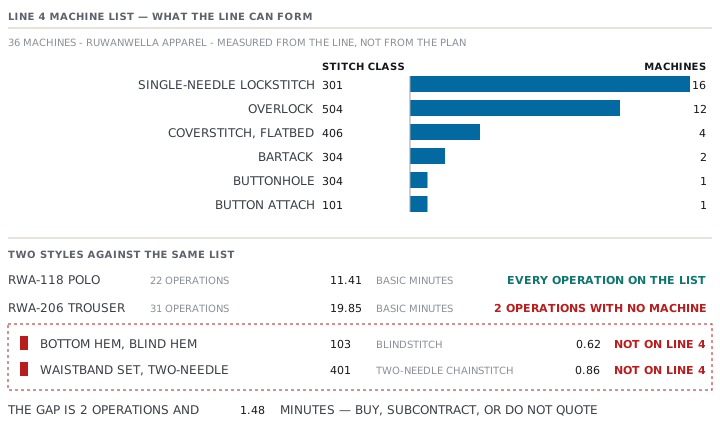
Line 4 has 36 machines. This is the whole of what it can make.
| Machine class | Stitch class it makes | Machines on the line |
|---|---|---|
| Single-needle lockstitch | 301 | 16 |
| Overlock, three and four thread | 504 and 514 | 12 |
| Coverstitch, flatbed | 406 | 4 |
| Bartack | 304 | 2 |
| Buttonhole | 304 | 1 |
| Button attach | 101 | 1 |
Nilanthi's list for the polo has 22 operations. Grouped by the machine each one needs, it looks like this.
| Machine class | Operations | SAM subtotal |
|---|---|---|
| Single-needle lockstitch | 9 | 5.42 |
| Overlock | 6 | 3.60 |
| Coverstitch | 3 | 1.55 |
| Bartack | 2 | 0.34 |
| Buttonhole | 1 | 0.28 |
| Button attach | 1 | 0.22 |
| Whole garment | 22 | 11.41 |
Every one of those six rows names a machine Line 4 owns. So the polo is a sewing plan. Now turn the handle.
- Basic time: 11.41 minutes.
- SMV: 11.41 times 1.15, which is 13.12 minutes.
- CM: 13.12 times 0.095 divided by 0.62, which is USD 2.01 a polo.
- On 24,000 polos, USD 48,240 of cut-and-make revenue.
That is the sentence this lesson exists for. The machine list is not a buildings question. It is the first line a costing sheet reads. The operation list is a list of machines. The machines are what the minutes are timed on. The minutes are what the CM is built from. Change the machine and you change the price.
The quote that does not fit
In February, Thornapple sends Ruwanwella a second enquiry: style RWA-206, 6,000 wool-blend tailored trousers. Nilanthi builds the list the same way. It comes to 19.85 basic minutes across 31 operations. Two of those operations do not land on Line 4's machine list.
| Operation | Stitch class required | Machine required | On Line 4 | SAM |
|---|---|---|---|---|
| Bottom hem, blind hem | 103 | Blindstitch | no | 0.62 |
| Waistband set, two-needle | 401 | Two-needle chainstitch | no | 0.86 |
| Everything else | 301, 304, 504 | on the list | yes | 18.37 |
Those two operations are 1.48 of the trouser's 19.85 minutes, which is 7.5% of the work. They are also the whole decision. A garment sent to a machine the line does not own is not a sewing plan. It is one of three other things, and each has a price.
Route one: buy the machines. Ruwanwella's dealer quotation, held in Kavinda's file and given here only as an example, is USD 1,850 for a blindstitch machine and USD 2,400 for a two-needle chainstitch. Delivery, installation and setting up both costs USD 300. That is USD 4,550 of capital.
Route two: subcontract the two operations. A unit 20 minutes away will blind-hem at USD 0.14 a piece and set waistbands at USD 0.11 a piece. On 6,000 trousers that is USD 1,500. Add two round trips of the factory van at USD 60 each, and it is USD 1,620. It also adds four days to the schedule. And it puts a second factory's hands on a garment that carries Thornapple's label.
Route three: change the specification. Hem the trouser on a lockstitch and topstitch it. This is not a routing decision. It is a product decision, and it is Thornapple's to make. Whether they would accept it is unknown, and it stays unknown until somebody asks. Never price a route on an approval you have not got.
Between routes one and two there is a break-even. It is a quantity, not an opinion.
- Buying costs USD 4,550 once.
- Subcontracting costs USD 0.25 a piece, plus USD 120 of transport per shipment. Spread over a 6,000-piece order, that transport is USD 0.02 a piece. So USD 0.27 all in.
- USD 4,550 divided by USD 0.27 is 16,852 pieces. Below roughly that much repeat business, subcontracting is cheaper.
Now say what the break-even leaves out. A number is only honest with its exclusions attached. It ignores the floor space the two machines take up. It ignores the maintenance and spares they will need, and the time Damith spends learning them. It ignores the operators who must be trained on a blindstitch nobody at Ruwanwella has run. It ignores whatever the machines would fetch second-hand if the work stopped. Every one of those is real, and none of them is measured. So 16,852 is a floor on the quantity that justifies buying, not an estimate of it.
What Kavinda actually decided
He bought neither machine, and subcontracted the 6,000. His reason is not in the arithmetic. Thornapple had not said whether the trouser would repeat, and 16,852 pieces of unpromised business is not a business case.
He also wrote the two missing classes onto a one-page list pinned in his office. That is the capability gap. Next time an enquiry is refused or subcontracted, the reason is written down rather than remembered.
That list is the deliverable of this lesson. A machine list read forwards tells you what you can make. Read backwards, against the enquiries you turned down, it tells you what to buy.
Check yourselfA buyer asks Ruwanwella to quote a jersey tee with a flatlock join at the shoulder, class 607. Line 4 has coverstitch machines. Can it quote?Show the answer
Not from the machine list alone. The honest answer is that it is unknown until somebody looks at the machine. A flat join of class 607 needs a covering machine with a top cover and a bottom cover, working on butted edges with no seam allowance. A plain 406 flatbed coverstitch covers only the underside, and is set up to hem a folded edge. They are both class 600 machines and they are not interchangeable. The general rule: the class number narrows the machine to a family, and the operation still has to be checked against the actual machine, its bed shape and its attachment. Write the class on the list, then have the mechanic confirm the machine.
Check yourselfNilanthi's polo list gives 11.41 basic minutes. A second factory quotes the same polo at 10.20 basic minutes and the same minute cost of 0.095 dollars. Before you conclude they are more efficient, what is the first thing to check?Show the answer
Which machines their list is on. A lower basic time can mean a faster line. It can just as easily mean a different machine list: an automatic collar-and-cuff unit, a pocket setter, an attachment on the hem. In that case the two numbers are not measuring the same work, and neither factory is faster than the other. Compare the operation lists, and the machine class beside each operation, before comparing the totals. Efficiency and equipment show up the same way in a total, and they are two entirely different things to buy.
Prompt · Check a style against my machine list before I quote
When an enquiry arrives and you are about to price it from a total minute figure, without checking what the garment has to be sewn on.
I am deciding whether I can quote a style on the machines I actually own. I will give you two things. First, my machine list: how many machines I have of each class, and the stitch class each one makes. Second, the style's operation list, with a machine or a stitch class and a standard minute (SAM) against every line.

Step one: match them. Give me a table of every operation whose stitch class or machine is NOT on my list, with its SAM. Then give me the total minutes, and what percentage of the garment those operations are. If an operation line names no machine and no stitch class, do not guess one. List it separately as unclassified, and say the match is incomplete until I fill it in.

Step two: price the three real routes for the gap, using only figures I give you. Buy the machines (I will give a dealer quotation and an installation cost). Subcontract the operations (I will give a piece rate and a transport cost per shipment). Or leave it. Show the break-even quantity between buying and subcontracting, with transport spread over my order size. Then say plainly what the break-even leaves out: floor space, maintenance, operator training, resale value. I must not read it as a full business case.

Step three: if a fourth route would need the buyer to change the specification, say so and stop. Do not price it. Whether the buyer accepts a different stitch is unknown until they are asked, and a quote built on an assumed approval is a quote I cannot stand behind.

Finally, give me my capability gap as a one-line list: the stitch classes I had to refuse or subcontract, so I can keep a running record of what to buy.

Do not name or recommend any machine brand or model, and do not supply a price I have not given you.
AI can make mistakes — check anything you act on.