Lessons · Lesson 3 of 3
The machines after the knife
The small machines between the knife and the sewing line — ply numbering, bundling, and where fusing sits relative to the cut — and the arithmetic that says which station a fault should be found at.
Lesson 3 of 3 · 38 min
The cutting room's real output
When the blade stops there is a heap of cut pieces on the table. Nothing about a heap says which pieces belong together, or which layer each one came off. The machines that answer those two questions are the cheapest in the room. Nobody argues about them, which is exactly why they are worth a lesson. This lesson also asks what an early warning is worth, and when the stiffening layer should be glued on.
The cutting room does not produce panels. It produces bundles that can be trusted. A trusted bundle is a set of panels that belong together, that came from cloth of the same shade, and that can be traced back to the plies they were cut from if something goes wrong later.
Everything in this lesson is about the machines that produce that trust, and none of them costs what the cutter costs. Nadia Benjelloun's whole list of after-the-knife equipment is under EUR 5,000. One item on it makes a certain mistake cost about a thousand times less.
| Machine | What it does | Price | What is lost without it |
|---|---|---|---|
| Ply-numbering gun | Prints and sticks a numbered label on every ply as the lay is broken down | EUR 1,850 | The ply a panel came from. A fault can be traced to a lay of 80 plies, but no closer |
| Bundle clamp and tying press | Compresses a bundle and holds the tie while it is fastened | EUR 620 | Nothing important. It is a speed machine |
| Ticket printer | Prints the bundle ticket from the cut plan rather than from a person's handwriting | EUR 410 | Legibility, and the guarantee that the ticket matches the plan |
| Small band knife, kept clear for recuts | Cuts replacement panels without breaking down a production lay | EUR 2,100 | A recut has to interrupt a running lay, or wait for one |
The ply-numbering gun is the one worth an argument, and the argument is not about the machine. It is about where a fault gets found.
One shade fault, three places it could have been caught
On OC-4180, 9 lays were spread from a delivery in which 3 rolls sat half a shade band lighter than the rest. Nobody was careless. The rolls were within the mill's own tolerance, and the shade check at goods-in passed them. In each of those 9 lays the lighter cloth ran from ply 1 to ply 26, and the rest from ply 27 to ply 80.
A garment made entirely from the lighter plies is fine. A garment made entirely from the darker plies is fine. A garment with a front from one and a back from the other is a reject under a light box, and it is invisible on the cutting table.
The fault was created by the fabric. Which station it is found at is decided by the machines. Price all three.
| At bundling | At the sewing line | At final inspection | |
|---|---|---|---|
| What is visible | The ticket shows two ply bands in one bundle | An operator notices the join | A light-box reject rate |
| Work to sort | 54 bundles at 2.4 min | 3,100 part-made garments at 0.4 min | 8,640 garments at 0.6 min |
| Sorting cost | EUR 6.70 | EUR 64.07 | EUR 267.84 |
| Garments already unfixable | none | 210 | 1,598 |
| Loss on those, at EUR 8.65 ex-factory less EUR 2.60 recovery | nil | EUR 1,270.50 | EUR 9,667.90 |
| Replacements to cut and make, at EUR 4.25 each | nil | EUR 892.50 | EUR 6,791.50 |
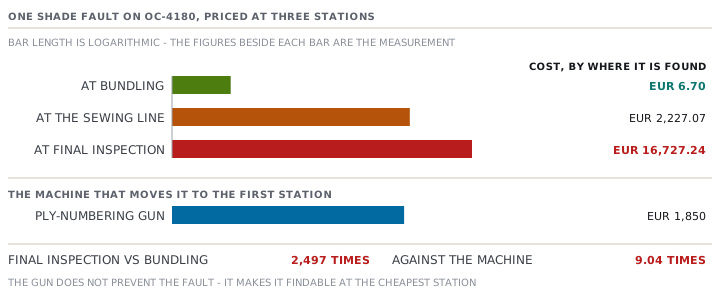
| Total | EUR 6.70 | EUR 2,227.07 | EUR 16,727.24 |
The arithmetic behind the loss and replacement lines is worth writing out, because it is the arithmetic that pays for a machine.
consumption      = 8.44 m a ply / 12 garments = 0.7033 m a garment
replacement cost = 0.7033 x EUR 3.28 + EUR 1.94 making
                 = EUR 4.2468, taken as EUR 4.25 a garment

affected garments at final inspection
                 = 9 lays x 80 plies x 12 = 8,640
mismatched, measured by sorting all of them
                 = 1,598, which is 18.5%
Found at bundling the fault costs EUR 6.70. Found at final inspection it costs EUR 16,727.24, which is 2,497 times as much. This one event on its own is 9.04 times the price of the ply-numbering gun.
Where fusing sits relative to the knife
OC-4180 has a fused waistband facing. Fusing means gluing a stiffening layer, called interlining, onto the cloth with heat and pressure. The cutting room has to decide something before the press is switched on: does the interlining go on before the piece is cut, or after?
- Block fusing. A block of cloth and a block of interlining are fused together, and the fused sandwich is then cut. The interlining is cut with the cloth, so the two line up perfectly by construction. You fuse the whole block, including the parts the marker throws away.
- Panel fusing. The panel is cut first, an interlining piece is cut to match, and the two are placed on the press bed together. You fuse only what you need, and somebody has to line up two pieces for every garment.
This is a cutting-room sequencing decision, and it belongs here because it changes what the knife cuts and in what order. The press itself — its temperature, its dwell time, its pressure, the belt speed that sets its throughput, and how you prove a bond — is the subject of course 20.3, and none of that is decided here.
Cost the two routes on this style.
| Panel fusing | Block fusing | |
|---|---|---|
| Interlining area a garment | 0.038 m² | 0.052 m² |
| Interlining cost a garment, at EUR 0.86 a m² | EUR 0.03268 | EUR 0.04472 |
| Interlining on the order | EUR 1,372.56 | EUR 1,878.24 |
| Handling | 0.11 min a garment placing two pieces | 44 blocks at 3.5 min, fed once |
| Handling cost | EUR 238.70 | EUR 7.96 |
| Total | EUR 1,611.26 | EUR 1,886.20 |
Panel fusing wins by EUR 274.94 on this style. The reason is that block fusing buys EUR 230.74 of labour with EUR 505.68 of interlining. That is a good trade in a factory paying European wages, and a bad one at EUR 3.10 an hour. The same decision goes the other way in a different country with the same machines.
It goes the other way here too, for a different reason, the moment lining-up matters. A shirt collar whose interlining must follow the cut edge to 1 mm cannot be panel-fused reliably, because nobody places two pieces to 1 mm on 42,000 garments. Block fusing guarantees it by geometry. So the decision is EUR 274.94 against a lining-up requirement. It is an owner's judgement, not the output of a formula — which is exactly the sort of decision that should be written down with both numbers visible.
What the machine list lets you quote
Track 20 opens with the claim that a machine list decides which styles a factory can sell. The cutting room is where that is most obviously true, because a cutting machine's accuracy is a hard ceiling that no amount of care raises.
| Enquiry | Answer | The machine that decided it |
|---|---|---|
| 900 units, coated outerwear shell, buyer's panel tolerance 2 mm | Declined | The manual route's measured gap is 3.6 mm on an 80-ply lay, and a coated cloth caps the lay at 30 plies, which makes it worse per unit rather than better. Nothing Ourika owns holds 2 mm |
| 6,000 units, tailored jacket, 22 small fused parts lined up to 1 mm | Accepted | The band knife at 0.8 mm plus block fusing. It costs 51 minutes of band-knife time a lay and a second handling, and the quotation says so |
| 420,000 pieces a year, workwear trouser, one repeated pocket shape | Accepted | The die press, because the volume crosses the tooling breakeven of 387,660 pieces in the first year |
Read the tailored jacket row carefully, because it is the one people get wrong. Ourika did not accept the jacket because it had a band knife. It accepted it because it had a band knife and had put the second handling into the price. A factory that accepts the order and forgets the 51 minutes has not sold a capability. It has sold a loss.
Check yourselfOurika is offered a second ply-numbering gun at EUR 1,850 for its third table. The first gun has been in use for a year. What is the case, and what is the trap in making it from the first year's figures?Show the answer
The case is the same one: a fault found at bundling instead of at final inspection, at the ratio of EUR 6.70 to EUR 16,727.24 that the first event showed. The trap is that the first year's figures now show 11 shade events rather than 2, and it is tempting to present that as a worsening the second gun will fix. It is not a worsening. It is the first year anybody could see. Using the 11 as a baseline for a saving would claim credit twice for the visibility the first gun created. The defensible case is the cost ladder itself, applied to the traffic through table 3, plus the honest statement that the event rate on that table is currently unknown because it has never been measured.
Check yourselfA buyer's technician asks whether your cutting room can hold a 1.5 mm panel tolerance on a 60-ply lay of a 200 g/m² poplin. You have never cut that cloth. What do you answer?Show the answer
That you do not know, and then what you will do about it. The band knife holds 0.8 mm on twill and would very likely hold the tolerance. But it was measured on a different cloth at a different ply height, and a lighter poplin slides more. The answer is to cut one short lay, measure the top-to-bottom gap at the bottom ply across ten reference notches, and send the technician the measurement. That costs about an hour of table time, and it turns an unknown into a number both sides can rely on. A "yes" here is worth nothing to the buyer, because they cannot check it. And it is worth less than nothing to you if the first shipment fails on a tolerance you guessed at.
Prompt · Price a cutting-room fault at every station it could be found
After any fault that reached final inspection, and before buying anything that promises traceability.
Build a detection-cost ladder for a fault that got out of my cutting room.

I will describe the fault, how many lays and plies it affected, how many garments those lays yield, and where it was actually found. I will give you my fully loaded labour rate, my ex-factory price a garment, what a rejected garment recovers if it is sold off, my fabric consumption and price a metre, and my making cost a garment.

For each station where it could have been caught — at the cutting table, at bundling, at the sewing line, at final inspection, at the buyer — show: what would have been visible there, the sorting work in minutes and in money, how many garments are already unfixable at that point, the loss on those at ex-factory less recovery, the cost of cutting and making replacements, and the station total. Show the ratio between the cheapest station and where it was actually found.

Then separate two things that always get confused. Say which controls would have PREVENTED the fault, and which would only have made it VISIBLE EARLIER. Put every machine and every check on one side or the other. A machine that makes a fault findable is worth the difference between the stations on the ladder. A machine sold as preventing the fault will be judged against the next fault that gets through.

If I ask you to justify a traceability machine, use the ladder and nothing else. Warn me clearly if I try to use a rise in reported faults after installing it as evidence that a problem is getting worse: a register that reports nothing is reporting that it cannot see. Where I have no measurement for an event rate, write unknown rather than zero.
AI can make mistakes — check anything you act on.