Lessons · Lesson 1 of 3
The spreader is bought with cloth
Why a spreading machine is paid for by the metres it stops you wasting, not by the operators it replaces, and which class of spreader can handle what the fabric demands.
Lesson 1 of 3 · 40 min
The factory, the order, the basis
Cloth is not cut one garment at a time. It is laid on a long table in many identical layers. One pass of the blade cuts the same piece from all of them. So cloth wasted at the end of one layer is wasted again on every layer under it. This lesson prices three ways of laying cloth. It also covers the cloths that will only lie one way, and how deep a stack may go.
Ourika Confection makes woven trousers in the Tangier free zone in Morocco. It employs 640 people. It runs four sewing lines and one cutting room with three spreading tables. Everything in this course happens in that cutting room.
Four people appear.
- Karim Ouazzani owns the factory and signs for machines.
- Nadia Benjelloun runs the cutting room.
- Soraya Lahlou is the industrial engineer. She owns the time studies and the cost models.
- Yassine Berrada is the spreading chargehand on table 3.
The order used in all three lessons is OC-4180. It is a men's cotton twill five-pocket chino for Veldkamp, a Dutch retailer: 42,000 units in six sizes, autumn 2027.
Say the basis once, because every figure below depends on it. All money is euro. Cutting-room labour is EUR 3.10 an hour fully loaded. Fully loaded means wage plus social charges plus a share of supervision. The figure comes from Ourika's own 2027 payroll, not from a country average. Machine costs are built from Ourika's own quotations and accounts: purchase price divided by a stated life, plus power, consumables and maintenance, each named.
Three words are used throughout. A ply is one layer of cloth. A lay is one spread stack of plies. A marker is the cutting plan laid over the stack.
The cloth is a cotton twill at 240 g/m². Its cuttable width is 1.48 m and it is delivered at EUR 3.28 a metre. The marker holds 12 garments and is 8.40 m long. So the order needs 42,000 divided by 12 = 3,500 plies. Those are spread as 44 lays: 43 lays of 80 plies, and one of 60.
Three classes of spreader, and one cycle model
A spreader does four things. It carries cloth from one end of the table to the other. It controls how hard the cloth is pulled while it moves. It keeps one edge of the ply on a line. And it cuts and clamps the end of each ply. The three classes differ in which of the four the machine does, and which a person does.
| Class | What the machine does | What the person still does | Purchase price, EUR |
|---|---|---|---|
| Hand spreading over the table | Nothing. The roll sits on a bar at one end | Everything: carry, tension, align, cut, clamp | nil, beyond the table |
| Powered carriage spreader | Carries the cloth, unwinds it with a driven let-off, holds the edge with a photocell guide, cuts and clamps the end | Rides the carriage, changes rolls, watches for faults | 18,400 |
| Automatic spreader | All of the above, plus a programmed ply count, an automatic turntable, and unattended running until the roll ends | Loads the roll, sets the programme, clears faults | 61,000 |
One cycle model prices all three. It is worth writing down, because it is the model every spreading argument in a factory is really about.
travel per ply = marker length + run-off at both ends
               = 8.40 + 0.80 = 9.20 m

face-to-face   time per ply = travel / laying speed + turn
face-one-way   time per ply = travel / laying speed
                            + travel / return speed
                            + cut and clamp
The twill on OC-4180 has no nap and no directional print. A nap is a raised surface that lies one way, like brushed fleece. So this cloth may be spread face to face: laid down the table and back again, with both traverses earning. Put Ourika's measured speeds into the model.
| Class | Laying speed | Turn per ply | Minutes per ply | Minutes per lay | People on the table |
|---|---|---|---|---|---|
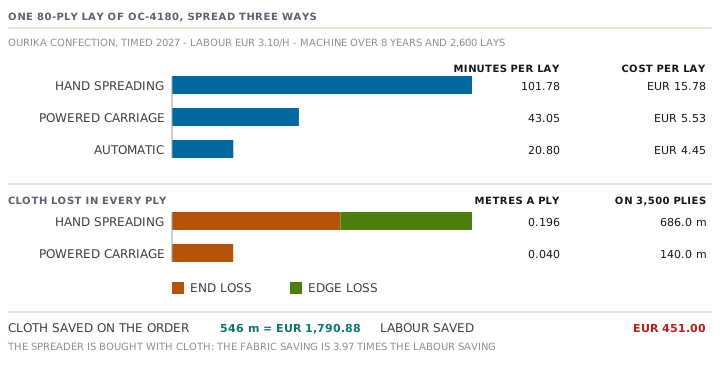
| Hand spreading | 9 m/min | 0.25 min | 1.27 | 101.78 | 3 |
| Powered carriage | 22 m/min | 0.12 min | 0.54 | 43.05 | 2 |
| Automatic | 46 m/min | 0.06 min | 0.26 | 20.80 | 1 |
Now turn that into money. Labour is minutes per lay times people, at EUR 3.10 an hour. The machine charge is the purchase price spread over an eight-year life and over the 2,600 lays Ourika's cutting room spreads in a year, plus its measured power and maintenance.
| Class | Labour | Machine, per lay | Total per lay |
|---|---|---|---|
| Hand spreading | 15.78 | nil | 15.78 |
| Powered carriage | 4.45 | 0.88 depreciation plus 0.20 power and maintenance | 5.53 |
| Automatic | 1.07 | 2.93 depreciation plus 0.45 power and maintenance | 4.45 |
Read the total column and you would say the automatic beats the carriage by EUR 1.08 a lay. Across 2,600 lays that is EUR 2,808 a year. That is real money, and it is nowhere near enough to justify a machine costing three times as much. The conclusion is right, and it is right for the wrong reason. The case for the automatic at Ourika is not the euro. It is the 22.25 minutes of table time it hands back on every lay. Across 2,600 lays that is 964.4 table-hours a year, in a cutting room whose tables are the bottleneck every time the sewing floor asks for a style early.
Now notice what did not appear in that table.
What the spreader is actually bought with
A spreader wastes or saves cloth in two ways. You can measure both in one afternoon.
End loss. Every ply needs a little cloth beyond the marker at each end, so the knife has somewhere to start and finish. On the powered carriage, an automatic end cutter takes that to a repeatable 0.04 m a ply. Yassine Berrada's team cut the same ends by hand with shears. Across a week of measurement they averaged 0.11 m a ply. That is not carelessness. It is the difference between a blade in a guide and a blade in a hand.
Edge loss. The marker is planned to the cuttable width. A photocell edge guide holds one selvedge on a line, so Nadia's marker maker can plan to the full 1.48 m. Hand spreading wanders, so the same marker has to be planned 1.5 cm narrower to be safe. That is a cuttable width of 1.465 m. The pieces still need the same area, so the marker gets longer in proportion.
marker at 1.465 m cuttable = 8.40 x 1.48 / 1.465 = 8.486 m
extra cloth                = 8.486 - 8.40        = 0.086 m a ply
Price both losses on the 3,500 plies of OC-4180.
| Where the cloth goes | Hand | Powered carriage | Difference | At EUR 3.28 a metre |
|---|---|---|---|---|
| End loss, per ply | 0.11 m | 0.04 m | 0.07 m | |
| End loss, 3,500 plies | 385.0 m | 140.0 m | 245.0 m | EUR 803.60 |
| Edge loss, per ply | 0.086 m | nil | 0.086 m | |
| Edge loss, 3,500 plies | 301.0 m | nil | 301.0 m | EUR 987.28 |
| Total | 546 m | EUR 1,790.88 |
The whole order takes 3,500 plies at 8.44 m. That is 29,540 m of cloth, costing EUR 96,891.20. So the difference between the two spreading methods is 1.85% of the fabric on the order.
Now set that beside the labour. 44 lays at EUR 15.78 against 44 lays at EUR 5.53 saves EUR 451.00 of labour on the whole order. The cloth saved is EUR 1,790.88. That is 3.97 times the labour.
What the fabric forces on you
The cycle model above assumed face-to-face spreading. Plenty of cloth will not allow it. Which spreader you own decides what that costs.
A nap or a directional print forces face-one-way. Every ply is laid in the same direction, the cloth is cut at the end of every ply, and the carriage returns empty. Ourika's brushed-back sweatshirt fleece, style OC-3960, is spread this way. Put it through the same model, at a 22 m/min laying speed, a 40 m/min empty return, and 0.15 min to cut and clamp. A ply costs 0.80 min against 0.54 face to face. That is 1.48 times as long. Course 5.2 prices what that does to a knit order's table hours and its ship date. The machinery question here is narrower, and it comes first.
Face-one-way is not a mode a hand spread has. Without a powered carriage there is no empty return. Somebody walks the cloth back, so the return traverse costs the same as the laying traverse, and the penalty roughly doubles instead. A cutting room that hand-spreads directional cloth is not doing the same job more slowly. It is doing a different and worse job.
A turntable turns a face-one-way problem into a face-to-face one, for some cloth. If the roll can be turned end for end at the end of each traverse, the nap stays in one direction while both traverses lay cloth. This works where the fabric is symmetrical across its width and the roll is light enough to turn. It does not work on a heavy roll, or on a cloth with a one-way print along its length. Ask which of those two cases you actually have before paying for the turntable.
Tubular knit needs a cradle feed. A tube pulled off a roll on a bar takes tension unevenly around its circumference, and it spirals as it lands. It has to be fed from a cradle or a folded bin, with no tension, or slit and spread open-width. This is a machine attachment, not a technique. A spreader without a cradle cannot spread tubular knit properly, however carefully the operator works.
Ply height: which limit is really binding
Every cutting room has a ply limit for each fabric. Most people believe the limit comes from the knife. At Ourika it almost never does.
| Fabric | Working ply limit | Compressed thickness a ply | Lay height at that limit | What sets the limit |
|---|---|---|---|---|
| Cotton poplin 110 g/m² | 120 | 0.28 mm | 33.6 mm | The cloth slides before the knife runs out of stroke |
| Cotton twill 240 g/m² | 80 | 0.55 mm | 44.0 mm | Measured accuracy at the bottom ply |
| Brushed fleece 300 g/m² | 40 | 2.10 mm | 84.0 mm | Loft: the lay compresses under the presser foot and springs back after the cut |
| Coated nylon 90 g/m² | 30 | 0.32 mm | 9.6 mm | Plies slip on each other and the lay walks under the blade |
Ourika's straight knives cut 165 mm below the presser foot. Not one of the four limits is anywhere near that. The lofty fleece, the fabric that looks like a height problem, gets closest at 84.0 mm. That is still only half the machine's reach. Its limit is not height at all. It is that a compressed lofty lay is a different shape from a relaxed one.
So on ordinary apparel cloth the knife's stroke is a theoretical limit, and the cloth is the real one. A cutting room that raises its ply height because the machine can take it is buying accuracy problems in exchange for table time it has not priced. The number to argue about is the measured accuracy at the bottom ply, and lesson 2 measures it.
Check yourselfOurika is quoted EUR 61,000 for an automatic spreader for table 1, which spreads 1,100 lays a year. Table 1 already has a powered carriage. Using this lesson's figures, what is the annual cash case, and what would you have to know before recommending it?Show the answer
On cost per lay, the automatic beats the carriage by EUR 1.08. So 1,100 lays returns EUR 1,188 a year against a machine costing EUR 61,000. On cash alone it cannot be defended. The real case is the 22.25 minutes of table time a lay, which is 1,100 times 22.25 = 24,475 minutes, or 407.9 table-hours a year. Whether that is worth EUR 61,000 depends on something this lesson does not tell you: whether table time is really the bottleneck at Ourika, and what an hour of it is worth when the sewing floor is waiting. If the tables are not the bottleneck, the released hours are worth nothing and the answer is no. Both spreaders control cloth the same way, so there is no fabric saving in this comparison at all. That is exactly why it is the harder case.
Check yourselfA supplier tells you their spreader will save a factory 3% of its fabric. What is wrong with the claim as stated, and what would make it checkable?Show the answer
It has no mechanism attached to it, so there is nothing to verify or refute. A spreader saves cloth through two named mechanisms. End loss depends on how the ply end is cut. Edge loss depends on how well one selvedge is held. Each is a measurable number of metres per ply on your own cloth. Ask which mechanism the 3% comes from, and what it was measured against. At Ourika the honest figure is 1.85%, it is measured against hand spreading rather than against another machine, and it is two parts you can each go and measure. A percentage with no mechanism and nothing to compare against is a brochure, not a measurement.
Prompt · Build the spreader case in metres, not head-count
When a spreading machine is being proposed or refused, and the argument is about how many operators it replaces.
Help me build the case for a spreading machine on my own numbers. I will give you: my marker length and the run-off allowance at each end, the laying speed and turn time for each option I am comparing, how many people each option needs on the table, my fully loaded cutting-room labour rate an hour, the purchase price and expected life of each machine, and the number of lays my cutting room spreads in a year.

First build the cycle model and show it. Give me minutes a ply, minutes for a lay of the ply height I tell you, man-minutes, labour cost a lay, machine cost a lay, and total cost a lay for each option.

Then do the part nobody does. Ask me for two measurements if I have not given them: my end loss in metres a ply on each option, and how much narrower than the cuttable width my marker has to be planned on each option. Convert the width difference into extra marker length in proportion. Then price both losses, in metres and in money, across the plies in my order. Show that total next to the labour difference, so I can see which is bigger.

Finish with a simple payback on the machine using the fabric saving, the labour saving and the running cost. Say in one line that it is a simple payback: it ignores the cost of money, and it ignores the option of buying the same machine later.

Three rules. If I have not measured a loss, leave the row blank and say it is missing, rather than filling it with a typical figure. Do not quote me any vendor throughput or fabric-saving percentage. And if the machine only wins on released table hours, say so plainly and ask me whether table time is really my bottleneck before you call it a saving.
AI can make mistakes — check anything you act on.