Lessons · Lesson 2 of 3
Five ways to cut the same lay
What each class of cutting machine is accurate to, what an hour of it costs once depreciation and consumables are in, and how to find the volume at which an automatic cutter becomes the cheaper answer.
Lesson 2 of 3 · 40 min
The same lay, five machines
Once the layers are stacked, something has to cut through them. There is more than one kind of blade for the job. Each blade is held differently, and that decides how far the bottom cut wanders from the top line. That wander is the accuracy figure that matters, because the bottom pieces become garments too. This lesson prices each machine by the hour, then asks when the expensive one is the cheap answer.
Nadia Benjelloun's cutting room owns four cutting machines and has borrowed a fifth. All five could cut an 80-ply lay of OC-4180. They are accurate to different amounts, they cost different amounts an hour, and the two differences do not point the same way.
Start with the mechanism, because the accuracy follows from it.
| Machine | How it cuts | Why its accuracy is what it is |
|---|---|---|
| Straight knife | A vertical blade moving up and down in a frame the operator pushes along the marker line | The blade is guided at the top and free at the bottom, so it bends sideways under load. What you get at the bottom ply is not what you drew |
| Round knife | A rotating circular blade driven by a motor over the lay | The blade meets the cloth along a straight chord, so it cannot follow a curve tighter than its own radius. Its shape makes it a straight-line and shallow-curve machine |
| Band knife | A continuous loop of blade running through a fixed slot; the work is carried to the blade | The blade is guided above and below the cut, so it cannot bend. The operator moves the cloth, not the blade |
| Die press | A steel-rule die pressed through the lay onto a board | The shape is the die's, not the operator's, so it does not vary from stroke to stroke or from person to person |
| Automatic conveyor cutter | The lay is sealed under film, held down by vacuum on a bristle bed, and a computer-controlled head with a blade, a drill and a notcher follows the marker file | The vacuum stops the plies moving, and the head has no operator steering it, so the error is the machine's repeatability rather than a person's hand |
Soraya Lahlou measured the first thing that matters, on the cloth this order is cut from. That is the sideways gap between the top ply and the bottom ply of an 80-ply twill lay, taken on the same reference notch, over ten lays each.
| Machine | Top-to-bottom gap | What it does on this lay | Minutes |
|---|---|---|---|
| Round knife | not applicable | Blocks the lay into five blocks, including placing and squaring the marker | 12 |
| Straight knife | 3.6 mm | Cuts the bulk: legs, back panels, waistband strip | 38 |
| Band knife | 0.8 mm | Cuts the blocked small parts: fly, pocket facings, belt loops, coin pocket | 51 |
| Die press | 0.4 mm | Cuts one repeated shape at 30 plies a stroke | see below |
| Automatic cutter | 0.9 mm | Cuts the whole lay, notches and drilled holes included | 21 |
Two rows in that table are worth stopping on. The band knife is more accurate than the automatic cutter, which surprises people who assume computerised means better. It is more accurate because its blade physically cannot move sideways, and that has nothing to do with electronics. And the die press is the most accurate of all, and it can make only one shape. Its accuracy comes from tooling, not from control.
What an hour of each machine costs
An hourly machine rate is a made-up number unless you say what is inside it. Ourika builds every rate the same way: purchase price divided by a stated life and by the hours that machine actually runs in a year, plus consumables, plus power, plus the operator.
| Machine | Price | Life | Hours a year | Depreciation an hour | Blades and consumables | Power | Operator | Rate an hour |
|---|---|---|---|---|---|---|---|---|
| Round knife | 780 | 6 years | 1,000 | 0.13 | 0.15 | 0.10 | 3.10 | 3.48 |
| Straight knife | 1,150 | 6 years | 1,600 | 0.12 | 0.28 | 0.12 | 3.10 | 3.62 |
| Band knife | 2,900 | 8 years | 1,400 | 0.26 | 0.11 | 0.08 | 3.10 | 3.55 |
| Die press | 9,400 | 10 years | 900 | 1.04 | dies costed separately | 0.06 | 3.10 | 4.20 |
| Automatic cutter | 214,000 | 8 years | 2,900 | 9.22 | 4.85 plus 3.31 maintenance contract | 1.55 | 3.10 | 22.03 |
The automatic cutter's rate is 6.1 times the straight knife's, and almost all of that gap is the purchase price. That is the shape of the whole decision, and it is why the next section is arithmetic rather than opinion.
Put the rates against the minutes and you get the cost of cutting one lay two ways.
manual route     round knife  12 min x EUR 3.48/h = EUR 0.70
                 straight     38 min x EUR 3.62/h = EUR 2.29
                 band knife   51 min x EUR 3.55/h = EUR 3.02
                                                  = EUR 6.01 a lay

automatic route  21 min x EUR 22.03/h             = EUR 7.71 a lay
So the automatic costs EUR 1.70 more a lay, and gives back 29 minutes of cutting-table time: 50 minutes on the lay against 21. It also removes the second handling of every small part, because the band-knife work disappears into the same pass.
The crossover volume, and how to work it out
Fixed cost is what Ourika pays in a year no matter how many lays go through: depreciation, and for the automatic cutter its maintenance contract. Variable cost is what one more lay costs: consumables, power and the operator on it.
| Manual route | Automatic route | |
|---|---|---|
| Depreciation a year | 684 | 26,750 |
| Maintenance contract a year | in the hourly consumables | 9,600 |
| Fixed a year | 684 | 36,350 |
| Consumables, power and operator, per lay | 5.69 | 3.33 |
manual a year     =    684 + 5.69 x lays
automatic a year  = 36,350 + 3.33 x lays

equal when  36,350 - 684 = (5.69 - 3.33) x lays
            35,666 = 2.36 x lays
            lays   = 15,112
Ourika cuts 2,600 lays a year. The crossover is 5.8 times that. At its real volume the automatic route costs EUR 45,008 a year against the manual route's EUR 15,478. That is EUR 29,530 more.
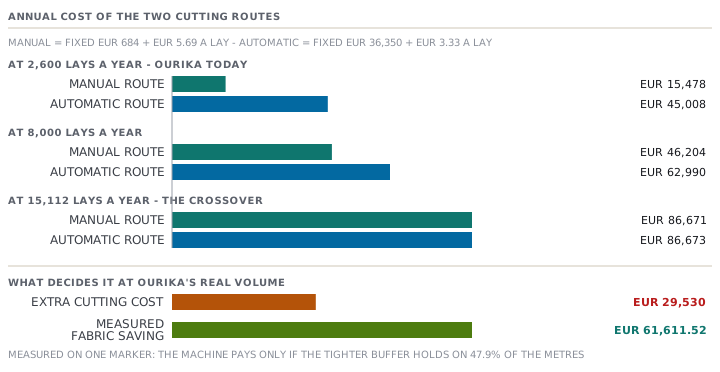
That is the honest answer on cutting cost, and it is the answer at every wage level like Ourika's. An automatic cutter is never bought with cutting labour. So the case has to come from somewhere else. There is exactly one place where it is large enough to matter.
The saving that changes the answer, and the share you have to prove
A straight knife bends, so a marker cut with one has to carry a safety margin around every piece. Ourika's marker maker plans 3 mm of margin on this style. On the borrowed automatic cutter, holding 0.9 mm, Nadia's team replanned the same marker with a 1 mm margin and measured what it did to the length.
marker with 3 mm margin   8.40 m
marker with 1 mm margin   8.31 m
saving                    0.09 m a marker = 1.07%
Ourika's cutting room puts 1,755,520 m of cloth on its tables in a year: 2,600 lays at 80 plies at 8.44 m. If the 1.07% held everywhere, that is 18,784 m, or EUR 61,611.52 a year at EUR 3.28 a metre. Against EUR 29,530 of extra cutting cost, the machine wins comfortably.
It held on one marker of one style, and that is all anybody has measured. So do not apply it everywhere. Turn it round and ask the question that can actually be checked.
breakeven share = 29,530 / 61,611.52 = 47.9% of the metresThe automatic cutter pays for itself at Ourika if the tighter margin holds on more than 47.9% of the cloth it cuts. That is a single number an owner can send somebody to verify. Take a year's markers, mark each style as one where the margin binds or one where it does not, and weigh them by metres. If the answer comes back at 40%, the fabric saving is EUR 24,644.61 and the machine loses EUR 4,885.39 a year.
Tooling: when a die is worth cutting
The die press is different from the other four, because the machine is cheap and the tooling is the decision. A steel-rule die is one shape, made once, and it earns back over the pieces it cuts.
OC-4180 has a coin pocket: one small piece a garment, 42,000 of them. There are two ways to cut it, both on machines Ourika already owns.
| Die press | Band knife | |
|---|---|---|
| Plies at a time | 30 a stroke | 40 a block |
| Operations | 1,400 strokes | 1,050 blocks |
| Time each | 0.25 min | 0.9 min |
| Total time | 350 min | 945 min |
| Machine rate | EUR 4.20 an hour | EUR 3.55 an hour |
| Running cost | EUR 24.50 | EUR 55.91 |
| Tooling | EUR 290 for the die | nil |
The die is cheaper to run by EUR 31.41 on a run of this size, and the die costs EUR 290.
runs to pay for the die = 290 / 31.41 = 9.23 runs of 42,000
                        = 387,660 pieces of that exact shape
At 42,000 pieces the die is nowhere near worth cutting on cost. It is worth cutting on accuracy, because 0.4 mm never varies, if something later in the process needs it. On this pocket nothing does. Ourika refused the die.
Then Veldkamp asked for a workwear trouser as a standing programme: the same coin pocket, 420,000 pieces a year, unchanged season to season. That crosses the line in the first year, and the reason it crosses is the thing to notice. Nothing about the machine changed, and nothing about the shape changed. Only the number of times the shape repeats. A tooling decision looks like an engineering decision. It is a volume decision.
Check yourselfA second factory runs 4,800 lays a year and pays EUR 9.40 an hour for cutting labour. Using this lesson's method, does the crossover move towards the automatic cutter or away from it, and by roughly how much?Show the answer
Towards it, because labour sits in the variable cost of both routes, but the manual route uses far more of it: 101 minutes of machine-attended labour a lay against 21. Rebuild the two variable costs at EUR 9.40 rather than EUR 3.10. The manual route's variable cost rises to about EUR 16.29 a lay and the automatic's to about EUR 5.53. So the gap widens from EUR 2.36 to about EUR 10.76, and the crossover falls from 15,112 lays to roughly 3,315. At 4,800 lays that factory is past the crossover, and the machine pays on cutting cost alone, before any fabric saving. This is why the same machine is obviously right in one country and obviously wrong in another. It is also why a payback period quoted without the wage rate it assumed means nothing.
Check yourselfA vendor's proposal says the automatic cutter will save 3% of fabric. On the evidence in this lesson, what is the largest fabric saving you can defend, and what would you say to the vendor?Show the answer
The mechanism Ourika measured is the safety margin around each piece, and replanning from 3 mm to 1 mm shortened one marker by 1.07%. That is the defensible figure. It applies only to markers where the margin actually binds, and it is a fifth of the vendor's number rather than a third of it. Ask the vendor which mechanism their 3% comes from, and on which cloth and marker it was measured. If the answer is a better nesting of pieces, that is the marker-making software rather than the cutter, and it can be bought separately and much more cheaply. Never accept a fabric percentage without a named mechanism, because a percentage with no mechanism cannot be tested against your own markers.
Prompt · Find the volume at which an automatic cutter starts to win
Before signing for, or refusing, a computerised cutter — and any time a payback period arrives without the wage rate it assumed.
Model the choice between my current manual cutting route and an automatic cutter, and find the crossover volume.

For every machine in my manual route I will give you: purchase price, expected life, hours a year it actually runs, blade and consumable cost an hour, power an hour, and the minutes it spends on one lay of the order I am costing. For the automatic cutter I will give you: purchase price, life, expected hours a year, maintenance contract a year, consumables and power an hour, and the minutes it takes on the same lay. Plus my fully loaded cutting labour rate.

Build an hourly rate for every machine with each part of it visible. Then show the cost of one lay on each route. Then say plainly, in one sentence, why cost per lay is the wrong tool for a buy decision. Split both routes into fixed cost a year and variable cost a lay. Solve for the crossover in lays a year, and compare it with my actual volume as a multiple.

Then the fabric question, because it usually decides the answer. Ask me what safety margin my markers carry around each piece on the manual route, what margin the automatic would allow, and the measured change in marker length between the two on at least one real marker. Convert that to metres and money across my annual metres. Then work out the breakeven SHARE: what fraction of my metres the tighter margin must hold on for the machine to pay. Present that as the number I have to go and verify.

Finally, list everything the model could not price — styles I could then quote, recuts prevented, marker-making time added — and mark each one unknown. Do not estimate them, and do not leave them out, because leaving them out values them at zero. Never give me a payback period without restating the labour rate it assumed.
AI can make mistakes — check anything you act on.