Lessons · Lesson 1 of 3
Four variables, and one that is not on the dial
What a fused bond is, why the number on a press display is not the number at the glue line, and how one afternoon with a temperature probe settles the argument.
Lesson 1 of 3 · 40 min
The factory, the order, the basis
The stiffness in a shirt collar is not the cloth. It is a second, lighter cloth glued to the back of it. That second cloth is called the interlining. The glue is a plastic printed on it in tiny dots, melted, then left to set. The glued join is called the bond. A bad bond looks exactly like a good one, and shows itself weeks later in a customer's wash. This lesson is about the machines that make that bond, and how a factory finds out what happened inside.
Talhouni Shirtworks makes men's shirts in the Sahab industrial estate outside Amman. It employs 410 people. It runs six sewing lines, one cutting room, one fusing room and one finishing hall. Everything in this course happens between the fusing room and the loading bay. That is the hot end of the building, where the shirt is already made and can still be ruined.
Four people appear.
- Rana Talhouni owns the factory and signs for machines.
- Ihab Masri runs the finishing hall.
- Dalia Qutub is the industrial engineer. She owns the time studies and the cost models.
- Sameer Hijazi is the chargehand on the fusing press.
The order carried through all three lessons is TS-7720 for Brackenhoff, a German menswear chain: 36,000 men's formal shirts in a 120 g/m² cotton poplin, autumn 2027.
Say the basis once, because every figure below depends on it. All money is US dollars. Fusing and finishing labour is USD 2.40 an hour fully loaded. Fully loaded means the wage plus social charges plus a share of supervision. The figure comes from Talhouni's own 2027 payroll, not from a country average. That is USD 0.04 a minute, and it is the multiplier under almost everything here. The factory's own electrician costs USD 3.60 an hour. The hall works 8 productive hours a day, 250 days a year. So a machine that runs whenever the hall runs has 2,000 hours available in a year. Machine costs are built from Talhouni's own quotations and its own meter readings: purchase price divided by a stated life, plus power, consumables and maintenance, each one named.
One shirt costs USD 3.48 of cloth, which is 1.62 m at USD 2.15. Add USD 2.10 to make it and USD 0.55 of trims, and one shirt costs USD 6.13. Ex-factory it sells at USD 6.85, which leaves USD 0.72 of margin a shirt. That is USD 25,920 on this order, and USD 302,400 across the 420,000 shirts Talhouni ships in a year. A shirt rejected and sold off recovers USD 1.90, so a reject loses USD 4.95.
Four pieces on every shirt are fused: the top collar, the collar band and two cuffs.
| Component | Interlining area | Cost at USD 1.35 a square metre |
|---|---|---|
| Top collar | 0.028 m² | 0.0378 |
| Collar band | 0.014 m² | 0.0189 |
| Two cuffs | 0.034 m² | 0.0459 |
| One shirt | 0.076 m² | 0.1026 |
Across TS-7720 that is USD 3,693.60 of interlining. It is the cheapest material on the shirt, and the only one that can make the shirt worthless.
What a bond actually is
Course 2.5 covers interlinings as a material: woven against non-woven, the resin dot, and the fusing triangle of temperature, pressure and dwell. Read it for the cloth. This lesson is about the machine, and the machine adds a fourth variable the triangle leaves out.
A fusible interlining is a base cloth carrying a heat-softening plastic, called a resin, printed on one face as dots. Fusing is four things happening in order.
- Heat raises the resin past the temperature at which it flows. It does not cure, dry or react. It melts, and it will melt again every time it is taken back past that temperature. That is the whole of lesson 2's problem.
- Pressure pushes the melted resin off the dot and into the gaps between the yarns of the face fabric. Too little, and the resin sits on the surface. Too much, and it goes all the way through and shows on the face.
- Dwell is the time the resin spends melted and under pressure. It is what lets the melt soak into the fibres instead of only touching them.
- Cooling under restraint is what turns melted resin into a bond. A pack lifted out hot and stacked is still liquid at the glue line. It sets inside the stack, under the weight of the stack, in whatever position the stack put it. The bond you get is not the bond the press made.
Most people list three. The fourth is the one that separates the machine classes, because cooling is not a dial. It is a section of the machine, or it is absent.
| Class | Heat | Pressure | Dwell | Cooling under restraint | Purchase price, USD |
|---|---|---|---|---|---|
| Steam iron on a table | Not controlled at the cloth | Whatever the operator's arm applies | Whatever the operator counts | None | 260 |
| Flat-bed platen press | Plate set point, one sensor | Set in bar, and even across the bed | A timer, repeatable to the second | None. The pack is lifted out hot | 4,600 |
| Continuous belt press | Set point, one sensor, several heater banks | Belt tension against a heated bed | Heated length divided by belt speed | A chilled section the pack passes through, still held between the belts | 38,500 |
Read the cooling column on its own. The steam iron and the platen press hand the same problem to the operator: get the pack off the machine and let it cool flat and undisturbed before anything is stacked on it. That is a rule someone has to remember, and rules like that get forgotten late in the shift. The belt press does not need the rule, because the pack is still held flat when it stops being liquid.
What each machine can actually make in an hour
Talhouni owns three platen presses and has been quoted for one belt press. Dalia Qutub timed both.
The platen press. The bed is 800 by 550 mm, which holds 6 pieces laid out. The cycle is load 22 seconds, closed dwell 18 seconds, open and unload 14 seconds. That is 54 seconds in all.
cycles an hour  = 3,600 / 54          = 66.67
pieces an hour  = 66.67 x 6           = 400
shirts an hour  = 400 / 4 fused pieces = 100
Two people work it. One loads, one takes off and stacks.
The belt press. Working width 900 mm, heated zone 1,400 mm long, belt speed 6 m/min.
dwell = heated length / belt speed
      = 1.4 m / 6 m/min = 0.2333 min = 14.0 seconds
The belt itself can carry a great deal. Pieces go on three across the width, spaced 0.30 m apart along the belt. So the belt could carry 3 times 6,000 divided by 300, which is 60 pieces a minute, or 3,600 an hour. It never does. Dalia timed the two feeders at 11.5 pieces a minute each, so the machine is fed at 23 a minute. That is 1,380 pieces an hour, 345 shirts an hour, and 38.3% of what the belt could carry.
That gap is the most useful number on the page. The limit on a continuous press is almost never the belt. It is the hands putting pieces on it. A proposal that quotes belt capacity is quoting a number the factory will never see. And a factory that answers a queue by turning the belt up is speeding an empty conveyor.
| Three platen presses | One belt press | |
|---|---|---|
| Shirts an hour | 100 | 345 |
| Hours needed for 420,000 shirts a year | 4,200 | 1,217.4 |
| Machines needed | 3, because one covers 200,000 shirts a year | 1 |
| Capital, USD | 13,800 | 38,500 |
| Depreciation a year, USD | 1,725, over 8 years | 3,850, over 10 years |
| Maintenance contract a year, USD | none | 1,400 |
| Power and consumables an hour, USD | 0.43 | 1.39 |
| People on the machine | 2, at USD 4.80 an hour | 3, at USD 7.20 an hour |
| Labour a year, USD | 20,160 | 8,765.28 |
| Power and consumables a year, USD | 1,806 | 1,692.19 |
| Total a year, USD | 23,691 | 15,707.47 |
| Cost a shirt, USD | 0.0564 | 0.0374 |
The belt press saves USD 7,983.53 a year for an extra USD 24,700 of capital. The money comes back in 3.1 years. That is a real case and a modest one, and it is not the case Rana Talhouni signed on.
Note the row of hours. The belt press does the whole year's fusing in 1,217.4 of its 2,000 available hours, so 782.6 hours are spare. Hold that figure. The argument at the end of this lesson spends some of it.
Why the dial is not the temperature at the glue line
A press display shows the temperature of a sensor inside the heated bed. The glue line is inside a sandwich of face fabric and interlining travelling over that bed. Between the two there is a belt, a layer of cloth, and a few seconds. The glue line always lags behind. How far behind depends on the cloth weight, how heavily the belt is loaded, the belt speed, and whether every heater element is still alive.
Course 2.5 recommends a colour-change strip run through with the panels. It changes colour once, at a known temperature, and it costs almost nothing. It answers one question: did the glue line reach the threshold at any point on its journey? It cannot answer the question the machine actually poses, which is for how long, and in which lane across the belt.
A thermocouple answers both. A thermocouple is a fine wire probe that reports temperature continuously. You tape a type-K probe between the shell and the interlining of a scrap pack, feed the pack through the belt with the production, and let a logger record temperature against time. What comes out is a curve: how fast the glue line climbed, what peak it reached, how many seconds it spent above the resin's flow temperature, and how fast it cooled on the way out.
Talhouni's interlining supplier states a window on the technical data sheet for the roll: 10 seconds above 128 degrees Celsius. That is a supplier's figure for that resin, not a standard, and it is the number the whole audit is measured against.
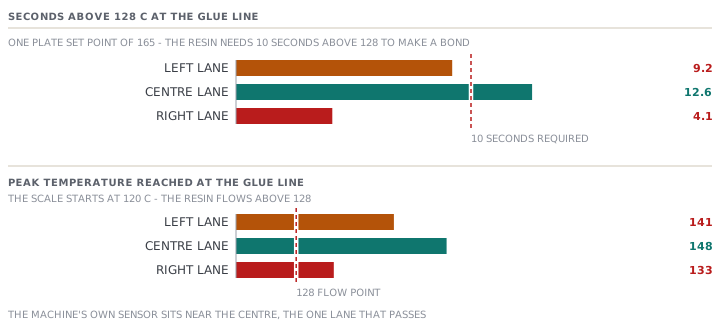
On 14 March, Dalia Qutub ran three probes across the 900 mm belt, with the plate set point at 165 and the belt at 6 m/min.
| Lane across the belt | Plate set point | Peak at the glue line | Seconds above 128 degrees | Against the 10 seconds required |
|---|---|---|---|---|
| Left, 150 mm in from the edge | 165 | 141 | 9.2 | Short by 0.8 |
| Centre | 165 | 148 | 12.6 | Passes |
| Right, 150 mm in from the edge | 165 | 133 | 4.1 | Short by 5.9 |
One dial, three answers, and a spread of 15 degrees across 900 millimetres of belt. The machine controls on a single sensor near the centre, which is the one lane that passes. Nothing on the display was wrong. Nothing on the display was informative either.
The cause took the electrician 40 minutes to find. One of the six elements in the right-hand heater bank had failed. The press has no alarm for a single element. It has one thermostat, and the thermostat was reading the lane that still worked.
The same fault, priced at two stations
The right-hand lane was where Sameer Hijazi's feeders put the cuffs. It ran under-bonded for three days before a washed test piece came back failed. That is 8,280 shirts' worth of cuffs, at 345 shirts an hour over three eight-hour days. Of those, 5,140 had been sewn, pressed and inspected. The other 3,140 were still loose panels.
Found at the press, the fault costs a heater element and part of a morning.
| Basis | Cost, USD | |
|---|---|---|
| Heater element | one, from stock | 210.00 |
| Electrician | 1.4 h at USD 3.60 | 5.04 |
| Press stopped | 1.4 h at USD 1.39 of power and consumables, out of 782.6 spare hours | 1.95 |
| Total | 216.99 |
Found at final inspection, which is where it was actually found, it costs this.
| Basis | Cost, USD | |
|---|---|---|
| Remake the cuffs on made-up shirts | 5,140 shirts at 9.4 min, at USD 0.04 a minute | 1,932.64 |
| Replacement cuff cloth and interlining | 5,140 at USD 0.3469 | 1,783.07 |
| Shirts damaged beyond recovery in the unpick | 4.2% of 5,140, so 216, at USD 4.95 | 1,069.20 |
| Re-fuse the loose panels | 6,280 pieces at 1,380 an hour, so 4.55 h at USD 12.90 | 58.70 |
| Panels lost to resin pushed through on the second pass | 7.5% of 6,280, so 471, at USD 0.17345 | 81.70 |
| Re-cut and handle those panels | 471 at 0.8 min, at USD 0.04 a minute | 15.07 |
| Late-shipment discount | 3% of ex-factory on 8,280 shirts | 1,701.54 |
| Total | 6,641.92 |
Found at final inspection, the fault costs 30.6 times what it costs at the press. Set that against the cost of running the test at all. A thermocouple and a logger cost USD 480 and last five years, which is USD 96 a year. A 14-minute run at the start of each of Talhouni's 750 fusing lots a year is 175 hours of Dalia's time, or USD 420. Together, USD 516 a year. One event pays for 12.9 years of it, and the 175 hours come out of the 782.6 the press was not using.
The fault also cost 25.6% of the whole order's margin, on a shirt part costing about 10 cents.
Check yourselfA supplier offers Talhouni a belt press with a built-in readout that shows the pack's glue-line temperature continuously. Using this lesson's figures, what is that worth, and what would you still have to buy?Show the answer
It is worth the difference between finding the March fault on the morning it started and finding it three days later. That is USD 6,641.92 less USD 216.99, so USD 6,424.93 on that one event. Talhouni has no measurement of how often such an event happens, so the value over a year is unknown rather than zero. But read what the readout actually measures. A single built-in sensor reads one point, and the fault was a 15-degree spread across the belt width that the machine's existing single sensor could not see either. Unless the readout is three sensors across the width, or unless it reports seconds above a threshold instead of a temperature right now, it is a better version of the instrument that already failed. You would still buy the thermocouple pack, because it is the thing that measures across the width and against a duration. At USD 516 a year it is not competing with the press for budget.
Check yourselfWhy does the platen press need a written cooling rule and the belt press does not, and what does that do to a comparison based on cost a shirt?Show the answer
Because cooling under restraint is the fourth variable, and it is a section of the machine rather than a setting. The belt press holds the pack between its belts through a chilled section, so the resin sets flat and held down whatever the operator does. The platen press hands the pack out hot and still liquid at the glue line, so the bond is made in whatever the pack is put onto. Flat on a cool table, it is fine. Stacked 20 deep on a warm trolley, it is not. The cost comparison in this lesson gives the belt press USD 0.0374 a shirt against USD 0.0564, and the money back in 3.1 years. None of that arithmetic contains the fourth variable at all, because a cost model prices what a machine does when everything goes right. The bond failure priced at USD 6,641.92 is what the fourth variable costs when it goes wrong once. That number belongs in the case, marked as one event with an unknown frequency. It does not belong spread into a per-shirt figure, because that would imply a rate nobody has measured.
Prompt · Audit one fusing press in seconds above the resin's threshold, not in dial settings
When a fusing press is suspected, when a bond has failed a wash test, or before signing for a new press whose specification is written in temperature.
Help me audit one fusing press properly. I will give you: the machine class and its working width, the plate or belt set point it runs at, the belt speed and heated length or the platen dwell time, the cloth and interlining on the lay, and the window my interlining supplier states on the technical data sheet for the roll. That window is a temperature AND a number of seconds. If I only give you a temperature, ask me for the seconds before you go any further.

First build the measurement plan. Tell me how many thermocouple probes to run across the working width and where to place them. Tell me why one probe in the centre cannot answer the question. Tell me what the logger has to record: the peak at the glue line, the seconds above the supplier's threshold, and the cooling rate on the way out.

Then, when I bring you the traces, build a lane-by-lane table: set point, peak, seconds above the threshold, and either pass or short by how many seconds against the supplier's figure. Give me the spread across the width in degrees. Say plainly whether that spread is larger than my instrument's own tolerance. If it is not, the result is inconclusive and you must say so rather than reading anything into it.

Then price the same fault twice: once caught at the press on the morning it starts, and once caught at final inspection after however many days I tell you it ran. Use my own labour rate a minute, my own reject recovery value, and my own late-shipment penalty if I have one. Show the ratio between the two.

Four rules. Never quote me a temperature or a dwell time from anywhere except my own supplier's data sheet. The resin decides, not a handbook. If I have not measured the cooling side, leave it blank and say it is missing. Do not turn a one-off event into a cost per garment, because that implies a frequency nobody has measured; state it as one event and mark the frequency unknown. And if I ask whether sorting the made-up garments would be cheaper than remaking them, say that a sort cannot prove a bond, and that the honest word for the unsorted remainder is not proven.
AI can make mistakes — check anything you act on.