Lessons · Lesson 2 of 3
Pressing shapes, finishing tidies
What under-pressing does that no final press can undo, which finishing machines take a fused shirt back past the temperature its resin flows at, and where a press cell stops being cheaper than a tunnel line.
Lesson 2 of 3 · 38 min
Two operations that share a name and share nothing else
Ironing a shirt at home is one job, done once, at the end. A factory is not like that. Heat and pressure go into the cloth again and again, at several points along the way. The machines that do it have nothing in common with a household iron, and none of them replaces another. This lesson sets out what each one can and cannot do, and what all that heat does to a collar that is already glued.
Talhouni Shirtworks presses a shirt twice, in two different places, for two different reasons. Only one of them appears in the finishing hall's cost.
Under-pressing happens inside the sewing lines, between operations. The collar is turned and its edge set before it is topstitched. The cuff is turned and set before it is closed. The front placket is creased before it is stitched down. The yoke seam is opened before the next seam crosses it. Each of these is a small iron or a small press standing beside the line, worked by the operator whose seam it is. Each one exists to make the next operation possible or accurate.
Final pressing happens at the end, after the last stitch. It exists to make the shirt look like the thing in the buyer's photograph.
The difference that matters is not where they happen. It is this: under-pressing cannot be done later, and final pressing cannot be done earlier. A collar edge that was not set before it was topstitched cannot be rescued by any final press, because the stitch line has already been laid along the wrong fold, and heat does not move a stitch. A shirt final-pressed before it is fully assembled will be handled, folded and creased again by the operations that follow.
Dalia Qutub timed both.
| Minutes a shirt | Where it is booked | What it produces | |
|---|---|---|---|
| Under-pressing, four line-side stations | 0.72 | The sewing lines' minutes | Accuracy in the next operation |
| Final pressing, the press cell | 1.90 | The finishing hall | Appearance in the carton |
| Both | 2.62 |
27.5% of the pressing on a Talhouni shirt is charged to sewing. At USD 0.04 a minute across 420,000 shirts, that is USD 12,096 a year of pressing labour that no finishing budget has ever seen. It is the first thing to find when somebody asks why the finishing hall costs what it does. It does not cost that. Part of the cost is somewhere else.
Four machine classes, and what each one can and cannot make
| Class | Mechanism | What it shapes | Can it make a sharp edge? |
|---|---|---|---|
| Vacuum table and hand iron | Steam through the soleplate, the operator's arm for pressure, air drawn down through the table | Anything, one small area at a time | Yes, and its quality is the operator's |
| Buck press | A shaped lower pad, called the buck, and a matching head. Steam is blown through both, the head closes under pressure, then air is pulled through the shirt | Only the part the buck is shaped for | Yes, and the same edge every time |
| Steam tunnel | The shirt hangs on a hanger and travels through a chamber of steam and then of hot air. Nothing touches it | Relaxes creases out of the body and the sleeves | No. Nothing presses it |
| Form finisher | The shirt is dressed onto a cloth dummy, which is blown up with steam and then with hot air from inside | The body's volume and drape | No |
Read the sharp-edge column. A steam tunnel and a form finisher cannot press a collar or a cuff, because an edge is made by pressure against a shaped surface and neither of them applies any pressure at all. You cannot engineer around that. It is what these machines are. Any route through the finishing hall that uses a tunnel for a formal shirt still needs a collar-and-cuff press. A proposal that leaves one out is a proposal for a different garment.
The number the presses are actually set by
A buck press has no temperature dial. It has a steam valve and a pressure gauge. Its temperature is decided by physics rather than by choice: steam in contact with its own water sits at the boiling temperature for its pressure. Nothing you do to the valve changes that relationship.
Talhouni's boiler runs at 6 bar gauge, which is 7 bar absolute, and that puts the steam at 165 degrees Celsius. The finishing hall's presses are fed through a reducing valve set to 4 bar gauge, which is 5 bar absolute, or 152 degrees.
| At the press | Absolute pressure | Steam temperature |
|---|---|---|
| 4 bar gauge | 5 bar | 152 |
| 5 bar gauge | 6 bar | 159 |
| 6 bar gauge | 7 bar | 165 |
The 165 in that table is the same number as the press display in lesson 1, and it is worth naming the coincidence rather than leaving it to trip somebody. One is a plate set point chosen by an operator. The other is a temperature nobody chose, fixed by the pressure the boiler is certified for. They mean entirely different things and they happen to be equal.
What each machine does to a shirt that has already been fused
Lesson 1's fourth variable was cooling under restraint. The point of it was that the resin melts again every time it is taken back past its flow temperature. Talhouni's interlining flows above 128 degrees. So the question for every machine in the finishing hall is one you can measure: does this operation take the glue line back above 128, and for how long?
Dalia Qutub taped the same type-K probe between the shell and the interlining of a collar band on a made-up shirt, and walked it through every machine in the hall.
| Operation | Medium temperature | Peak at the glue line | Seconds above 128 |
|---|---|---|---|
| Fusing press, centre lane, from lesson 1 | Plate at 165 | 148 | 12.6 |
| Collar-and-cuff buck press, 4 bar gauge, 12 seconds head-down | Steam at 152 | 138 | 6.8 |
| Collar-and-cuff buck press, 5 bar gauge, 12 seconds head-down | Steam at 159 | 149 | 14.2 |
| Steam tunnel, 96 seconds of travel | Chamber at 105 | 96 | 0 |
| Form finisher, 40 seconds | Air at 118 | 104 | 0 |
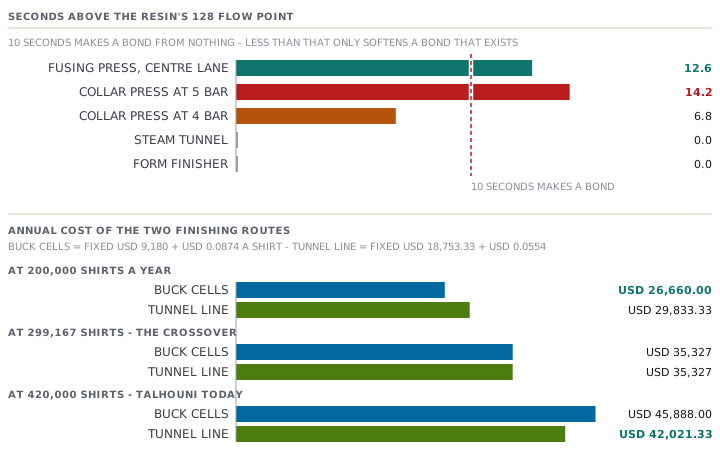
Three findings come out of that table, and they do not point the same way.
The buck press melts the bond again, then sets it under restraint. At 4 bar the glue line spends 6.8 seconds above the flow point. That is not enough to make a bond. The supplier's data sheet asks for 10 seconds, because the resin has to soak into fresh fibre and that takes time. But 6.8 seconds is plenty to soften a bond that already exists. What happens next is the thing worth noticing. The head stays down, and then the vacuum pulls room air through the shirt. That takes the glue line back below 128 while the collar is still held flat between two shaped surfaces. That is cooling under restraint, done by a machine nobody thinks of as a fusing machine.
So a buck press silently repairs weak fusing. A collar that came off the belt under-bonded, such as the 9.2-second left lane in lesson 1 against 10 required, goes under the collar press, is melted again, and is set flat under pressure and cooled by vacuum. It arrives at final inspection looking and behaving like a good collar, because in every way you can see, it now is one. Nobody records this, nobody costs it, and nobody knows how much of it is happening.
The tunnel and the form finisher do neither harm nor good. Neither gets closer than 24 degrees to the flow point. A bond that was weak when it entered is exactly as weak when it leaves. They cannot damage a bond, and they cannot mend one.
The same machine, turned up, becomes a defect
For four weeks in April the collar press ran at 5 bar gauge. A chargehand raised it to get through a run of a heavier oxford cloth, and nobody put it back. At 5 bar the glue line reaches 149 degrees and stays above the flow point for 14.2 seconds. That is longer than the fusing press's own 12.6 seconds, at a temperature 1 degree higher.
The resin had time to go somewhere, and it went to the face of the top collar as a faint shine. Resin pushed through to the outside face like that is called strike-through.
| Month | Setting | Shirts pressed | Top collars with shine | Rate |
|---|---|---|---|---|
| April, 20 working days | 5 bar gauge | 33,600 | 941 | 2.80% |
| May, 21 working days | 4 bar gauge | 35,280 | 106 | 0.30% |
The difference caused by the pressure is 2.50 percentage points, which on April's 33,600 shirts is 840 shirts.
A strike-through top collar cannot be repaired, because the resin is on the outside face where everyone will look at it. The collar is unpicked from the finished shirt and rebuilt.
| Basis | Cost, USD | |
|---|---|---|
| Unpick, re-cut, re-fuse and rebuild the collar | 840 at 16.4 min, at USD 0.04 a minute | 551.04 |
| Top collar cloth | 840 at 0.09 m at USD 2.15 | 162.54 |
| Interlining | 840 at 0.028 m² at USD 1.35 | 31.75 |
| Shirts spoiled in the unpick | 5.0% of 840, so 42, at USD 4.95 | 207.90 |
| Total | 953.23 |
USD 953.23, against lesson 1's USD 6,641.92 for a bond fault. The comparison is the lesson. A pressing fault puts a mark on the outside of the shirt, so it is found in the hall on the day it starts and it is over in four weeks. A bond fault is invisible until somebody washes the shirt, so it runs for three days and then travels to Germany. The visible defect is the cheap one. A factory that ranks its quality problems by how much they annoy the finishing hall will spend its attention in exactly the wrong order.
The 0.30% that remained in May is not zero, and nobody has found its cause. The record says unknown. That is a live question, not an acceptable background level.
Two routes through the hall, split into fixed and variable
Talhouni finishes 210 shirts an hour. Rana Talhouni has a quotation for a tunnel line and wants to know whether it beats the presses she owns.
Route A, three press cells. A cell is three presses worked by three people: collar and cuffs at 34 seconds, body and back at 42, sleeves and yoke at 38. So one person's work adds up to 114 seconds, or 1.90 minutes. But the cell's rate is set by its slowest station, so a cell produces 3,600 ÷ 42 = 85.7 shirts an hour, and three cells produce 257.1.
Route B, three collar-and-cuff presses and a tunnel line. The presses run at 34 seconds, so three of them clear 317.6 shirts an hour. The tunnel's conveyor was measured at 380 an hour, and two people load and unload at 26 seconds a shirt between them, which is 276.9 an hour. The line's rate is the smallest of those three, 276.9. One person's work is 34 + 26 = 60 seconds, or 1.00 minute.
Fixed cost is what the route costs in a year whether a shirt goes through it or not: depreciation and maintenance contracts.
| Cost, USD | Route A, three press cells | Route B, presses and a tunnel |
|---|---|---|
| Presses | 9 at 7,200 = 64,800 | 3 at 7,200 = 21,600 |
| Tunnel | — | 118,000 |
| Hanger stock and rail | — | 5,800 |
| Capital | 64,800 | 145,400 |
| Press depreciation, 10 years | 6,480 | 2,160 |
| Tunnel depreciation, 12 years | — | 9,833.33 |
| Hanger and rail depreciation, 5 years | — | 1,160 |
| Maintenance | 2,700 | 5,600 |
| Fixed a year | 9,180 | 18,753.33 |
Variable cost is what one more shirt costs.
Route A  labour            1.90 min x USD 0.04       = USD 0.0760
         steam and power   1.90/60 h x USD 0.36      = USD 0.0114
                                                     = USD 0.0874 a shirt

Route B  labour            1.00 min x USD 0.04       = USD 0.0400
         collar press      34/3,600 h x USD 0.36     = USD 0.0034
         tunnel            USD 4.56 an hour / 380    = USD 0.0120
= USD 0.0554 a shirtThe crossover volume, and why it does not settle the question
The tunnel route costs USD 9,573.33 a year more in fixed cost, and USD 0.0320 a shirt less in variable cost. Divide one by the other and you have the volume at which the two routes cost the same.
crossover volume = extra fixed cost / variable saving a shirt
                 = USD 9,573.33 / USD 0.0320
= 299,167 shirts a year| Shirts a year | Route A, press cells, USD | Route B, tunnel line, USD | Cheaper by |
|---|---|---|---|
| 200,000 | 26,660.00 | 29,833.33 | Route A, by USD 3,173.33 |
| 299,167 | 35,327 | 35,327 | neither |
| 420,000 | 45,888.00 | 42,021.33 | Route B, by USD 3,866.67 |
Talhouni makes 420,000 shirts a year, comfortably above the crossover volume, so the tunnel line is the cheaper route on annual cost. Rana Talhouni did not sign for it, and she was right.
An annual cost that includes depreciation answers one question: which route is cheaper to own and run. It does not answer how long the extra money takes to come back. Those are different questions with different answers. The extra capital is USD 145,400 − USD 64,800 = USD 80,600. The cash it returns each year is the difference in labour, energy and maintenance, with depreciation taken back out, because depreciation is not a payment.
Route A cash a year   labour       420,000 x USD 0.0760   = USD 31,920
                      energy       420,000 x USD 0.0114   = USD  4,788
                      maintenance                         = USD  2,700
                                                          = USD 39,408

Route B cash a year   labour       420,000 x USD 0.0400   = USD 16,800
                      energy       420,000 x USD 0.0154   = USD  6,468
                      maintenance                         = USD  5,600
                                                          = USD 28,868

cash saving a year                                        = USD 10,540
payback               USD 80,600 / USD 10,540             = 7.6 years
The hanger stock has a five-year life, so it is bought again before the money has come back: USD 86,400 against the same USD 10,540 is 8.2 years. Rana Talhouni's limit for finishing equipment is four years, and 8.2 is not close to it.
Both statements are true and they are not in conflict. The crossover volume spreads USD 118,000 over the 12 years the tunnel is expected to last. The payback asks how long the cash takes to come back, and gets a different answer because the machine outlives the question. Quote one and not the other, and you can make a proposal say whatever you want.
What would change it is volume, and the arithmetic says by how much. For the payback to reach four years, the cash saving must reach USD 80,600 ÷ 4 = USD 20,150 a year. At USD 0.0320 a shirt less in variable cost and USD 2,900 more of maintenance, that needs 720,313 shirts a year, which is 1.7 times what Talhouni makes. The honest answer to Rana is not "no". It is "not at this volume, and here is the volume".
Check yourselfA supplier tells Talhouni its tunnel will cut the finishing hall's headcount from 29 to 21, and offers that as the justification. Using this lesson's figures, what is wrong with the claim as a case, and what would you put in its place?Show the answer
Three things. First, the headcount saving the machines can actually deliver is 4 people, not 8. Route A puts 9 people on presses and Route B puts 5. The other 20 people in the hall are trimming, spotting, inspecting, folding and cartoning, which a tunnel does not touch. Second, 4 people at 2,000 hours and USD 2.40 is USD 19,200 a year, but pricing by the minutes the job takes gives USD 15,120 of labour saving, and the USD 4,080 gap is idle time inside the manning. Whichever figure you use, you have to say which one it is and why. Third and largest, a headcount case ignores the fixed side entirely. The tunnel adds USD 9,573.33 a year of depreciation and maintenance, and uses up USD 80,600 of capital. That is why the whole-route comparison gives a USD 3,866.67 annual advantage rather than a USD 19,200 one, and a payback of 7.6 years against a four-year limit. In its place put the fixed-and-variable model, with the crossover volume named: 299,167 shirts a year against Talhouni's 420,000. State the cash payback separately from the annual cost. Give the volume at which the payback clears the limit, which is 720,313 shirts a year. And put the unpriced item in the case in words: the buck press has been melting and re-setting weak bonds, the tunnel will not, and how much that is worth is unknown until somebody measures how many bonds are weak.
Check yourselfA supervisor raises the collar press from 4 to 5 bar gauge to get through a heavier oxford. What has he actually changed, and what is the cheapest way to stop it happening again?Show the answer
He has raised the steam temperature from 152 to 159 degrees, because on saturated steam the pressure gauge is the temperature dial and there is no way to have one without the other. At the glue line that turns 6.8 seconds above the resin's 128-degree flow point into 14.2 seconds at a peak of 149. That is longer and hotter than the fusing press that made the bond in the first place. It gives the resin time to move to the face of the top collar as strike-through. It cost USD 953.23 over four weeks. The cheapest way to stop it is not a training session, because the setting is a knob and the reason for turning it was real: a heavier cloth genuinely needs more heat or more time. Lock the reducing valve at 4 bar, so the pressure cannot be raised without a tool and a decision. Give the heavier fabrics the other variable instead, which is a longer head-down time. It lengthens the dwell without raising the temperature, and the measured curve says that is the safe direction. Then measure the new setting the same way, because a 16-second head-down at 152 is a number nobody in this lesson has taken a probe to.
Prompt · Work out which of your finishing machines is a second fusing operation
Before changing a pressing route, before raising a press's steam pressure, or when strike-through or peeling appears at final inspection and the fusing press is being blamed.
Help me work out what my finishing machines are doing to garments that have already been fused, and then cost the route change I am considering.

Start with the physics and be exact. Ask me for the flow temperature and the required dwell from my interlining supplier's data sheet. Then ask, for every hot operation in my finishing hall: the machine class, the medium (saturated steam at what gauge pressure, or hot air at what measured temperature), and the contact or travel time. For saturated steam, convert gauge pressure to absolute and give me the steam temperature, and say plainly that on saturated steam the pressure gauge IS the temperature dial. Then tell me which operations can take the glue line back above the flow point and which cannot come close. And tell me that the only way to know the glue-line figure rather than the medium figure is a thermocouple run.

Then name the consequence in both directions. Which of my machines may be quietly melting and re-setting weak bonds, repairing my fusing for me without appearing in any log. And which of my machines, at a raised pressure, holds enough seconds above the flow point to push resin to the face.

Then build the route comparison as fixed and variable, never as a cost a garment. Fixed is depreciation over a stated life plus maintenance contracts. Variable is the minutes the job takes plus metered energy. Give me the crossover volume, the annual cost of each route at my real volume, and separately the cash payback on the extra capital with depreciation taken back out. Say in one line why those two can point different ways.

Four rules. Price labour at the minutes the job takes only if I confirm I can move people when a station runs dry; otherwise price it as headcount and tell me there is no crossover to find. Do not quote me any supplier throughput figure. If a machine's energy is metered only while it runs, say the per-garment figure is a floor and that warm-up is unknown. And put the unpriced item in words at the end: if I am replacing a press with a tunnel, tell me I am switching off a bond repair I never measured, and that the record for it says unknown, not zero.
AI can make mistakes — check anything you act on.