Lessons · Lesson 3 of 3
The style that did not repeat
What a specialised machine costs once the garment changes — changeover, tooling that fits one shape, and the machine that stands idle for a season — and the four questions that decide it before the money is spent.
Lesson 3 of 3 · 38 min
Three costs that only appear later
A machine built to do one job perfectly has an obvious weakness, and it is not a mechanical one. Clothing does not stay the same. A machine that can only do its one thing then sits in the corner, and it is still being paid for. This lesson is about the money that goes on being spent after the purchase, and about what to do with the machine afterwards.
Lessons 1 and 2 costed two machines while they were doing the job they were bought for. This lesson costs the rest of their lives. There are three headings, they are very different sizes, and that is itself the finding: the one everybody argues about is the smallest.
- Changeover — the time and the spoilt pieces every time the machine is set up for a different style.
- Tooling — the template, folder, clamp or cassette that fits one shape and no other.
- Idle time — the machine standing with nothing to do, because the style it was bought for did not come back.
Changeover, which is the small one
Sekartaji runs 9 different chest-pocket shapes on the setter across its four customers. Agus Nugroho changes the template 74 times a year. Each changeover takes a measured 16 minutes of his time, and 6 panels are spoilt before the first good one.
| Line | Working | Amount |
|---|---|---|
| Mechanic time | 74 x 16 = 1,184 min = 19.73 hours at USD 2.15 | USD 42.42 |
| Test panels | 74 x 6 = 444 panels at USD 0.63 | USD 279.72 |
| Cash cost | USD 322.14 | |
| Machine time lost | 1,184 of 114,000 available machine-minutes | 1.04% of the machine year |
USD 322.14 against a machine returning USD 7,137.06 a year is 4.5% of the return, and it is not the problem. It is worth measuring, so that it can be dismissed with a number instead of argued about. It is also worth watching, because both the cash and the lost capacity rise directly with the number of changeovers. A factory that goes from 74 changeovers a year to 300 has a different machine on its hands. The lost capacity matters more than the cash here, because lesson 1 left the setter 92.0% full. Sekartaji's discipline is to run the identical pocket shapes of all four customers in the same week. That is a planning decision, and it shows up as a machine cost.
Tooling, which is the one that surprises people
The pocket setter needs a template for each pocket shape. A template is quoted at USD 415 and it fits one shape: a 130 mm pocket will not run in a 138 mm template, and there is no adjustment that makes it. Sekartaji has bought 9, USD 3,735 in total. The interesting column is not what they cost. It is the one headed Pieces to date.
| Template | Pieces to date | Tooling a piece, USD |
|---|---|---|
| Square, 138 mm | 214,000 | 0.0019 |
| Square, 130 mm | 158,000 | 0.0026 |
| Square, 145 mm | 96,000 | 0.0043 |
| Angled base, 138 mm | 74,000 | 0.0056 |
| Angled base, 130 mm | 41,000 | 0.0101 |
| Round base, 138 mm | 22,000 | 0.0189 |
| Round base, 145 mm | 8,600 | 0.0483 |
| Square, 122 mm | 5,200 | 0.0798 |
| Angled base, 152 mm | 1,200 | 0.3458 |
Lesson 1 established that the setter is worth USD 0.0472 a shirt: USD 0.0127 of labour plus USD 0.0345 of avoided scrap. Set that number against the column headed Tooling a piece and the nine templates split cleanly in two.
Six of the nine paid for themselves. Three cost more than the machine saved on the work they were bought for. The angled-base 152 mm is the worst: USD 0.3458 of tooling a shirt against USD 0.0472 of benefit, which is 7.33 times the saving. Across the 1,200 shirts that shape ever ran, the template cost 0.3458 minus 0.0472 = USD 0.2986 a shirt more than it returned, which is USD 358.32. On top of that, taking the machine in and out of that shape cost 32 minutes of Agus Nugroho's time at USD 2.15 (USD 1.15) and 12 spoilt panels (USD 7.56). The style cost USD 367.03 to run on the automat that was supposed to make it cheaper.
| Template | Pieces | Tooling a piece | Less USD 0.0472 of benefit | Loss |
|---|---|---|---|---|
| Round base, 145 mm | 8,600 | USD 0.0483 | USD 0.0011 | USD 9.46 |
| Square, 122 mm | 5,200 | USD 0.0798 | USD 0.0326 | USD 169.52 |
| Angled base, 152 mm | 1,200 | USD 0.3458 | USD 0.2986 | USD 358.32 |
| Total | USD 537.30 |
There is a single number that would have stopped all three, and it is one division.
tool break-even = tool price / benefit a piece
                = 415 / 0.0472
                = 8,792 pieces of that exact shape
A dedicated tool pays only above 8,792 pieces of that shape, counted over the tool's whole life and not over the order in front of you. Every one of Sekartaji's three losing templates was bought for work under 8,792 pieces, and in each case somebody knew the order quantity before the template was ordered. Nobody did the division, because a template looks cheap next to the machine. It is not cheap next to the saving, which is the only thing it has to be measured against. Look at the round-base 145 mm row: it lost USD 9.46, and it is not a scandal — it fell 192 pieces short of the line. The point of the break-even is not that a near miss is a disaster. It is that the angled-base 152 mm was a disaster and looked exactly like the round-base 145 mm on the day the order was placed.
Idle time: the machine bought for a style that did not come back
In 2026 Sekartaji bought a belt-loop attaching automat for SK-7431, a cargo work trouser with 7 loops, for a customer that ordered 58,000 pairs. The machine feeds loop tape, cuts it and tacks both ends. On that style it did in 0.71 standard minutes what took 1.34 by hand: a saving of 0.63 standard minutes, or USD 0.0250 a pair.
The customer did not repeat.
| Line | Amount |
|---|---|
| Purchase price | USD 26,500.00 |
| Depreciation, 8-year life | USD 3,312.50 a year |
| Power, air, parts, servicing, measured | USD 620.00 a year |
| Fixed charge | USD 3,932.50 a year |
| Pairs run on SK-7431, at USD 0.0250 | 58,000: USD 1,450.00 |
| Pairs run since, all customers | 4,100: USD 102.50 |
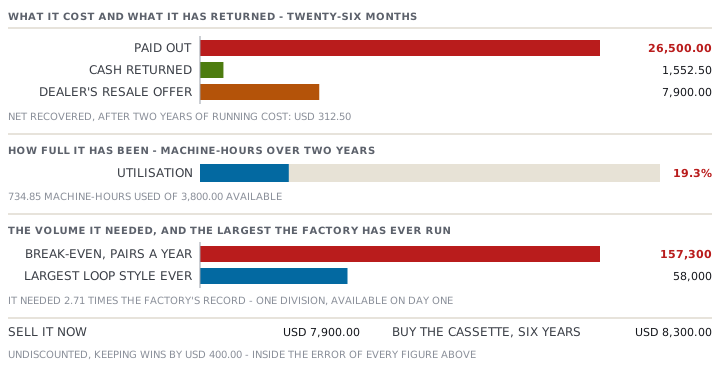
| Cash returned, 26 months | USD 1,552.50 |
| Less running cost, two years | USD 1,240.00 |
| Net recovered against USD 26,500 | USD 312.50 |
The reason it has run only 4,100 pairs since is not that nobody wants belt loops. Sekartaji's other trousers have 5 loops at a different spacing, and the machine needs a different feed cassette for that spacing: USD 880, quoted, and nobody has authorised it.
How full the machine has been says the same thing more plainly. 62,100 pairs at 0.71 minutes is 44,091 machine-minutes, or 734.85 machine-hours, against the 3,800 available in two years. That is 19.3%.
The number that was knowable before signing
Take the fixed charge and the benefit a pair, exactly as lesson 1 did for the pocket setter.
break-even = fixed charge a year / benefit a pair
           = 3,932.50 / 0.0250
           = 157,300 pairs a year
Sekartaji has never made 157,300 pairs of trousers with belt loops at any single spacing in a year. Its largest belt-loop style ever, before or since, is the 58,000 pairs of `SK-7431` itself. The machine could not have paid on any volume the factory has ever seen, and that sentence could have been written in full on the day the quotation arrived. It needed the yearly volume of the operation — a number the planning office had — and one division.
This is the difference between a bad outcome and a bad decision. The customer not repeating was a bad outcome, and nobody could have known it. Signing for a machine whose break-even was 2.71 times the largest volume the factory had ever run was a bad decision, and it would still have been a bad decision if the customer had repeated twice.
What to do with it now, which is a separate decision
The dealer offered USD 7,900 for it, which is 29.8% of its price after 26 months. So the position today is a write-off of 26,500 minus 7,900 = USD 18,600, less the USD 312.50 recovered: USD 18,287.50. That loss exists whether or not the machine is sold. Selling makes it real. Keeping it puts it off and calls it depreciation.
The live question is the cassette, and it is a different question from the machine, because the USD 26,500 is spent and no decision available today brings any of it back.
Assume the five-loop volume holds at Sekartaji's current 86,000 pairs a year. That is an assumption, and it is the one worth testing hardest. Then the cassette buys 86,000 times USD 0.0250 = USD 2,150.00 a year of saving, against USD 620.00 a year to run the machine, so keeping and converting nets USD 1,530.00 a year. The machine has 6 years of life left, and the work fits: 86,000 pairs at 0.71 minutes is 61,060 machine-minutes, or 1,017.67 hours of a 1,900-hour year.
| Option | Cash now | Cash later | Six-year total |
|---|---|---|---|
| Sell it | USD 7,900.00 | nil | USD 7,900.00 |
| Buy the cassette and keep it | minus USD 880.00 | USD 1,530.00 a year | USD 8,300.00 |
With no discounting, keeping it wins by USD 400.00 over six years. That is well inside the error of every figure in the table. The 86,000 is an assumption, the resale offer is one dealer's, and six years of a saving is not worth the same as cash today. So the honest answer is that it does not much matter, and a decision that does not much matter is a decision to stop spending time on. Note what appears in neither column: the USD 26,500. Any argument that reaches for it — we have to use it, we paid for it — is an argument for spending USD 880 to feel better about USD 26,500 that is gone in both columns alike.
The gate: four questions before the quotation is signed
Check yourselfSekartaji is offered a sleeve-placket setter for USD 17,600 — a placket is the finished opening at the wrist. It saves 0.58 standard minutes a shirt, running cost is USD 500 a year and life is 8 years. Each placket size needs its own folder at USD 290. Sekartaji makes 138,000 work shirts a year across three placket sizes, running 96,000, 34,000 and 8,000. Work out both break-evens and give an answer.Show the answer
The benefit is 0.58 times USD 0.0397 = USD 0.023026, so USD 0.0230 a shirt. The machine's fixed charge is 17,600 over 8 years = USD 2,200.00 plus USD 500.00 = USD 2,700.00, so the machine's break-even is 2,700.00 divided by 0.0230 = 117,391 shirts a year against 138,000 available. The machine clears it by 17.6%, which is a yes and a thin one — thin enough that it turns on whether the 138,000 holds, so check how much of it is one customer. Then the folders, which are a separate decision each. 290 divided by 0.0230 is 12,609 shirts over a folder's life. So buy the folder for the size that runs 96,000 and the folder for the size that runs 34,000, and run the 8,000 size by hand: its folder would cost USD 290 to return 8,000 times 0.0230 = USD 184.00. Two things are missing before signing. There is no defect figure on either route, and lesson 1 showed that is usually where most of the case lives. And there is no cycle time, so the machine's capacity in hours is unknown and has to be asked for.
Check yourselfA buyer offers a two-year commitment for 46,000 shirts a year with a new pocket shape. The template costs USD 415 and the pocket setter is already bought and paid for. Does the tooling break-even of 8,792 pieces settle it?Show the answer
It settles the tooling, and the tooling is the easy half. 92,000 shirts over two years is more than ten times the break-even, so the template is an obvious yes: USD 415 to return 92,000 times USD 0.0472 = USD 4,342.40. What it does not settle is capacity, which is the half that really matters here. The setter is already 1,748 hours into a 1,900-hour year, and 46,000 shirts at 0.76 minutes is 34,960 machine-minutes, or 582.67 hours a year. That takes the machine to 2,330.67 hours, over by 430.67. So this work does not fit, and the real question is what comes off the machine, or whether a second one is bought. That puts you back at question 1 of the gate, not at a template. It also does not settle the commitment itself: two years promised is not two years measured, though at these figures the template still pays on a quarter of the volume. Capacity first, tooling second — and the cheap number is the one everybody looks at first.
Prompt · The four questions before signing for a specialised machine
Before a quotation is signed for any machine that does one operation, one shape, or one style.
Act as the gate on a machine purchase. Ask me the four questions below in order, and refuse to move on until each is answered in money or answered with the word unknown.

One. What is the YEARLY volume of this exact operation and this exact shape, across every customer, over the last two years and forecast for the next two? Not the order that prompted the question. If my only answer is one order, say so and stop.

Two. What is the break-even yearly volume - the fixed charge a year, being depreciation over a stated life plus measured running cost, divided by the benefit a piece? Compare it with my answer to question one and tell me the ratio in both directions. If the break-even is larger than any volume my factory has ever run, say that sentence back to me plainly, because that is the finding.

Three. What tool does each shape need - template, folder, clamp, cassette, die - what does each cost, and what is its break-even in pieces over the tool's whole life, being tool price divided by benefit a piece? Then ask me, for each shape I actually run, how many pieces it has run to date and how many it is expected to run. List any that fall below the line and total what they cost me. Treat each tool as its own decision: a tool can be a clear yes on a machine that is a clear no, and the other way round.

Four. If the style does not repeat, what is this machine worth? Give me three answers in money - sold, moved to another shape and what that conversion costs, and written off. A resale figure is one phone call to a dealer, so do not accept unknown for that one without telling me to make the call.

Then two closing checks. Capacity: machine cycle times yearly volume, against productive machine-hours a year, and the number of changeovers times changeover time on top of it. And changeover: time per changeover, changeovers a year, pieces spoilt each time, priced.

Three rules. Never treat money already spent as a reason to spend more. If I am asking about a tool for a machine I already own, price the tool against its own return and leave the machine's purchase price out of both columns. Never fill a missing measurement with a typical figure; write unknown. And if the decision comes out inside the error of the figures, say so and tell me to stop spending time on it.
AI can make mistakes — check anything you act on.