Lessons · Lesson 2 of 3
The machine that is a second factory
How embroidery and printing are costed — by stitch count and machine-hours, or by setup and the cost of one more piece — and why bringing either in-house is a capacity and a quality decision before it is a price one.
Lesson 2 of 3 · 39 min
A different way of counting
The logo on a work polo shirt is not made by the people who sew the polo shirt. One machine clamps the cloth still and drives needles across it, following a pattern held in a file. Another pushes coloured paste through a fine mesh. Either way it is a small separate factory inside the factory. This lesson asks whether to own one, and what a specialist's quotation contains besides its headline price.
A sewing machine is costed per garment, because a garment is what passes through it. An embroidery machine is not, and getting this wrong is the commonest error in an embroidery quotation.
A multi-head embroidery machine is costed by stitch count and by machine-hours. It does not know what garment is in the frame. It knows how many stitches the design has, how fast it can lay them down on that fabric with that backing, and how long it takes to change the frame. Two polo shirts with the same logo cost the same to embroider. A polo shirt and a jacket with the same logo also cost the same to embroider. And a polo shirt with a 7,400-stitch logo costs nearly twice a polo shirt with a 3,900-stitch one. The garment is not in the formula. That is why an embroidery quotation given per garment tells you nothing until you know the stitch count it assumed.
SK-7710 is Brennholt's corporate polo shirt: 140,000 pieces, one left-chest logo, 7,400 stitches in 4 colours. Sekartaji embroiders the cut front panel before assembly, not the finished garment, and lesson 3 explains what that choice is worth.
The cycle, then the rate, then the piece
The machine class is a 12-head embroidery machine: twelve identical heads on one beam, all sewing the same design at the same time, so one cycle produces twelve panels.
sewing time  = stitches / effective speed
             = 7,400 / 720 = 10.28 min

cycle        = sewing + frame change
             = 10.28 + 1.80 = 12.08 min per 12 panels
             = 1.0067 min a panel
The 720 stitches a minute is the number to be careful about. The machine's rated speed is far above it. What Ratih Wijayanti measured, over a full shift on this design and this cloth, is 720. That average includes colour changes, thread trims, the four thread breaks in a shift, and the slower speed the machine drops to on the dense edge stitching around the logo. Use a measured average speed, never a rated one. A quotation built on the rated speed will be short by a third, and nobody will find out until the delivery is late.
Now the machine-hour rate. The 12-head was quoted at USD 78,000 installed, plus USD 6,400 for the stations where panels are clamped into frames, the frames themselves, and the workstation where artwork is turned into a stitch file. That is USD 84,400. Over an 8-year life and 1,900 productive machine-hours a year, that is 84,400 divided by 15,200 = USD 5.55 a machine-hour of depreciation. Power, needles, tension parts and servicing, measured over Sekartaji's first year, are USD 1.24. The machine needs two people, one at the beam and one clamping panels into spare frames ahead of it, at USD 1.62 each: USD 3.24.
| Line | Amount |
|---|---|
| Depreciation, USD 84,400 over 8 years and 1,900 hours | USD 5.55 a machine-hour |
| Power, needles, parts, servicing, measured | USD 1.24 a machine-hour |
| Two operators at USD 1.62 | USD 3.24 a machine-hour |
| Machine-hour rate | USD 10.03 |
| Machine time, 1.0067 min = 0.016778 hours, at USD 10.03 | USD 0.1683 a panel |
| Backing, the sheet under the cloth that stops it stretching | USD 0.0210 a panel |
| Thread, 7.4 thousand stitches at USD 0.0132 a thousand | USD 0.0977 a panel |
| Spoil, 0.7% of a USD 0.63 panel | USD 0.0044 a panel |
| In-house cost | USD 0.2914 a panel |
Turning the logo artwork into a stitch file was a one-off USD 55. Across 140,000 pieces that is USD 0.0004, so it is left out of the table because it rounds away. It does not round away on a 900-piece run, and that is the point of naming it.
The capacity question, which comes first
Before comparing that USD 0.2914 with anybody's quotation, do the arithmetic that decides whether the comparison is even available.
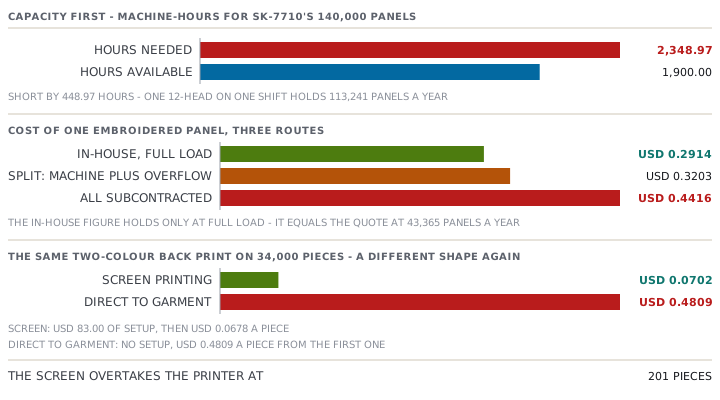
machine-minutes needed = 140,000 x 1.0067 = 140,938 min
                       = 2,348.97 machine-hours

available, one machine, one shift = 1,900 machine-hours
The order needs 1.24 machines and Sekartaji has one. One 12-head on one shift holds 1,900 times 60 divided by 1.0067 = 113,241 panels a year. SK-7710 alone is 140,000, and the factory embroiders for two other customers as well. So "bring it in-house" is not one decision. It is a choice among five, and only after that choice is made does a price comparison mean anything.
- One machine, one shift, and subcontract what will not fit.
- One machine, two shifts — 3,800 machine-hours, and a night-shift premium Sekartaji has never paid.
- Two machines, one shift — 226,482 panels of capacity against 140,000 of demand, which is 86,482 panels of capacity nobody has bought.
- Subcontract all of it.
- Do not take the order.
Nothing in the price arithmetic below chooses between those. Capacity does.
Now the quotation, with all of it in
The embroidery house in Ungaran quoted Sekartaji, and the quotation is typical: the headline price is the smallest part of the story.
| Term | As quoted | On this order |
|---|---|---|
| Piece rate, logo up to 8,000 stitches | USD 0.42 a piece | USD 58,800.00 |
| Setup, per colourway per delivery | USD 18 | 28 deliveries: USD 504.00 |
| Minimum batch | 500 pieces, charged as 500 | Nil here; every batch is 5,000 |
| Transport, up to 6,000 pieces a trip | USD 46 a round trip | 24 trips: USD 1,104.00 |
| Spoilt panels: their embroidery labour is replaced, the cloth is yours | Spoil measured at 1.6% | 2,240 panels at USD 0.63: USD 1,411.20 |
| Time to get the work back | 4 working days | Priced below, and partly unknown |
| Total | USD 61,819.20, or USD 0.4416 a panel |
Read the spoil line twice, because it is where a subcontract quotation usually hides its difference from an in-house cost. The subcontractor carries its own labour and none of your cloth. Its spoil rate is 1.6% against Sekartaji's measured 0.7%. That is not because its operators are worse. It is because a clamping error on somebody else's panel is found by somebody with no reason to slow down and check. On 140,000 panels that difference is 1,260 panels, USD 793.80, and it lands entirely on Sekartaji.
| Route | Panels in-house | Panels out | Total, USD | Per panel, USD |
|---|---|---|---|---|
| Subcontract all of it | nil | 140,000 | 61,819.20 | 0.4416 |
| One machine at full load, subcontract the rest | 113,241 | 26,759 | 44,844.94 | 0.3203 |
| Two machines, one shift | 140,000 | nil | see below | see below |
The split route is 113,241 panels in-house at USD 0.2914 = USD 32,998.43. To that add 26,759 panels subcontracted, made up of USD 11,238.78 of piece rate, USD 108.00 of setup on 6 deliveries, USD 230.00 of transport on 5 trips and USD 269.73 of spoil: USD 11,846.51. It beats full subcontracting by USD 16,974.26 on this order.
The two-machine route cannot be costed on this page, and it should not be, because its cost depends entirely on what the second machine does with the 1,451.03 machine-hours this order leaves it. That is the same question as lesson 3, and it has the same answer. A machine's cost per piece depends on how full it is. Quoting it at full load when it will not be full is the commonest way a good machine becomes a bad purchase.
What load the machine needs to beat the quotation
Hold everything else still and ask what depreciation per machine-hour would make the in-house panel cost equal the subcontractor's USD 0.4416.
0.016778 x (D + 1.24 + 3.24) + 0.1187 + 0.0044 = 0.4416
                       D + 4.48 = 0.31849 / 0.016778 = 18.98
                              D = USD 14.50 a machine-hour

hours a year = 84,400 / (8 x 14.50) = 727.6
panels       = 727.6 x 60 / 1.0067  = 43,365 a year
The 12-head beats the local quotation above about 43,365 panels a year, which is a bit over a third of one shift. That looks like an easy purchase, and on price it is. It is still the last question to ask, and the order of the questions is the real content of this lesson.
Printing is a different shape entirely
Brennholt wants a two-colour back print on 34,000 of the polo shirts. Printing is not embroidery costed differently. It is a different cost shape, and the shape is what decides the route.
Screen printing has a large setup and almost no cost for one more piece. Two screens at USD 26 each, plus USD 31 to set up the press and match the colours, is USD 83 before the first garment. Then ink and the adhesive that holds the garment on the board cost USD 0.0370. Three people on a rotating press producing 420 pieces an hour at USD 1.62 each is 4.86 divided by 420 = USD 0.0116. And press and dryer depreciation is USD 0.0192 a piece. That is USD 0.0678 a garment thereafter.
Printing straight onto the garment has no setup and a large cost for every piece. No screens, no separating the design into colours, nothing to store. Ink costs USD 0.3400 and the pre-treatment that makes the ink hold costs USD 0.0600, for a two-colour design on a light garment. One operator produces 44 pieces an hour, so USD 1.62 divided by 44 = USD 0.0368. Printer depreciation of USD 29,500 over 8 years and 1,900 hours is USD 1.9408 a machine-hour, and at 44 pieces an hour that is USD 0.0441. That is USD 0.4809 a garment, from the first one.
| Route | Setup, USD | Per garment, USD | 34,000 garments |
|---|---|---|---|
| Screen printing | 83.00 | 0.0678 | USD 2,388.20, or USD 0.0702 each |
| Straight onto the garment | nil | 0.4809 | USD 16,350.60 |
crossover = 83.00 / (0.4809 - 0.0678) = 201 piecesAbove 201 pieces screen printing is cheaper, and by 34,000 it is not close — USD 0.0702 against USD 0.4809, nearly seven times. Nobody should read that as "printing straight onto the garment is expensive". It is a machine whose whole case lives below 201 pieces, and in the things a screen cannot do at all: a sample tomorrow, one garment in each size, a name on each garment, a design nobody will ever print again. Sekartaji uses one for exactly that, and would not print 34,000 of anything on it.
Check yourselfA subcontractor quotes USD 0.38 a piece for a logo, against your in-house cost of USD 0.31 a piece. Your machine has spare capacity. What else has to be in the comparison before it is an answer?Show the answer
At least four things, and all of them push the same way. The setup charge, per colourway and per delivery, which turns on how many deliveries the order is split into rather than how many pieces it has. The minimum batch, which matters on the last small delivery of the order and on any repeat. Transport, per trip and per direction. And the terms on spoilt work. Find out exactly what a spoilt panel costs you rather than them, and get both spoil rates measured rather than asserted. At Sekartaji it was 1.6% outside against 0.7% inside, and the panel was Sekartaji's either way. Then check the in-house USD 0.31 itself. It contains depreciation spread over an assumed number of machine-hours, and if the machine will not actually be that full, the real in-house figure is higher than the one you are comparing. Spare capacity is exactly the condition under which that assumption is wrong.
Check yourselfSekartaji is asked to quote 2,600 polo shirts with a 12,200-stitch back logo. Using this lesson's model and its measured 720 stitches a minute, what is the machine time, and what is the first thing you would check before quoting a price?Show the answer
Sewing is 12,200 divided by 720 = 16.94 minutes, plus 1.80 for the frame change is 18.74 minutes for 12 panels, so 1.5617 minutes a panel. Across 2,600 panels that is 4,060.42 machine-minutes, or 67.67 machine-hours. At the USD 10.03 machine-hour rate that is USD 0.2610 a panel of machine cost, and thread rises with stitches: 12.2 thousand at USD 0.0132 is USD 0.1610, against USD 0.0977 for the chest logo. So the two designs are nowhere near the same price, and a per-garment quotation carried over from SK-7710 would be badly wrong. The first thing to check is not arithmetic at all. It is whether 720 stitches a minute holds on a 12,200-stitch back design, with a different colour sequence and a much longer run in the frame. That 720 is a measured average for one design, and this is a different one. Measure it on a short run before quoting, or quote with the speed named as an assumption.
Prompt · Costing embroidery or printing in-house against a quotation
When a decorated order is being placed and somebody has compared a per-garment quotation against a per-garment in-house guess.
Help me compare doing decoration in-house against sending it out, and keep the questions in the right order.

Start with capacity, before any price. Ask me for the stitch count, my MEASURED average stitches a minute including colour changes, trims and thread breaks, my frame change time, and how many heads the machine has. Build the cycle: sewing time equals stitches over effective speed; cycle equals sewing plus frame change; divide by the number of heads for minutes a garment. Then multiply by the order quantity and compare it against my productive machine-hours a year. Tell me plainly whether the order fits. If it does not, list my real options - one machine plus the overflow subcontracted, a second shift, a second machine, all of it outside, or not taking the order.

Then build the in-house rate properly. The machine-hour rate is depreciation, at purchase price over life and productive hours a year, plus measured power and parts and servicing, plus the operators the machine actually needs. Convert that to a cost a garment. Then add the per-garment consumables separately: backing, thread by stitch count, and a measured spoil rate times the value of what a spoilt piece destroys. Ask me whether I decorate the cut panel or the finished garment, because that decides what a spoilt piece costs.

Now the quotation, and put ALL of it in: the piece rate, setup per colourway per delivery times the number of deliveries, the minimum batch, transport per trip in both directions, and the terms on spoilt work - specifically, whether their spoilt panel costs me the cloth. Ask for both spoil rates as measurements. Then show the total and the cost a piece for every route, including the split route where my machine runs full and the remainder goes out.

Finish with two things. Solve for the yearly volume at which the in-house cost equals the quotation, so I know how full the machine has to be, and say clearly that my in-house figure is only true at that load. Then price the loop: how many pieces are permanently out of my building, at what value for stock sitting between operations, at what cost of capital - and label the capital rate as an assumption. If I have never measured what a late-discovered decoration fault costs, write UNKNOWN and give me the size of what is at risk instead, in pieces and in money.
AI can make mistakes — check anything you act on.