Lessons · Lesson 1 of 3
What a fixed cycle buys
Why a machine that does one job and nothing else is bought for the variation it removes rather than the seconds it saves, and how to find the yearly volume at which it starts to pay.
Lesson 1 of 3 · 40 min
The factory, the contract, the basis
Some sewing machines do exactly one thing. One buttonhole. One button. One pocket, folded and stitched to the same pattern every time. A machine like that is called an automat. This lesson is about deciding whether to buy one, and that is harder than it sounds. An automat costs more than several years of wages for the person standing beside it, and you live with the choice for years. The argument that breaks out on the floor is almost always about the wrong quantity.
Sekartaji Apparel is a corporate-uniform and workwear factory at Ungaran, inland from Semarang in Central Java. It employs 1,180 people on eight sewing lines. It makes work shirts, work trousers and corporate polo shirts. Everything in this course happens inside that building.
Four people appear.
- Bimo Prasetyo is the managing director. He signs for machines.
- Ratih Wijayanti is the industrial engineer. She owns the time studies and the cost models, and every measurement in this course is hers.
- Endang Suryani runs the shirt lines.
- Agus Nugroho is the mechanic. He sets the automats and keeps the tooling cupboard.
The work carried through all three lessons is the Brennholt 2027 uniform contract, for Brennholt Workwear, a German supplier of corporate clothing to utility and building-services companies. It has three garments in it: SK-7724, a work shirt with two flapped chest pockets, 62,000 pieces; SK-7710, a corporate polo shirt with an embroidered left-chest logo, 140,000 pieces; and SK-7702, a work trouser, 96,000 pairs.
Say the basis once, because every figure below is built from it. All money is US dollars. A standard minute is one minute of work done at a normal pace; it is the unit every time study in this course uses.
A sewing operator costs USD 1.62 an hour fully loaded — wage, legal contributions, and a share of supervision and floor overhead. That comes from Sekartaji's own 2027 payroll, not from a country average. It is USD 0.0270 an attended minute. The lines run at a measured 68% efficiency, so one standard minute of work needs 1.4706 attended minutes and costs 0.0270 divided by 0.68 = USD 0.0397. Every labour figure in this course is standard minutes times that rate. A mechanic costs USD 2.15 an hour fully loaded. A machine is charged at its purchase price spread evenly over 8 years, with no resale value assumed. That is an assumption, and lesson 3 is about what it hides. A machine year is 1,900 productive machine-hours: 250 working days at 7.6 hours. A cut shirt front panel — the cloth and the cutting, nothing else — is worth USD 0.63.
What an automat is, and what it is not
An automat is a machine built for one operation, which it performs on a fixed cycle. The sequence, the number of stitches, the cut and the stop are all set by the machine. The operator does not choose them each time. The operator loads the work and takes it off again, and everything between those two acts is the same on the first garment of the shift and on the last.
That definition does most of the work in this lesson, so it is worth seeing what it covers.
| Class | The operation | What the machine fixes | What still varies |
|---|---|---|---|
| Buttonhole automat | Cuts and sews one buttonhole | Length, stitch width at the cut edge, stitch density, whether the cut comes before or after the stitching | Where the operator places the panel |
| Button attaching automat | Sews on one button | Number of stitches, thread tension, the length of the thread neck under the button | Which button is in the feeder |
| Bartack automat | One bartack, a short block of stitches that strengthens a point of strain | Length, width, number of stitches | Where it goes on the garment |
| Belt-loop attaching automat | Feeds loop tape, cuts it and tacks both ends | Loop length, tack position, the spacing between loops | The spacing of the loop tape, which needs a matching feed cassette |
| Welt-pocket automat | Sews, cuts and corner-cuts a double welt pocket, which is a slit pocket with two cloth lips | Lip width, opening length, corner-cut depth | Panel loading and flap alignment |
| Patch pocket setter | Folds and sews a patch pocket against a template | Pocket shape, seam allowance, topstitch margin | The template, which fits one pocket shape and no other |
Read the column headed What still varies. On every one of the six, what is left to the person is loading. On three of them that column also names a physical tool — a cassette, a template or a clamp — and that tool ties the machine to one shape. Remember it. It is the whole of lesson 3.
The rest of this lesson costs one of them: the patch pocket setter, on the two chest pockets of SK-7724.
The measurement that decides it
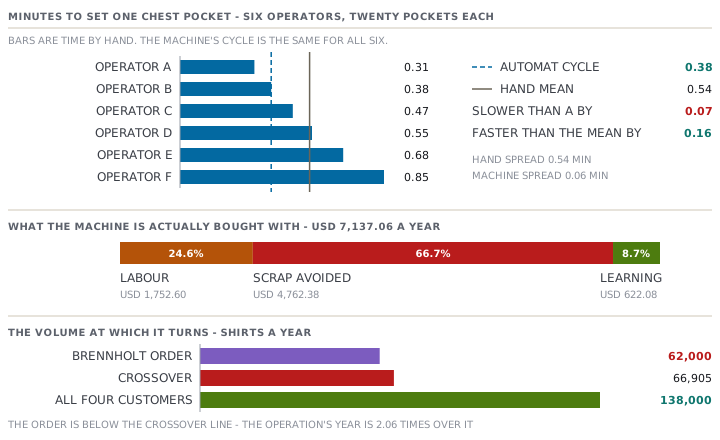
Ratih Wijayanti timed the operation on the six operators in the shirt section who set chest pockets. Twenty pockets each, on the same cloth and the same panel, over one week. By hand it is a single-needle machine with a folder — a metal guide that turns the raw edge under as it feeds — and a pocket that has already been pressed to shape. On the automat, the operator lays the panel and the pocket into a template and presses a pedal.
| Operator | By hand, single needle with a folder | On the pocket setter |
|---|---|---|
| A | 0.31 | 0.35 |
| B | 0.38 | 0.37 |
| C | 0.47 | 0.38 |
| D | 0.55 | 0.38 |
| E | 0.68 | 0.39 |
| F | 0.85 | 0.41 |
| Mean | 0.54 | 0.38 |
Two facts fall out of that table, and they point in opposite directions.
The automat is slower than operator A, and it always will be. A takes 0.31 minutes. The machine takes 0.38. The machine is 0.07 minutes a pocket slower than the best person in the section, a little over four seconds, and no amount of practice will change that, because the cycle is the cycle. Anyone who has watched a good pocket operator work already knows this. It is the commonest reason an automat proposal is thrown out on the floor by people who are right about what they saw and wrong about what it means.
The automat has no spread. By hand, the slowest operator takes 2.74 times as long as the fastest, a spread of 0.54 minutes a pocket. On the automat the spread is 0.06 minutes — six people loading a template — and the slowest is 1.17 times the fastest. What variation is left is loading, which is the only part of the operation the machine did not take over.
So the machine is not bought to beat A. It is bought to make everyone else into A, and to make the question who is on the pocket seat today stop having a consequence. Compare an automat against the section mean, never against your best operator. The mean is what the factory actually runs at. The best operator is on one seat out of six.
Costing it
Two pockets a shirt. The mean by hand is 2 times 0.54 = 1.08 standard minutes. On the automat it is 2 times 0.38 = 0.76. The saving is 0.32 standard minutes a shirt, which at USD 0.0397 a standard minute is USD 0.0127.
That is a very small number, and it is supposed to look small. At Sekartaji's labour rate, an automat is almost never justified out of wages alone. SK-7724 is 62,000 shirts, worth 62,000 times 0.0127 = USD 787.40 of labour, against a machine quoted at USD 24,000. Anyone who stops there stops in the wrong place, and in two directions at once. The yearly volume is not the order. And labour is not what the fixed cycle mainly changed.
Yearly volume first. Chest patch pockets are not a Brennholt thing. Sekartaji sets them on 138,000 shirts a year across four customers, of which Brennholt is 62,000. The right denominator is 138,000, and the yearly labour saving is 138,000 times 0.0127 = USD 1,752.60.
Then the defects, which are the real case. The chest pocket on SK-7724 carries the same 7,400-stitch Brennholt logo the polo shirt does, embroidered on the pocket before it is set. A pocket that goes on skewed, or short of topstitching, cannot be lifted off again. Unpicking marks the shirt front, and the embroidered pocket does not survive a second pass. The panel is scrapped, and so is the pocket. Ratih measured what that costs.
| Component | Value, USD |
|---|---|
| Cut shirt front panel | 0.63 |
| Cut pocket, cloth only | 0.09 |
| Embroidery on the pocket, built up in lesson 2 | 0.2914 |
| Sewing already in the panel, 4.50 standard minutes at USD 0.0397 | 0.1787 |
| Scrapped by one bad pocket | 1.19 |
Measured against Brennholt's placement tolerance, across 500 shirts from each route, the hand-set rate was 3.4% and the automat's was 0.5%, a difference of 2.9%. On 138,000 shirts that is 4,002 panels a year at USD 1.19, which is USD 4,762.38.
Then the learning curve, which nobody costs. A new pocket operator reaches the section mean in 7 weeks, and across those weeks produces at an average 64% of it. Seven weeks is 280 attended hours, so the factory pays for 280 hours and earns 179.2: that is 100.8 hours paid and not earned, at USD 1.62 = USD 163.30. On the automat a new operator reaches full cycle in 3 days — 24 hours at an average 80%, so 4.8 hours at USD 1.62 = USD 7.78. Sekartaji replaced 4 pocket operators last year. The difference is 4 times (163.30 minus 7.78) = USD 622.08.
| Line | Amount, USD |
|---|---|
| Labour, 138,000 at USD 0.0127 | 1,752.60 |
| Scrap avoided, 2.9% of 138,000 at USD 1.19 | 4,762.38 |
| Learning curve, 4 replacements | 622.08 |
| Gross return | 7,137.06 |
| Depreciation, USD 24,000 over 8 years | 3,000.00 |
| Power, air, needles, servicing, measured | 780.00 |
| Net of the machine charge | 3,357.06 |
Read the shares before you read the total. Labour is 24.6% of the gross return, scrap is 66.7%, and the learning curve is 8.7%. The machine is bought with defects. The seconds barely move the answer. That is not a peculiarity of Sekartaji. It is what a low labour rate does to every automat argument, and it is why an automat proposal written as a head-count saving is both unconvincing and wrong about its own subject.
On cash rather than on the accounting charge, the machine returns 7,137.06 minus the USD 780 it costs to run = USD 6,357.06 a year against USD 24,000. That is a payback of 3.78 years, or 45.3 months, with no discounting.
The volume at which it starts to pay
Split the yearly return into the part that moves with volume and the part that does not, because they answer different questions. The volume where the two routes cost the same is called the crossover, or the break-even volume. This course uses both words for the same thing.
per shirt, moves with volume
  labour                 0.0127
  scrap, 2.9% x 1.19     0.0345
  total                  0.0472

fixed for the year
  depreciation + running    3,780.00
  less the learning saving    622.08
  net fixed                 3,157.92

crossover = 3,157.92 / 0.0472 = 66,905 shirts a year
The learning saving sits in the fixed block on purpose. It depends on how many operators Sekartaji replaces, not on how many shirts it makes.
So the pocket setter starts to pay at 66,905 shirts a year. Sekartaji runs 138,000, which is 2.06 times the crossover, and the machine is clearly right. The Brennholt order on its own is 62,000, which is below it. So a proposal written on the strength of SK-7724 alone would have been a proposal to lose money, on a machine that is the correct purchase. An automat is bought against the yearly volume of the operation, never against the order that made you think about it.
One more check before signing, and it is the one lesson 2 makes a whole argument out of. Does the machine have the hours? At 0.76 minutes a shirt, 138,000 shirts is 104,880 machine-minutes, or 1,748 hours of a 1,900-hour year. The machine is 92.0% full. It fits, with very little room. A second customer bringing 20,000 shirts would not fit, and the answer then is a second machine, a second shift or a refusal — decided before the order is taken, not after.
Check yourselfA supplier tells you their bartack automat runs a bartack in 3.1 seconds while your best operator takes 4.4 seconds on a plain bartacker, so the machine is 30% faster. What is wrong with that comparison, and what would you put in its place?Show the answer
It compares a machine cycle against one person's best time, and a factory does not produce at its best operator's rate. It produces at the section mean, which is the average across everyone who sits there over a year, including the new starter and the day the good one is on leave. Time the whole section, twenty pieces each, and use the mean. Then look at the spread as well as the mean, because the spread is what a fixed cycle actually removes. At Sekartaji the hand mean was 0.54 minutes a pocket against 0.31 for the fastest, so a comparison against the fastest would have wiped out the saving entirely and shown the machine as slower. Two further things are wrong with it. A cycle claim is not a measurement on your cloth with your loading, so it has to be timed on your own panels. And on this evidence you would still be deciding an automat on seconds, which at Sekartaji was a quarter of the case. Ask for the defect rate on each route before you ask for the cycle time.
Check yourselfSekartaji is offered a buttonhole automat for USD 21,000. It saves 0.34 standard minutes a shirt and cuts a 1.1% rework rate to 0.2%; a buttonhole rework is 2.60 standard minutes and scraps nothing. Running cost is USD 610 a year and life is 8 years. No learning-curve figure has been measured. Sekartaji makes 138,000 work shirts a year. What is the crossover volume, what is the answer, and what would you go and measure?Show the answer
Labour is 0.34 times USD 0.0397 = USD 0.013498, so USD 0.0135 a shirt. A rework costs 2.60 times 0.0397 = USD 0.103220, so USD 0.1032, and the rate falls by 0.9%: 0.009 times 0.1032 = USD 0.000929, so USD 0.0009 a shirt. The variable benefit is USD 0.0144. Fixed is 21,000 over 8 years = USD 2,625.00 plus USD 610.00 = USD 3,235.00, with nothing subtracted, because the learning curve has not been measured. The crossover is 3,235.00 divided by 0.0144 = 224,653 shirts a year against 138,000 available. So on these figures the answer is no, and it is not close. Note why this one behaves so differently from the pocket setter. A buttonhole defect is reworked rather than scrapped, so the defect term is USD 0.0009 instead of USD 0.0345. The case falls back onto labour, which never carries an automat at this rate. Before accepting the no, measure the learning curve. It is the one term missing, and it sits in the fixed block, where it moves the crossover directly. It would have to be worth USD 1,247.80 a year to bring the crossover down to 138,000.
Prompt · The volume at which an automat starts to pay
When a machine that does one operation is being proposed or refused, and the argument is about seconds or head-count.
Help me decide an automat on my own numbers, and make me measure the things I have not measured.

First ask me for the time study, and refuse to go on with one operator's time. I need the operation timed on EVERY operator in the section who does it, at least fifteen pieces each, on the same cloth. Give me back the mean, the fastest, the slowest, the spread, and the ratio of slowest to fastest, for the hand route and for the machine route. Then say plainly whether the machine's cycle is slower than my fastest operator, because it often is, and tell me to compare it against the MEAN and not against my best person.

Then build the case in three parts and keep them apart. Labour: minutes saved a garment, times my fully loaded cost of a standard minute. Defects: ask me for the defect rate on each route, measured on a stated sample, and ask me what one defect actually destroys - a rework in minutes, or a scrapped panel with everything already in it. Learning curve: how many weeks a new operator takes to reach the section mean, what percentage of it they average over those weeks, how fast they reach full cycle on the machine, and how many operators I replaced last year.

Now split the yearly return into a part that moves with volume and a part that does not. The learning-curve saving is fixed, because it depends on how many people I replace, not on how many garments I make. Give me: benefit a piece, net fixed cost a year, and the break-even volume, being fixed cost divided by benefit a piece.

Finish with three checks. Compare the break-even against the YEARLY volume of this operation across all my customers, and say plainly whether the single order that prompted this would have justified the machine on its own. It usually would not. Check capacity: machine cycle times yearly volume, against my productive machine-hours a year, and tell me if it does not fit. And tell me which of the three parts is carrying the case, because if it is labour alone at a low wage rate, the answer is probably no.

Two rules. If I have not measured something, leave the line blank and say it is missing. Never fill it with a typical figure. And do not quote me any supplier cycle time or productivity percentage. The only times that count are the ones taken on my own cloth.
AI can make mistakes — check anything you act on.