Lessons · Lesson 2 of 6
- 01 · Twenty-four components, twenty-four clocks
- 02 · Band and cup: a size system with two axes
- 03 · Millimetres, and a measurement that is a force
- 04 · Where the money is: trims and minutes, not cloth
- 05 · Swim: the chemistry the garment has to survive
- 06 · After the wash, and the defect an inspector cannot see
Band and cup: a size system with two axes
Turn a two-dimensional size grid into a buy, a tooling bill and a stock file, and stop treating it as a list.
Lesson 2 of 6 · 17 min
A size that is a pair of numbers
Everything a merchandiser learns about size curves assumes an ordered list. XS to XXL. 36 to 46. Waist 28 to 38. Six or eight values, one axis, one ratio, one row on a cut plan. Course 4.5 builds the size ratio into a cut plan and course 18.1 splits it across shops. Both of them are working on a list.
BR-6140 is not a list. It is a grid: five underbands — 70, 75, 80, 85 and 90 — crossed with five cups, A to E. 25 sizes. In three colours that is 75 stock-keeping units on a 9,000-piece order. A stock-keeping unit is one thing a warehouse counts on its own line.
Two things follow at once, and neither of them shows on a one-axis size curve.
The average cell is small. 9,000 pieces over 75 units is 120 pieces each. Nobody sells the average. But it is the number every minimum has to be checked against.
The two axes are not independent. A woman with a 90 underband is not, on average, wearing the same cup letter as a woman with a 70. Multiply a correct band curve by a correct cup curve and you get twenty-five wrong numbers.
The grid, from the buyer's own history
Here is Aubrette's history for this fit, one colour, 3,000 pieces:
| Band | A | B | C | D | E | Band total |
|---|---|---|---|---|---|---|
| 70 | 60 | 110 | 90 | 30 | 10 | 300 |
| 75 | 90 | 250 | 260 | 130 | 50 | 780 |
| 80 | 60 | 250 | 320 | 210 | 90 | 930 |
| 85 | 25 | 130 | 200 | 180 | 95 | 630 |
| 90 | 5 | 40 | 90 | 110 | 115 | 360 |
| Cup total | 240 | 780 | 960 | 660 | 360 | 3,000 |
Now the mistake nobody made. A planner has the two edges of that table: the band totals down the right, and the cup totals along the bottom. He does not have the grid itself. So he does the obvious thing and multiplies them. Band 90 is 360 of 3,000. Cup E is 360 of 3,000. So cell 90E is 360 multiplied by 360, divided by 3,000.
That gives 43.2. The history says 115. The estimate is wrong by a factor of 2.7, and it is wrong in the direction that hurts. A customer cannot buy 90E anywhere else, and she will not take a different size instead.
At the other corner the error turns round. Cell 90A comes out at 28.8 against a true 5. The planner buys nearly six times too many of a size almost nobody wears. Cell 70A comes out at 24.0 against 60, which is half of what is needed.
Every band total is right. Every cup total is right. Twenty-five cells are wrong, and the two biggest errors sit at opposite corners, so the totals hide them perfectly.
Nine moulds for twenty-five sizes
A moulded cup is shaped with heat. A blank of foam laminate is pressed between a heated matched pair of aluminium tools until it holds the shape. The tool is real capital. It is machined for one cup volume, and BR-6140 cannot be cut until the tools exist.
Here the two axes help you for once. Cup volume is set by the difference between the bust and the underbust measurement. So going up one band and down one cup letter leaves the volume where it was. 80B, 75C and 85A are sister sizes: three labels, one cup. Follow the diagonals across the grid and twenty-five sizes collapse into 9 distinct volumes.
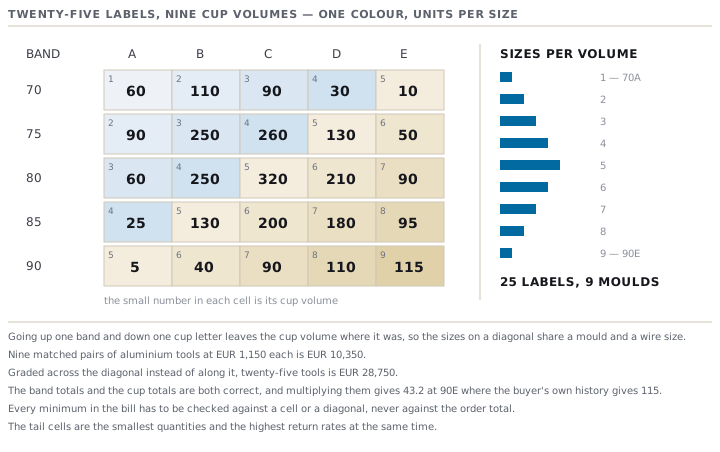
| Volume | Sizes on this diagonal | Sizes | Pieces |
|---|---|---|---|
| 1 | 70A | 1 | 180 |
| 2 | 70B, 75A | 2 | 600 |
| 3 | 70C, 75B, 80A | 3 | 1,200 |
| 4 | 70D, 75C, 80B, 85A | 4 | 1,695 |
| 5 | 70E, 75D, 80C, 85B, 90A | 5 | 1,785 |
| 6 | 75E, 80D, 85C, 90B | 4 | 1,500 |
| 7 | 80E, 85D, 90C | 3 | 1,080 |
| 8 | 85E, 90D | 2 | 615 |
| 9 | 90E | 1 | 345 |
That table has the same diagonal shape the wire sizes follow in lesson 1, for the same reason. A wire is cut and formed to the base of a cup, so it is indexed by volume too. Nine moulds, nine wire sizes, twenty-five labels.
A matched pair of aluminium tools, with its trial run, costs EUR 1,150 at Thalna's tool maker. Nine of them is EUR 10,350.
- On this order alone: 10,350 over 9,000 pieces is EUR 1.15 a bra. That is 21.3% of a EUR 5.40 selling price.
- Over the two-year programme Aubrette has committed, 60,000 pieces: EUR 0.17 a bra.
The tooling line on the cost sheet in lesson 4 is EUR 0.17. It is only EUR 0.17 because somebody wrote the programme down. Quote the tool against a single order and the style does not exist.
The question to ask before you quote
Some brands grade the cup across the sister diagonal. A 90A cup is shaped a little differently from a 70E, because the same volume sits on a different rib cage. That is a fair fit decision. It is also a tooling decision, and it turns nine moulds into twenty-five:
- 25 tools at EUR 1,150: EUR 28,750
- Against nine: EUR 18,400 more
- Over the programme: EUR 0.48 a bra instead of EUR 0.17, which adds EUR 0.31 to every piece
Nobody puts this on a tech pack. You get the answer by asking the technologist one question: does the cup grade across the sister diagonal, or only along it? The answer changes your quotation by more than any fabric negotiation in this course.
Check yourselfAubrette asks to extend the range with a 95 band, cups B to E. What does that cost before a single garment is made?Show the answer
Four new labels, but the volumes are what you count. With 95 added at cups B to E the diagonals extend: 95B sits with 90C and 85D on a volume you already have, 95C with 90D, 95D with 90E. But 95E is a volume that does not exist yet. So that is one new mould at EUR 1,150, and one new wire size with a 3,000-pair minimum against a demand of perhaps a hundred pairs. The four labels cost EUR 1,150 of tooling and about EUR 1,220 of wire nobody will use. That is a real answer to give a buyer, and the grid gives it to you in ten minutes.
What the grid does to everything downstream
- Cutting and moulding. Nine mould set-ups, not one marker. The moulding press changes tools between volumes, so the run order is by volume, not by colour. That is the opposite of how a cutting room sequences a tee.
- Stock. Seventy-five units in a warehouse file where a tee has six. Splitting one demand across many units raises the safety stock the business has to hold. The effect follows the number of units, not the total demand. Course 23.6 does that arithmetic for a distribution network. The same force is at work inside one size grid.
- Replenishment. A shop that is out of 80C is not out of stock. It is out of one cell. Course 18.2 shows a chain curve that is right while every shop is wrong on one axis. On two axes the same error is twenty-five times harder to see.
- Returns. A wrongly sized bra comes back. The small cells at the edges of the grid have the highest return rates and the smallest quantities at the same time. That is why they look unprofitable on every report, and why removing them is usually wrong. Those sizes are the reason the customer came to a specialist in the first place.
Prompt · Twenty-four clocks, and every minimum against a cell
Before you confirm a size range or issue a material deadline on a garment with more than about ten components.
Act as a lingerie factory's material planner. I need a component clock table and a minimum check, not a summary. Order facts: buyer [BUYER], purchase order [NUMBER], style [STYLE], quantity [QTY] pieces, price [PRICE] on FOB terms, colours [LIST], size range [LIST EVERY SIZE], cut date [DATE], date the goods leave the factory [DATE]. Bill of materials, one line per component, and for each line: description, supplier, price per piece, quoted lead time in days, minimum order quantity and the UNIT that minimum is written in (per order, per colour, per size, per metre), and whether it needs a colour approval, an artwork sign-off or nothing at all before its clock can start. My buyer's approval cadence: [HOW OFTEN, HOW MANY ITEMS PER SESSION, TYPICAL ROUNDS]. Do the following. First, count the components that need an approval before their clock starts, multiply by the colours, and give me the total number of approvals this style implies. Second, build the approval queue against the buyer's cadence and give each component the DAY its clock can actually start. Third, produce the clock table with columns: component, starting gun, gun fires on day, lead time, arrives on day, float against the cut date — sorted by ARRIVAL, not by lead time. Fourth, name the component that lands last and say what it costs per piece, because it is usually not the fabric. Fifth, take every minimum and check it against the quantity at the level the minimum is expressed in — if it is per size, check it size by size and show me the shortfall for each; do not check a per-size minimum against the order total. Sixth, price the overhang in money and per shipped piece, then repeat it against a [PROGRAMME QTY] annual programme so I can see both numbers. Seventh, list what I should change before confirming the range. Where an input is missing, ask for it rather than assuming.
AI can make mistakes — check anything you act on.
The buy is a grid. The tooling is a diagonal. The stock file is neither. Get the grid from the buyer's own cells. Get the diagonal from the technologist. And never let a size range be confirmed before both have been costed.