Lessons · Lesson 4 of 6
- 01 · Twenty-four components, twenty-four clocks
- 02 · Band and cup: a size system with two axes
- 03 · Millimetres, and a measurement that is a force
- 04 · Where the money is: trims and minutes, not cloth
- 05 · Swim: the chemistry the garment has to survive
- 06 · After the wash, and the defect an inspector cannot see
Where the money is: trims and minutes, not cloth
Read a cost sheet whose largest material line is a piece of wire, and choose the lever that is actually worth a week.
Lesson 4 of 6 · 17 min
The shape of the sheet, not the sheet
Course 8.1 builds a cost sheet line by line, and course 8.2 buys the materials into it. Neither is repeated here. This lesson is about the shape the finished sheet has in this category. The shape is what decides where a merchandiser spends the week, and a merchandiser trained on knitted tops will spend it in the wrong place.
Here is BR-6140 against a knitted tee costed at the same factory in the same month. FOB means the factory delivers the goods loaded on the ship, so the FOB line is the selling price. QC is quality control.
| Line | BR-6140 | Share | Knitted tee | Share |
|---|---|---|---|---|
| Fabrics | 0.77 | 14.3% | 0.94 | 44.8% |
| Trims | 1.37 | 25.4% | 0.11 | 5.2% |
| Material wastage at 4% | 0.09 | 1.7% | 0.06 | 2.9% |
| Direct labour | 0.95 | 17.6% | 0.38 | 18.1% |
| Factory overhead | 0.86 | 15.9% | 0.34 | 16.2% |
| Cup tooling, amortised | 0.17 | 3.1% | none | none |
| Finishing, packing and QC | 0.21 | 3.9% | 0.08 | 3.8% |
| Total cost | 4.42 | 81.9% | 1.91 | 91.0% |
| Margin | 0.98 | 18.1% | 0.19 | 9.0% |
| FOB | 5.40 | 2.10 |
To amortise a tool is to spread its cost over all the pieces it will make.
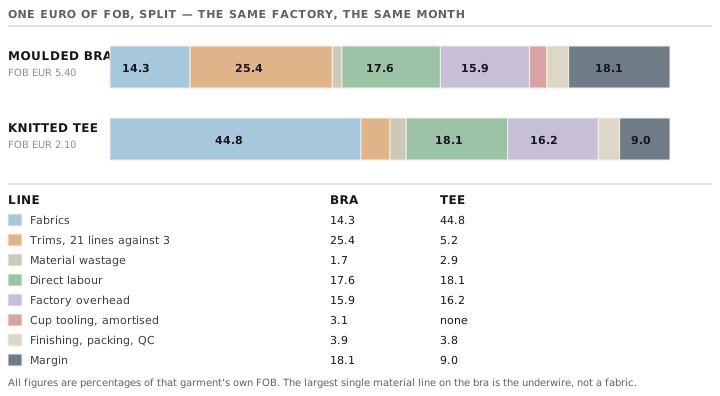
Three things in that table are worth more than the rest of the lesson.
Cloth is a minority line. On the tee, fabric is nearly half the price. On the bra it is a seventh. That is not because the cloth is cheap. The cup laminate is EUR 4.82 a metre, five times a jersey. It is because a bra uses almost none of it. The cup laminate consumes 0.085 m, the powernet 0.11 m and the lining tricot 0.055 m.
The largest single material line is not a fabric. It is the underwire at EUR 0.42, one cent above the cup laminate at EUR 0.41. Add the wire casing and the three elastics, and the narrow fabrics and hardware come to EUR 0.89, against EUR 0.77 for every piece of cloth in the garment.
Labour and overhead take about the same share on both. 33.5% on the bra, 34.3% on the tee. That is not a coincidence, and it is not good news. The bra earns its higher selling price by consuming 15.8 standard minutes against 6.4. So the minutes are not a smaller problem here. They are the same problem at a larger scale.
The lever that is worth a week
A merchandiser has only so much negotiating attention. Where does a week of it pay?
| Five per cent off | BR-6140 per piece | On the order | Share of the bra's margin |
|---|---|---|---|
| Fabrics | 0.0385 | 347 | 3.9% |
| Trims | 0.0685 | 617 | 7.0% |
| Direct labour | 0.0475 | 428 | 4.8% |
On the tee, the same five per cent off the fabric is EUR 0.047 a piece, which is 24.7% of that garment's margin. A tee merchandiser who spends the week on fabric is doing the right thing. Bring the habit here and the same week moves 3.9%, while the trims that are worth nearly twice as much go out on a purchase order nobody read.
The trims are also where the negotiating room really is. There are twenty-one trim lines, and each one carries a minimum, a set-up and a freight consignment of its own. The ten Sahline lines were placed as four orders and four shipments. Putting them onto one order and one shipment took EUR 0.02 a piece off the sheet on its own. That is more than a five per cent fabric win, from an afternoon of scheduling.
The engineering answer that is not buyable
The cup is built from a moulded laminate and a separate tricot lining, sewn together. Verrone sells a laminate with the lining already bonded into it. Cost it properly:
- Laminate rises from EUR 0.41 to EUR 0.48
- The separate lining tricot at EUR 0.09 disappears
- The lining-attach operation, 0.61 standard minutes at Thalna's EUR 0.0601 a minute, is EUR 0.037
That is a net saving of EUR 0.057 a piece, or EUR 513 on the order. It also removes two bill lines and one operation. Standard minutes drop from 15.8 to 15.19, so the line's output rises from 452 pieces a day to 470.
Then read the minimum. The bonded laminate is made to order, and Verrone's minimum is 3,000 m a colour. At 0.085 m a bra, that is 35,294 bras per colour. This order is 3,000 bras a colour.
So the right engineering answer is not available at this quantity. That is not a failure of the analysis. It is the analysis showing you the category's real constraint, which is that component engineering in lingerie is unlocked by volume and by nothing else. Keep the calculation. Put it in front of the buyer with the programme, where it belongs, rather than in front of the order, where it cannot be bought.
Check yourselfThe buyer asks for EUR 0.15 off the FOB. Where do you look first, and what do you refuse?Show the answer
Not at the fabric. Five per cent off every metre of cloth in the garment is EUR 0.0385, a quarter of what is being asked. Look at the twenty-one trim lines and the operations attached to them: a bow removed, two labels combined, a consolidated shipment, a hardware finish that does not need a chip approval. Then look at the minutes, which are EUR 0.0601 each, so EUR 0.15 is two and a half minutes of work. That has to come out of the method, not out of the operator. What you refuse is the wire. It is the largest line and the one nobody sees, which is what makes it tempting, and a cheaper wire is a wire that migrates. Lesson 6 prices that.
One classification note, and a caution about it
Bras, girdles and corsets sit in their own tariff heading. That is unusual, because the rest of the tariff separates knitted garments from woven ones and puts them in different chapters. This heading covers the article whether or not it is knitted, and covers parts of it too. That matters commercially. A bra and a bra component can share a duty treatment, and the knit-or-woven question that decides classification for most garments does not decide it here.
Do not carry a rate away from this paragraph. Headings, notes and rates are revised, and preferential rates depend on the agreement in force between two named countries on a named date. Course 8.5 is where duty is actually calculated. The point here is only that this category's classification behaves differently from the rest of a wardrobe, so the answer you remember from a tee shirt is not the answer.
Prompt · Twenty-four clocks, and every minimum against a cell
Before you confirm a size range or issue a material deadline on a garment with more than about ten components.
Act as a lingerie factory's material planner. I need a component clock table and a minimum check, not a summary. Order facts: buyer [BUYER], purchase order [NUMBER], style [STYLE], quantity [QTY] pieces, price [PRICE] on FOB terms, colours [LIST], size range [LIST EVERY SIZE], cut date [DATE], date the goods leave the factory [DATE]. Bill of materials, one line per component, and for each line: description, supplier, price per piece, quoted lead time in days, minimum order quantity and the UNIT that minimum is written in (per order, per colour, per size, per metre), and whether it needs a colour approval, an artwork sign-off or nothing at all before its clock can start. My buyer's approval cadence: [HOW OFTEN, HOW MANY ITEMS PER SESSION, TYPICAL ROUNDS]. Do the following. First, count the components that need an approval before their clock starts, multiply by the colours, and give me the total number of approvals this style implies. Second, build the approval queue against the buyer's cadence and give each component the DAY its clock can actually start. Third, produce the clock table with columns: component, starting gun, gun fires on day, lead time, arrives on day, float against the cut date — sorted by ARRIVAL, not by lead time. Fourth, name the component that lands last and say what it costs per piece, because it is usually not the fabric. Fifth, take every minimum and check it against the quantity at the level the minimum is expressed in — if it is per size, check it size by size and show me the shortfall for each; do not check a per-size minimum against the order total. Sixth, price the overhang in money and per shipped piece, then repeat it against a [PROGRAMME QTY] annual programme so I can see both numbers. Seventh, list what I should change before confirming the range. Where an input is missing, ask for it rather than assuming.
AI can make mistakes — check anything you act on.
The summary you can use tomorrow
- Sort the bill by line count, then by value. Twenty-four lines is the cost driver. The euros are its shadow.
- Check the share of the selling price each group takes before deciding where to negotiate. If fabric is under twenty per cent, the fabric negotiation is not the week's work.
- Cost every proposed component change with three numbers: the material, the operation it removes, and the minimum that makes it real.
- Amortise tooling against the committed programme, and say which programme, in writing.
- Read the minutes as a capability, not as a rate. The bra earns more per piece, and it consumes more than twice the minutes to do it.