Lessons · Lesson 1 of 6
- 01 · Twenty-four components, twenty-four clocks
- 02 · Band and cup: a size system with two axes
- 03 · Millimetres, and a measurement that is a force
- 04 · Where the money is: trims and minutes, not cloth
- 05 · Swim: the chemistry the garment has to survive
- 06 · After the wash, and the defect an inspector cannot see
Twenty-four components, twenty-four clocks
Plan a garment whose finish date is the latest of twenty-four material clocks, not the longest one you happened to look at.
Lesson 1 of 6 · 17 min
The order
6 February. Purchase order AU-5507 from Aubrette, a Paris lingerie and swim house, to Thalna Intimates in Beni Khiar, Tunisia.
Style BR-6140, a moulded T-shirt bra. 9,000 pieces, three colours — Black, Almond and Cassis — and twenty-five sizes. Price EUR 5.40 on FOB terms, which means the factory delivers the goods loaded on the ship. Order value EUR 48,600. Cutting opens 28 April. The goods leave the factory on 29 May.
Sirine Bouchiba is the merchandiser at Thalna. She has run this factory's tee-shirt and legging programmes for four years. She builds the plan the way she always does. Find the material with the longest lead time. Count backwards from the cut date. Manage everything else against that date.
On BR-6140 the fabric is quoted at 42 days. She takes 42 days off 28 April, adds a round for the lab dip, and issues a material deadline. Every supplier delivers inside its own quoted lead time. Cutting still opens 5 days late, and putting it right costs EUR 3,940.
Nobody made a mistake. The plan asked the wrong question.
A bill of materials with twenty-four lines
A knitted tee has three material lines that matter: body fabric, thread, labels. A fourth if it is printed. BR-6140 has 24 lines, from seven material suppliers:
| Group | Lines | Supplier |
|---|---|---|
| Cup laminate, powernet frame and wing, cup lining tricot | 3 | Verrone Tricot |
| Underwire, one matched pair | 1 | Ormsby Wire |
| Wire casing tape, underband elastic, cup-edge elastic, strap elastic, cup foam binding | 5 | Halverston Elastics |
| Rings and sliders, four coated pieces | 1 | Vertine Hardware |
| Hook-and-eye tape, gore bow, bridge tape, strap patch, four labels and tickets, size sticker | 10 | Sahline Trims |
| Body thread and looper thread | 2 | the thread house |
| Polybag, carton and divider | 2 | the packaging converter |
Do not read that as one bill. Read it as twenty-four separate promises. Each line has its own price, its own minimum order quantity, its own lead time and its own check on arrival. And each line has its own starting gun — the moment its clock is allowed to start. That is the part the plan missed.
Seven of the twenty-four are dyed to the garment's colour: the three fabrics, three of the elastics, and the hook-and-eye tape. In three colours that is 21 lab dips for one style. A lab dip is a small piece of the real material dyed to the buyer's colour standard and sent for approval. A plain tee needs one. The rings and sliders are not dyed at all. They are lacquered metal, so they need an approved coated chip instead.
The finish is a latest date, not a length
If a garment needs one material, the material clock is that material's lead time. If it needs twenty-four, the clock is the latest of twenty-four finishing dates. A latest date behaves differently from an average. It never improves when you add another line. Every component you add can only push the finish later, or leave it where it is.
So "the fabric is the long lead time" is a habit, not a rule. It is true on a tee, because a tee has almost nothing else in it. On BR-6140 it is false. The drawing shows why.
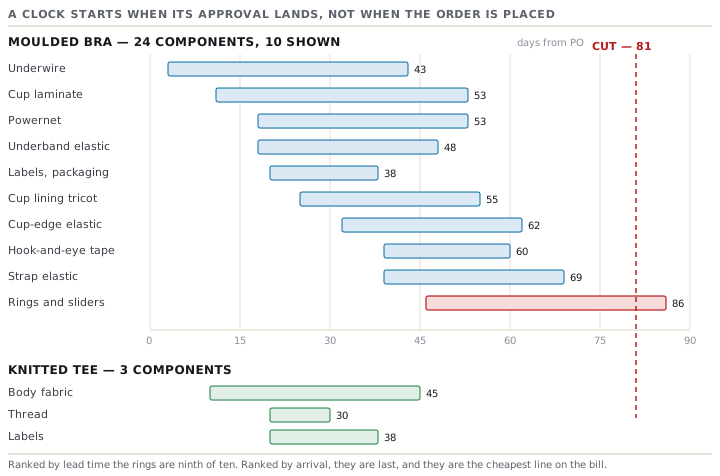
Days are counted from the day the purchase order was confirmed. Cutting opens on day 81.
| Component | Starting gun | Gun fires | Clock | Arrives |
|---|---|---|---|---|
| Underwire | PO confirmed | day 3 | 40 days | day 43 |
| Cup laminate | dip approved | day 11 | 42 days | day 53 |
| Powernet | dip approved | day 18 | 35 days | day 53 |
| Underband elastic | dip approved | day 18 | 30 days | day 48 |
| Cup lining tricot | dip approved | day 25 | 30 days | day 55 |
| Cup-edge elastic | dip approved, round two | day 32 | 30 days | day 62 |
| Labels and packaging | artwork signed | day 20 | 18 days | day 38 |
| Hook-and-eye tape | dip approved, round two | day 39 | 21 days | day 60 |
| Strap elastic | dip approved, round two | day 39 | 30 days | day 69 |
| Rings and sliders | chip approved, round three | day 46 | 35 days plus freight | day 86 |
The fabric is the thing the whole plan was built on. It lands on day 53 with 28 days to spare. The line that misses is the last one in the table, and it is the cheapest piece of hardware on the bill.
The component that did it costs six cents
Four pieces of coated metal — two rings and two sliders — cost EUR 0.06 the set. On a EUR 5.40 bra that is 1.1% of the price.
Here is its chain. Aubrette issued the colour standards on day 6. Vertine sent a lacquered chip in each colour. Round one was rejected. Round two matched the Cassis fabric under the store's own light, but read visibly pink beside it under daylight. That is a metameric pair: two samples that match under one light and separate under another. Round three was approved on day 46. Thirty-five days of coating took it to day 81, and five days of freight took it to day 86.
Metamerism is not carelessness. You are asking a lacquer on metal to match a disperse dye on nylon. Two different materials, two different ways of reflecting light. No dyehouse in the world can make them agree under every light. The right answer is to approve hardware against a stated pair of lights, and to accept a small, named difference. That is exactly what Aubrette's own standard says, three pages after the page anybody reads.
What five days cost
Cutting opened on day 86 instead of day 81. Five days late at the cut is five days late leaving the factory, and 29 May was the last date for the 4 June sailing. The next sailing was 7 June.
Thalna flew the order instead. Nine thousand bras are light and bulky. They weigh 765 kg, but once the cartons are measured the airline charges for 1,900 kg. Air freight at EUR 2.40 the chargeable kilogram is EUR 4,560, against EUR 620 by sea.
- Extra freight: EUR 3,940
- Per bra: EUR 0.44
- Against the component that caused it, at EUR 0.06: 7.3 times its own cost
The minimum nobody priced
The wire has a second problem, and it does not show on a lead-time chart at all. Ormsby forms wires on tooling built for one size, so its minimum is 3,000 pairs per wire size, not per order. BR-6140 uses 9 wire sizes. Lesson 2 explains why. On this order the largest wire size needs 1,785 pairs and the smallest needs 180. Not one of the nine reaches the minimum.
- Wires needed: 9,000 pairs. Wires that must be bought: 27,000 pairs.
- The excess is 18,000 pairs at EUR 0.42, which is EUR 7,560, or EUR 0.84 on every bra shipped.
The margin on this bra is EUR 0.98. That single line would take the order to break-even. It does not, because Thalna does not buy wire against one order. Aubrette's programme is 36,000 pieces across the year. At programme volume, five of the nine sizes clear the minimum on their own. Only the four small tail sizes carry an excess: 5,040 pairs, EUR 2,116.80, EUR 0.06 a piece.
The same component, the same price, the same minimum: EUR 0.84 on an order, EUR 0.06 on a programme. Fourteen to one. This is the arithmetic behind something every lingerie factory knows and few tee-shirt factories meet. This category is a programme business. A one-off order in it is mispriced unless somebody has priced the minimums.
Check yourselfA buyer asks you to quote 4,000 pieces of a wired style as a one-off, with the same size range. What do you check before you give a price?Show the answer
The component minimums, size by size, before the lead times. On a 4,000-piece order the wire alone is nine sizes at a 3,000-pair minimum: 27,000 pairs bought against 4,000 needed, EUR 9,660 of excess, EUR 2.42 on every piece. The honest answers are a shorter size range, a price that carries the excess, a wire size already in the factory's stock, or a refusal. All four are decisions, and none of them can be made after the size range has been confirmed. Lead time is the second question here, not the first.
What to do instead
- Write the bill of materials with a line per component, not a line per group. Twenty-four lines, seven suppliers.
- Give every line two dates: when its clock starts and when it arrives. The start date is a colour approval, an artwork sign-off, or the purchase order itself.
- Sort by arrival, never by lead time. The last arrival is your material deadline. Everything else has spare time.
- Count the approvals the plan needs. Twenty-one lab dips and three hardware chips are not paperwork. They are twenty-four starting guns, and they queue.
- Check every minimum against the quantity for that size, not the order total, before the size range is confirmed.
- Price the difference between an order and a programme, and say which one you are quoting.
Prompt · Twenty-four clocks, and every minimum against a cell
Before you confirm a size range or issue a material deadline on a garment with more than about ten components.
Act as a lingerie factory's material planner. I need a component clock table and a minimum check, not a summary. Order facts: buyer [BUYER], purchase order [NUMBER], style [STYLE], quantity [QTY] pieces, price [PRICE] on FOB terms, colours [LIST], size range [LIST EVERY SIZE], cut date [DATE], date the goods leave the factory [DATE]. Bill of materials, one line per component, and for each line: description, supplier, price per piece, quoted lead time in days, minimum order quantity and the UNIT that minimum is written in (per order, per colour, per size, per metre), and whether it needs a colour approval, an artwork sign-off or nothing at all before its clock can start. My buyer's approval cadence: [HOW OFTEN, HOW MANY ITEMS PER SESSION, TYPICAL ROUNDS]. Do the following. First, count the components that need an approval before their clock starts, multiply by the colours, and give me the total number of approvals this style implies. Second, build the approval queue against the buyer's cadence and give each component the DAY its clock can actually start. Third, produce the clock table with columns: component, starting gun, gun fires on day, lead time, arrives on day, float against the cut date — sorted by ARRIVAL, not by lead time. Fourth, name the component that lands last and say what it costs per piece, because it is usually not the fabric. Fifth, take every minimum and check it against the quantity at the level the minimum is expressed in — if it is per size, check it size by size and show me the shortfall for each; do not check a per-size minimum against the order total. Sixth, price the overhang in money and per shipped piece, then repeat it against a [PROGRAMME QTY] annual programme so I can see both numbers. Seventh, list what I should change before confirming the range. Where an input is missing, ask for it rather than assuming.
AI can make mistakes — check anything you act on.
Courses 7.1 and 8.6 build the critical path and the material requirement plan in general. Course 27.3 shows what an approval queue does across a portfolio. Nothing here replaces them. What changes in this category is the count: twenty-four lines instead of four, and a finish date that is the latest of all of them.