Lessons · Lesson 6 of 6
- 01 · A colour is a measurement, and a measurement carries its conditions
- 02 · The screen is an emitter and the garment is a reflector
- 03 · Why a render can never disagree with itself
- 04 · A digital material is two halves, and one of them is usually missing
- 05 · The library nobody curates
- 06 · The library is a lead-time asset, and the unit is days
The library is a lead-time asset, and the unit is days
Work out what a curated colour library is worth by counting the approval cycles it lets you skip, and where those days actually land.
Lesson 6 of 6 · 18 min
The situation
The colour card was issued on 6 January. Fabric for the autumn range has to be booked by 9 March — 62 days. Every colour on the card has to be through approval before the booking, because a mill will not commit dyeing capacity to a shade nobody has agreed.
The head of merchandising asks the question this whole course has been building to. We have spent two years and a lot of money on digital product creation. What has it bought us?
The honest answer is not "better renders". It is that an approved colour does not have to be approved again, and that is countable in days.
What a re-use actually requires
An approval is not the approval of a colour. It is the approval of a dyeing, on a substrate, at a dyehouse. That is why the record's fields from lesson 5 matter here. To know whether last season's approval can be carried forward, you have to answer three questions from the data.
| Colour standard | Substrate | Dyehouse | What is needed now |
|---|---|---|---|
| Same | Same | Same | Nothing. The approval carries |
| Same | Same | Different | One confirmation submission, to prove this dyehouse reaches it on this cloth |
| Same | Different | Either | A full approval cycle. It is a different dyeing |
| New | — | — | A full approval cycle, and a standard has to be created first |
The third row is the one that costs people money, because it looks like a re-use. The colour genuinely is the same colour, and the record genuinely says approved. But a navy approved on poplin is not a navy approved on twill, because the same recipe on a different construction and a different finish gives a different result. Course 3.3 covers why. A library that stores only the colour cannot answer this question, so it will offer you re-uses that are not re-uses.
Thistlewaite's card sorts like this.
| Situation | Colours | Submissions each | Submissions |
|---|---|---|---|
| New colour, no record | 11 | 3 | 33 |
| In the library, all three keys match | 12 | 0 | 0 |
| In the library, new dyehouse | 6 | 1 | 6 |
| In the library, different substrate | 3 | 3 | 9 |
| Total | 32 | 48 |
The 3 at the bottom of that list are the ones the library would have offered as free if the substrate had not been in the record. They are worth exactly as much work as the 11 brand-new colours.
Where the days come from
Two numbers set the calendar, and neither of them is about any individual colour.
A round is 12 days. Four days for the dyehouse to prepare and dye a submission, three in transit, and five for the buyer's colour room to look at it and answer. Thistlewaite budgets 3 rounds for a colour needing a full approval, from its own record: last season 30 colours took 69 rounds, an average of 2.3.
The colour room settles 8 submissions a week. Two colourists, a light box, and the rest of the season's work to do as well. This is the number that decides the calendar, and almost nobody plans against it.
Because once the colours run in parallel — and they do, they all start on 6 January — the length of any single approval stops mattering. What matters is how long the queue takes to clear.
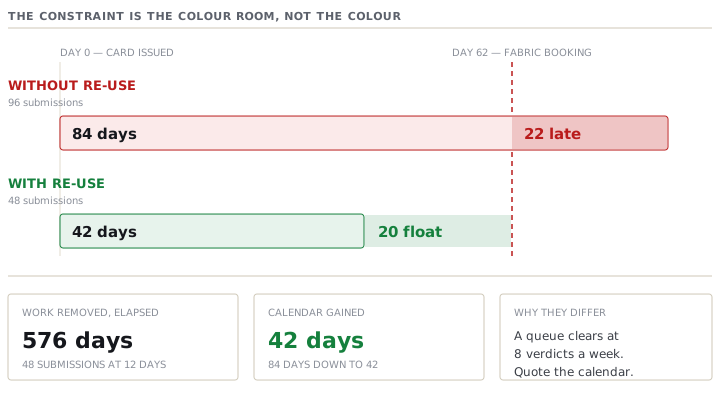
| Without re-use | With re-use | |
|---|---|---|
| Colours needing a full cycle | 32 | 14 |
| Colours needing one confirmation | 0 | 6 |
| Submissions to be judged | 96 | 48 |
| Weeks at 8 a week | 12 | 6 |
| Days | 84 | 42 |
| Against a window of 62 days | 22 days late | 20 days of float |
42 days. That is what a curated library is worth on this season, and it is the difference between a colour calendar that fits and one that does not.
The finding, and it is not the one people expect
Now put the two ways of counting side by side. They disagree by a factor of nearly fourteen, and both are correct.
48 submissions were removed from the season. At 12 elapsed days a round, that is 576 days of approval work that no longer has to happen.
The calendar gained 42 days.
Why the two numbers differ is worth understanding, because it also tells you where the next improvement is. The season's colour work is not limited by how long a colour takes. It is limited by how fast the buyer's colour room can judge submissions. Take work out of a queue and you take waiting time out of everything behind it. You do not shorten anything.
That has a practical consequence which surprises people. A second colourist in the buyer's colour room is worth roughly what the library is worth, because it moves the same constraint. Doubling the throughput from 8 to 16 a week would cut the without-re-use case from 84 days to 42 as well. The two levers are alternatives, and the library is the one that does not need a headcount approval — which is a better argument for it than any render ever made.
There is an honest caveat on the 42, and it is worth saying out loud when you present it. The arithmetic above treats the colour room as clearing exactly 8 submissions every week. Real queues do not behave that way. Submissions arrive unevenly, a colourist takes leave, and the closer a queue runs to its capacity the more waiting time grows out of proportion to the work. So 84 days is an optimistic estimate of the without-re-use case, not a pessimistic one. That makes the case for the library stronger rather than weaker, and it makes the 20 days of float in the other column something to protect rather than something to spend.
What the 42 days are for
Days only matter if something is waiting for them. On this season three things were.
- The fabric booking on 9 March. Without re-use the colour calendar finishes 22 days after it, so either the booking goes ahead on unapproved shades or the range ships late.
- Air freight. Thistlewaite's rule is that a first delivery which misses its floor-set date travels by air. The autumn first delivery is 1,860 kg. The brand's forwarder quotes USD 4.10 a kilo against USD 0.62 by sea, so the premium is USD 3.48 a kilo — USD 6,472.80 on one delivery.
- The float itself. 20 days of float is what absorbed the two incidents in this course without either of them delaying the range: 11 days on the navy in lesson 5, and 9 days on the taupe tape in lesson 3. The season finished with none left, which is the honest verdict on how much slack there really was.
Prompt · Turn the library into a date
The day next season's colour card is drafted, and any time somebody asks what the digital programme has bought.
Act as a merchandising planner who thinks in constraints rather than in totals. I want next season's colour approvals turned into a date, and I want to know what re-use is genuinely worth. Facts: colours on the card [LIST OR NUMBER], the date the card is issued [DATE], the date fabric must be booked [DATE], for each colour the substrate it will be realised on and the dyehouse that will dye it [LIST], what the library holds for each colour and what it was approved FOR — standard, substrate, dyehouse, date [PASTE], the rounds a full approval is budgeted at and the measured average from last season [NUMBERS], the elapsed days in one round broken into preparation, transit and verdict [NUMBERS], and how many submissions the buyer's colour room settles a week [NUMBER]. Do the following. First, sort every colour into one of four states: all three keys match so the approval carries; standard and substrate match but the dyehouse is new, so one confirmation submission; standard matches but the substrate differs, which is a full cycle; brand new. Give me the count in each and the submissions each state generates. Second, total the submissions both ways — as if nothing were re-used, and as sorted — divide each by the weekly throughput, convert to days, and set both against my window. Say plainly whether each fits and by how many days. Third, give me the calendar gain and, separately, the elapsed approval work removed, and tell me which of the two to put in front of a director and why. Fourth, name my binding constraint and tell me what else would move it by the same amount. Fifth, list what I can do in October if the calendar does not fit — colours to cut, colours to move onto an existing substrate, capacity to ask the buyer for — with the days each option returns. Treat the weekly throughput as a smooth rate only if I have given you no evidence of variability, and say that this makes your estimate optimistic.
AI can make mistakes — check anything you act on.
Check yourselfYour library says a colour is approved. The style uses the same cloth as last season, but a different mill is dyeing it. What have you got?Show the answer
A strong head start, and not a finished approval. The standard is agreed and the substrate is unchanged, and both of those are real work you do not repeat. But the new dyehouse has never made this colour on this cloth, and its recipe will be built from its own dye stock. Budget one confirmation submission rather than a full cycle: send the measured standard, ask for a single dyeing on the bulk quality, and check it the way you would check any submission. On this season that difference is worth two rounds a colour, which across six colours is twelve submissions the colour room does not have to judge.
Check yourselfYou tell your director the colour library saved 576 days, and they ask why the range still shipped in the same week. What is the answer?Show the answer
That the 576 is elapsed approval work removed from parallel tracks, and the calendar only moves by what the constraint allows. Here the constraint is the buyer's colour room at 8 submissions a week, which turns 48 removed submissions into 42 days. Both figures are true and only the second is a date. The right way to present it is the second one first: the colour calendar went from 84 days to 42 against a 62-day window, so it now fits with float. Then, if anybody wants the size of the effort avoided, give them the 576 as background rather than as the headline.