Lessons · Lesson 1 of 6
- 01 · A colour is a measurement, and a measurement carries its conditions
- 02 · The screen is an emitter and the garment is a reflector
- 03 · Why a render can never disagree with itself
- 04 · A digital material is two halves, and one of them is usually missing
- 05 · The library nobody curates
- 06 · The library is a lead-time asset, and the unit is days
A colour is a measurement, and a measurement carries its conditions
Read a colour library as data, and know what a record must carry before anybody outside your building can use it.
Lesson 1 of 6 · 20 min
The situation
6 January 2027, a design studio in Skipton. Thistlewaite is a UK clothing brand. It has just closed its autumn colour card: 32 colours. Three of them sit on style TW-4180, a cotton twill overshirt. That is 6,200 units on purchase order TH-2711 to Sundargarh Apparel in Bhiwandi. The price is FOB USD 19.40 — FOB means the factory's price with the goods loaded at the port, so the freight is the buyer's. Order value USD 120,280. The three colours are Tolbooth Navy, Redwing Orange and Rushmere Taupe.
Over Christmas the studio moved six seasons of colour into a new product system. 214 colour entries came across. This morning the merchandiser has one instruction from the head of design: send the mill the colours.
That sentence hides the whole subject of this course. Course 3.3 covers how a colour is agreed and enforced as a physical craft: the lab dip chain, the light box, the shade band, what a fastness failure costs. This course starts one layer underneath. What has to be true of a colour written down as a number, so that it arrives as the same colour in a building three thousand miles away?
Four kinds of entry, all in one field called Colour
The merchandiser opens the library and sorts the 214 entries by what they really contain.
| Kind of entry | What the record holds | What it can be used for | How many |
|---|---|---|---|
| Measured | The reflectance curve, the measurement conditions, and coordinates worked out from them | Sent to a mill as a target; recomputed under any light; compared to any other measured record | 61 |
| Colorimetric only | Three coordinates, and the light and the observer they were computed under. No curve | Compared to another record measured the same way, under that one light. Nothing else | 88 |
| Code or name only | A colour system reference, or a house name, pointing at a physical card in a drawer | Finding the card, if the card still exists and has not aged | 47 |
| Screen value only | Three display numbers lifted out of a design file, with no colour space named | Nothing. These are instructions to a screen, not a colour | 18 |
61 of 214 — 28.5% of the library — can be used without going back to a physical object. Each of the other 153 entries costs somebody a search, a courier or a fresh measurement before a mill can start.
Now sort the autumn card the same way. Of the 32 colours, 21 already exist in the library in some form and 11 are new. Of the 21, only 9 carry a curve. 12 do not.
The one-way door
Here is the sentence to keep. Three coordinates are a computation. A curve is the measurement.
A spectrophotometer — the instrument that reads colour — does not measure a colour. It measures how much light the surface sends back at each wavelength across the visible range. That list of numbers is the reflectance curve.
Coordinates are then calculated from the curve. You combine the curve with a chosen illuminant (the light you are assuming) and a chosen standard observer (an agreed model of average human vision). Change the illuminant and the same measurement gives you different coordinates. Both sets are correct.
That calculation runs one way only. From the curve you can work out the coordinates for any illuminant and any observer, this year or in ten years, including one the buyer has not asked for yet. From the coordinates you cannot get back to the curve. The information was thrown away when the number was produced. A library that stores the output of the calculation has thrown away the input.
That is why a bare colour code and a bare RGB triple are different failures that look the same on screen. RGB is the red, green and blue triple a display works in. The code points at an object that may have faded or been thrown out. The triple points at nothing at all: it is an instruction to a screen, and until somebody names the colour space it was written in, it does not identify a colour. Lesson 2 is all about that.
What a record has to carry
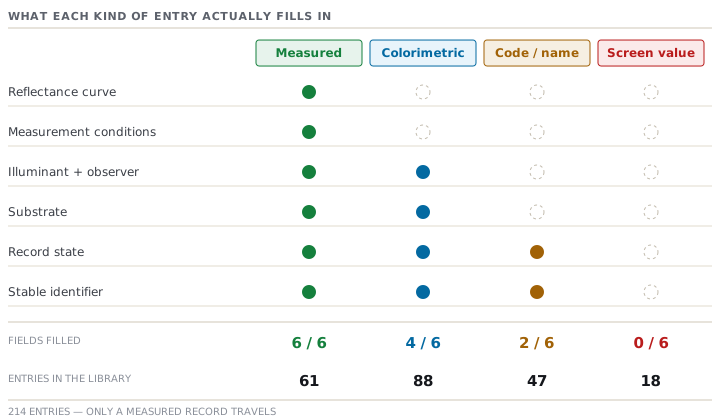
A colour record somebody can work from anywhere carries six things.
- The curve — the reflectance measurement itself. It is the only part that is not somebody's arithmetic.
- The measurement conditions — the instrument geometry, the size of the opening it reads through, and how the sample was presented. Cloth measured as one layer over a white backing and the same cloth measured folded are not the same measurement, and the record has to say which one it is. Course 3.3 covers the craft of taking that reading. The discipline here is that the conditions travel with the number.
- The illuminant and the observer used to work out any coordinates in the record. Those coordinates mean nothing without them.
- The substrate the standard was made on: the fibre, the construction and the finish of the cloth it was dyed on. A colour is not a free-floating property. It is what one particular material does to light.
- The state of the record — proposed, measured, approved, superseded. Lesson 5 is about what happens when this field does not exist.
- An identifier that is not the name. Lesson 5 again, and it costs Thistlewaite eleven days.
Two kinds of record get confused all the time, so separate them now. A standard is the target: what everybody is trying to make. A measurement of a submission is what somebody actually made. They have the same fields and completely different authority. A library that files them together will one day let somebody match to a lab dip.
The mistake nobody made
Thistlewaite did the expensive part properly. Marchmont Colour, an independent colour bureau, measured all 32 standards in the first week of January. It sent one file per colour, carrying the curve and the conditions. That is exactly right, and most brands do not do it.
Then five ordinary, correct decisions followed.
- The colour field in the product system was set up to hold a name, a house code and three coordinates. That is what a colour field held in every system anybody in the room had used before.
- The measured files did not fit in that field, so they were attached to the record as documents. Attaching a file to the record it belongs to is good practice.
- The integration developer mapped the mill-facing feed to the fields, because a feed is built out of fields. Attachments are documents. They belong to people, not to systems.
- The recipe system at Chandori Mills pulled Rushmere Taupe over that feed in May and got the coordinates. It matched to them, correctly.
- Nobody noticed, because the mill's first dip came back inside tolerance under the light the coordinates had been computed for.
Every one of those decisions is defensible on its own, and there is nobody to blame. The outcome is that the measurement was in the building from January and never reached the mill. Rushmere Taupe was matched to a point instead of to a curve. Lesson 3 is the bill for that, and it arrives on the trim tape rather than on the cloth.
What the merchandiser sends this morning
Not "the colours". A list, colour by colour, with a state against each.
- 9 colours go out as measured records. Complete, ready for a mill to work from.
- 12 colours are in the library but carry no curve. Each one needs either the kept physical standard measured again by Marchmont, or a fresh standard. That is a job with a cost and a date on it, and it goes on the critical path today rather than in March.
- 11 colours are new and have no record at all. They need a standard created, which is a decision about what the colour is before it is a decision about how it is stored.
That list is the deliverable of this lesson, and the honest version of the instruction the merchandiser was given. "Send the mill the colours" is not a task until somebody has said which of the 32 are colours and which are pointers to something that may no longer exist.
Prompt · Audit a colour library handover
The week a colour card is issued, or the week you inherit somebody else's library, and before anybody is told to send the colours to a mill.
Act as a colour technologist who has taken over a brand's colour data and has to tell the merchandising team what they actually have. I will paste an export of a colour library and a season's colour card. Facts: brand [BRAND], season [SEASON], colours on the card [NUMBER], entries in the library [NUMBER], the fields the library holds [LIST THEM EXACTLY AS THE COLUMN HEADINGS READ], what the mill-facing export or API feed carries [LIST THOSE FIELDS SEPARATELY], the colour bureau or lab that measures standards [NAME], the mills and dyehouses in play [LIST]. Library export: [PASTE]. Colour card: [PASTE]. Do the following. First, classify every library entry into one of four kinds — measured with a spectral curve and its measurement conditions; colorimetric only; code or name only; screen value only — and give me the count and the percentage of each, saying for each kind exactly what it can and cannot be used for. Second, sort this season's card against the library and tell me, colour by colour, whether it exists as data, exists only as a pointer to a physical object, or does not exist at all. Third, and separately, tell me what the MILL-facing feed carries as opposed to what the record carries, and say plainly whether the spectral data reaches the mill — treat an attachment as not reaching it unless I tell you the feed serves attachments. Fourth, list the colours where a missing curve will cost the most, which are the shades mixed from three or four dyes and any colour appearing on two substrates from two suppliers. Fifth, write me the email asking for what is missing, addressed to the colour bureau, naming each colour and what I need for it. Do not guess at any count: if the export does not let you tell, say so and tell me which column would.
AI can make mistakes — check anything you act on.
Check yourselfYour buyer sends a colour as a code plus three coordinates and names the illuminant and observer. Is that enough to send to a mill?Show the answer
It is enough to start. It is not enough to finish. The mill can build a recipe that lands on those coordinates under that one light, and it will pass a check made the same way. What it cannot do is tell you whether the recipe behaves like the standard under a second light. That comparison needs both curves, and you have supplied a point. So accept it, start the work, and ask for the measured file in the same reply. Name the colours where it matters most: the mixed, muted shades of lesson 3. You are not asking for a favour. Any bureau that measured the standard already has the curve.
Check yourselfWhy is an RGB triple pulled from a design file worse than a colour code, when the code points at a card that may have faded?Show the answer
Because a faded card is a damaged reference, and a triple with no colour space is not a reference at all. The code at least names a colour that exists in the world, and a current card can be bought. The triple is a set of instructions to a screen. The same three numbers make visibly different colours on two displays, and until somebody states the colour space they were written in, there is no way to say which colour was meant. A faded card is a measurement problem, and you fix it by measuring. A triple with no space is a missing specification, and no amount of care downstream brings it back.