Lessons · Lesson 4 of 6
One model, one body: the grade rule is the rest of the range
See why fit complaints gather at the ends of a range, and why the cheapest repair is the grade rule and the most expensive one is another fit session.
Lesson 4 of 6 · 20 min
14 September: excellent evidence about one person
Halla has been Ostley's fit model for four years. She is a size 10, and she is a good one. Measured on the same afternoon as the scan calibration, her waist is 75.7 cm against the scan median of 75.9, and her hip is 99.4 cm against 99.6. Within two millimetres of the middle of the size band, at both girths.
So every fit session Ostley has ever run is high-quality evidence. It is evidence about size 10.
OS-2214 goes through four fit rounds on Halla. A round costs USD 486.00 — two samples, courier, and an hour of three people's time — and takes 11 days. The fourth round is approved on 14 September with no comments left open. The trouser fits.
Then it is graded, and grading is where nine garments are created out of one.
The grade rule is a claim, and it is the same claim as the chart
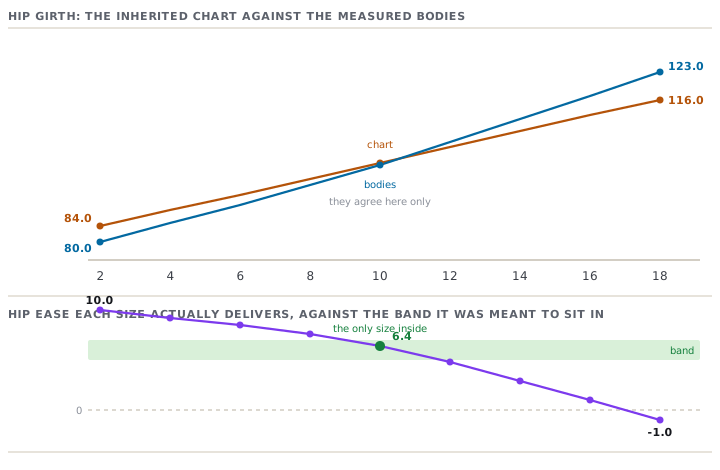
Ostley's grade rule is the same step everywhere: 4.0 cm at the waist and 4.0 cm at the hip, from size to size, all the way up and all the way down. It was inherited alongside the chart in lesson 1, and it says the same thing that chart says — that bodies get bigger without changing shape.
The scan says otherwise, and it says it in a straight line that bends.
| Size | Chart waist | Measured waist | Chart hip | Measured hip | Measured hip step |
|---|---|---|---|---|---|
| 2 | 60.0 | 60.4 | 84.0 | 80.0 | |
| 4 | 64.0 | 64.1 | 88.0 | 84.8 | 4.8 |
| 6 | 68.0 | 67.8 | 92.0 | 89.5 | 4.7 |
| 8 | 72.0 | 71.7 | 96.0 | 94.4 | 4.9 |
| 10 | 76.0 | 75.9 | 100.0 | 99.6 | 5.2 |
| 12 | 80.0 | 80.4 | 104.0 | 105.2 | 5.6 |
| 14 | 84.0 | 85.2 | 108.0 | 111.1 | 5.9 |
| 16 | 88.0 | 90.3 | 112.0 | 117.0 | 5.9 |
| 18 | 92.0 | 95.6 | 116.0 | 123.0 | 6.0 |
Read the last column. The measured hip step is 4.8 cm at the bottom of the range and 6.0 cm at the top. It is not one number. The chart uses 4.0 everywhere, so the chart and the bodies agree at size 10 and pull apart in both directions — by 4.0 cm at size 2 and by 7.0 cm at size 18, in opposite directions.
Of course they agree at size 10. Size 10 is the size that fifteen years of fit sessions have corrected. The chart is right in exactly one place, and that is the place it has been tested over and over.
What the person wearing it actually gets
Ostley's policy is 2.0 cm of waist ease and 6.0 cm of hip ease, and the specification allows plus or minus 1.0 cm. Take the garment as specified, and set it against the body the scan found at each size.
| Size | Waist ease delivered | Hip ease delivered | Hip inside tolerance |
|---|---|---|---|
| 2 | 1.6 | 10.0 | no |
| 4 | 1.9 | 9.2 | no |
| 6 | 2.2 | 8.5 | no |
| 8 | 2.3 | 7.6 | no |
| 10 | 2.1 | 6.4 | yes |
| 12 | 1.6 | 4.8 | no |
| 14 | 0.8 | 2.9 | no |
| 16 | -0.3 | 1.0 | no |
| 18 | -1.6 | -1.0 | no |
The hip ease runs from 10.0 cm at the small end to minus 1.0 cm at the large end. One size out of nine delivers the ease the policy asked for, and it is the size the fit model wears.
Now the part that should be uncomfortable. Every one of those nine garments passes final inspection. The inspector measures the garment against the specification. The specification is the chart plus the ease. And the garment matches it at every size, well inside tolerance. Nothing in the quality system can find this, because the document the quality system checks against is the thing that is wrong.
Two complaints, one cause
Lesson 1 quoted the free-text returns. The small sizes said gapes at the waist, bags under the seat. The large sizes said tight across the seat, cannot sit down. Read those two sets separately and you reasonably conclude there are two problems, and that they contradict each other.
There is one problem. A uniform grade rule applied to a population whose shape changes with size gives you too much room at one end and too little at the other, from a single garment that was correct at the base. Both complaints are the same fault, measured from opposite sides.
The two repairs, priced
| Another fit session | Re-grade from the measured chart | |
|---|---|---|
| Pattern room time | included | USD 308.00 |
| Samples | 2 | 4, at the two extremes |
| Cost | USD 486.00 | USD 569.20 |
| Calendar | 11 days | 9 days |
| What it tests | size 10, again | the ends, for the first time |
| What it fixes at the ends | nothing | the grade, on every style on this block |
The two numbers are within USD 83.20 of each other, and one of them cannot possibly work. The fit session tests a body that is already within two millimetres of the median; there is nothing there to find. The re-grade replaces the uniform step with the measured one and corrects every size at once. And because it corrects the block — the master pattern a whole family of styles is drafted from — rather than the one style, it corrects every trouser Ostley develops on that block afterwards.
Set the re-grade against the damage. The four end sizes cost USD 155,849.40 a year in fit returns alone, before any lost sale. That is 273.8 times the cost of the re-grade.
Course 4.4 owns what belongs in a size set and why the ends rather than the middle; take that as read. What this lesson adds is the reason the ends are where the error lives. It is not that a buyer's graded chart broke its own rule. It is that a uniform grade rule is a claim about how bodies change shape, and the claim is measurably false — so the error is zero at the base and grows with every step away from it.
Check yourselfYour fit model reports the base size as slightly tight through the hip, and your large-size returns say the same thing. Do you correct the base pattern?Show the answer
Not until you know whether the two are the same problem, and finding out costs nothing. Take the ease your specification intends at the hip, and subtract it from the ease each size actually delivers against your measured body chart. If the delivered ease is short at every size by about the same amount, the base really is tight and correcting it is right. If it is correct at the base and falls away as the range rises, the base is fine and the grade is the fault — and correcting the base will make the small sizes worse while barely touching the large ones, because the correction is spread over the whole range. Two complaints that sound identical can have opposite fixes, and the arithmetic that separates them is a subtraction on nine rows.
Prompt · Check a grade rule against measured bodies
Before you book another fit session on the base size to answer a complaint that came from the ends of the range.
Act as a pattern-room manager who grades ranges for a living and is willing to tell me the fit session I have booked is the wrong spend. I want my grade rule tested against the bodies it is supposed to serve. Here is what I have. The range: [SIZES]. My graded body chart, row per size, column per point of measure: [PASTE IT]. My grade rule as the pattern room applies it, in steps per size: [PASTE IT]. My written ease policy by point of measure, if one exists: [PASTE IT OR SAY THERE IS NONE]. My finished-garment specification with tolerances: [PASTE IT]. Any measured body data I hold about my own customers — a scan study, a fitting programme, a returns measurement exercise: [PASTE IT, WITH SAMPLE SIZE AND HOW IT WAS MEASURED]. Complaints or returns by size, with reasons: [PASTE THEM]. Do the following. First, put my grade rule beside the measured steps in one table, point of measure by point of measure, and tell me where they agree and where they diverge, with the size at which the divergence passes my tolerance. Second, compute the ease each size actually delivers to the measured body at that size, and mark every size where the delivered ease falls outside the tolerance my specification allows. Say how many of my sizes deliver the ease I intended. Third, tell me whether my complaints are consistent with a grade problem, a base problem, or both, and give me the arithmetic that separates them rather than an opinion. Fourth, price two responses for me: another fit session on the base size, and a re-grade from the measured chart with a size set at the extremes. Use my own costs where I have given them and say clearly which numbers you assumed. Fifth, tell me what a re-grade will not fix, and be specific about the difference between systematic error and the spread of real bodies inside one size. Sixth, write the two-paragraph note I should send to the buyer proposing the re-grade, with the evidence named. Do not recommend changing the base pattern on evidence that came from the ends of the range.
AI can make mistakes — check anything you act on.
What to take to your own range
- Write the grade rule down beside the measured body steps, one column each, and look at the two columns. If your rule is one number and the measured steps are not, you have a range that fits at the base and nowhere else.
- Treat every fit comment on the base size as a change to nine garments, and say so in the room before it is actioned.
- Price the ends. Fit returns, exchanges, alterations, size-specific markdown — whatever your business records — split by size. That number is what a re-grade is worth, and it is normally very large against a pattern-room afternoon.
- Re-grade the block, not the style. A style fix dies with the style; a block fix is still working three seasons later.