Lessons · Lesson 1 of 6
The sequence is forced
Why a digital programme has to be built from the bottom up, what happens to work done above a layer that does not exist yet, and how to read fourteen weeks of correct work that changed nothing.
Lesson 1 of 6 · 19 min
Fourteen weeks, forty-one virtual samples, nothing removed
Bezirhan Konfeksiyon makes tailored jackets and padded outerwear on six sewing lines outside Bursa. In a normal year it develops 142 styles for four buyers: Wraysbury, Norhaven, Selbourne and Marlstone. To do that it ships 483 physical sample rounds a year. That is an average of 3.40 rounds a style.
In March it started a digital product creation programme. That means building and fitting a garment on a screen instead of sewing one. Bezirhan bought four seats, refreshed the workstations, ran a training week, and hired a genuinely good 3D technician, Deniz Yalman, from a competitor.
Fourteen weeks later the programme had made 41 virtual samples. The number of physical sample rounds it had removed from the calendar was 0.
Nobody was lazy. Nothing was mis-sold. The garments on screen looked like garments. The technical manager, Emre Balkan, could not explain to the owner why fourteen weeks of correct work had changed nothing. The reason is the most important idea in this course. He had started at the top of a stack that had no bottom.
The three things that were missing, and they were all underneath
Ask why a buyer's technologist would not judge fit from those 41 files. Three answers come back. Each one is a layer that had not been built.
The cloth was a guess. All 41 were simulated on a general woven preset, which is a set of default cloth settings that ships with the software. Bezirhan had not measured one of its own fabrics. So the software was told nothing about how its cloth bends, stretches, shears or hangs. A jacket in a limp preset and the same jacket in a firm woollen cloth are different garments on screen. The one on the screen was neither.
The blocks were objects, not records. A block is the master pattern a factory cuts a style from. Bezirhan's live set is 38 blocks. Every one of them is correct. Every one has also been amended on the table over the years: a millimetre here, a deeper scoop there. Each amendment was made to the piece of card, and never to any record. The digital versions were traced from that card. So they carried the amendments the tracer could see, and lost the ones the cutting room had already absorbed into habit. The virtual garment was not the garment Bezirhan cuts.
The colour was whatever the monitor did. No measured colour, and no profiled display. Nobody was going to approve a colourway from it, and nobody sensibly asked.
Course 22.2 covers how a material is characterised, which means measured so the software knows how it behaves. Course 22.3 covers how colour and material libraries are built and kept. This lesson covers only the order they come in. All three sit underneath the thing everybody buys the software for.
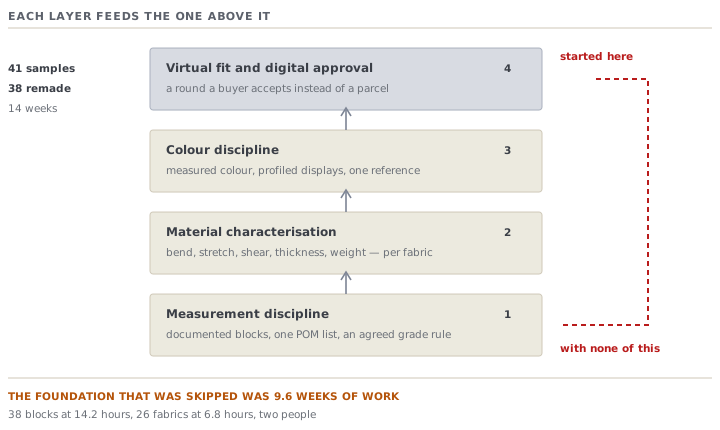
The stack, and why the order is not a preference
| Layer | What it supplies | What the layer above it does without it |
|---|---|---|
| Measurement discipline: documented blocks, one point-of-measure list, an agreed grade rule | A garment shape that matches what the factory actually cuts | Simulates a garment nobody makes |
| Material characterisation: bend, stretch, shear, thickness, weight, per fabric | Drape and fit behaviour that belongs to this cloth | Produces a picture, not a fit judgement |
| Colour discipline: measured colour, profiled displays, a shared reference | A colour two parties can argue about | Shows a colour that means nothing off this desk |
| Virtual fit and digital approval | A round a buyer will accept instead of a parcel | Nothing, which is what Bezirhan got |
This is not a maturity model, and it is not a philosophy. It is a dependency network, the same kind course 7.1 draws for an order. It has the same property. You may work on any activity you like. But an activity whose inputs do not exist will be done again when they arrive.
The arithmetic of building top-down
When the blocks were finally rebuilt from measured garments, 38 of the 41 virtual samples had to be remade. Three survived, for a reason worth noticing. They were the three styles cut in the one fabric that Ravenglass Mills, Wraysbury's nominated woollen mill, had already measured and supplied as data.
So 92.7% of fourteen weeks of skilled work was redone. A virtual sample costs USD 71.07: 4.6 hours of a 3D technician at Bezirhan's loaded rate of USD 15.45 an hour. Loaded means the wage plus everything the factory pays on top of it. The remake cost USD 2,700.66, and that is not the expensive part. The expensive part is the fourteen weeks.
Now price the foundation that was skipped:
- Rebuilding 38 blocks from measured garments: 14.2 hours each, 539.6 hours
- Characterising the 26 fabrics that carry most of the book: 6.8 hours each, 176.8 hours
- Two people at 37.5 hours a week: 9.6 weeks
The foundation was 9.6 weeks of work, and the programme spent fourteen weeks avoiding it. That sentence is the whole lesson. It is worth saying in the general form, because it will be true of your programme too. Work done above an unbuilt layer is not lost. It is repeated, once for every time the layer beneath it changes. The blocks changed once. Had they changed twice, the 41 would have been made three times.
What the fourteen weeks were actually worth
They were not worthless. Pretending otherwise is how a programme gets cancelled by an owner who was told a fairy tale. Bezirhan came out of them with three real things: a trained technician who now works four times faster than in week one, a written list of everything the software could not answer, and the knowledge that its own blocks were undocumented. Nobody in the building had known that, because a block that works is invisible.
What it did not come out with is a single round removed, a single day saved, or a single buyer who had agreed to anything. Those three are the only currencies this course counts in, and lesson 6 is entirely about refusing to count anything else.
Check yourselfYour 3D supplier proposes starting with your best-selling padded jacket next month. What do you need to know before you can say whether that is possible?Show the answer
Three things. Whether the block for that jacket exists as a record or only as a piece of card, and how many hours it is from being a record. Whether the shell, the lining and the wadding have been measured, or whether the software will be told to guess. And whether the buyer who approves that jacket has agreed to look at a screen at all. If the answers are card, guess and no, the month will produce pictures. That is not nothing, but it is not a round removed. Say so out loud before you start, rather than in week fourteen.
Prompt · Tell me which layer I am actually standing on
Before buying anything, or in month four when a programme is busy and nothing has come off the calendar.
Act as an experienced technical director who has run a digital product creation programme in a garment factory and is sceptical of demonstrations. I will describe where my company actually is. Tell me which layer of the stack I am standing on, and what has to exist beneath it before the work above it stops being repeated. My blocks: [HOW MANY IN THE LIVE SET], [HOW MANY EXIST AS A RECORD SOMEBODY ELSE COULD RE-CUT FROM WITHOUT THE CARD], [HOW MANY HAVE BEEN AMENDED ON THE TABLE WITHOUT THE RECORD BEING UPDATED]. My materials: [HOW MANY DISTINCT FABRICS IN LAST YEAR'S BOOK], [HOW MANY HAVE MEASURED BEND, STRETCH, SHEAR, THICKNESS AND WEIGHT], [WHERE THAT DATA CAME FROM — MILL, LAB OR A SOFTWARE PRESET]. My colour: [IS COLOUR MEASURED OR JUDGED ON A MONITOR], [ARE DISPLAYS PROFILED]. My point-of-measure lists: [ONE SHARED LIST OR ONE PER BUYER], [DO THEY MATCH THE BUYER'S LETTERING]. What I have already done digitally: [WHAT, HOW MANY STYLES, HOW MANY WEEKS]. Do the following. First, tell me which of the four layers is the highest one I can honestly claim to have built: measurement discipline, material characterisation, colour discipline, or virtual fit. Say what evidence would prove it. Second, for every piece of work I have already done above that layer, tell me how many times it will have to be redone, and what triggers each redo. Third, price the missing foundation in hours: blocks to rebuild, fabrics to characterise, and the elapsed weeks at the staffing I give you. Fourth, tell me the one thing I could stop doing this month because it is being done above an unbuilt layer. Be blunt, and do not tell me the software will solve any of it.
AI can make mistakes — check anything you act on.
What to take away
- A digital product workflow is a stack: measurement discipline, then characterised materials, then colour, then virtual fit. The order is forced by what each layer feeds the one above.
- Work done above an unbuilt layer is repeated once for every change underneath it. Bezirhan remade 38 of 41 virtual samples.
- The visible layer is the one that gets bought, because it is the only one with a demonstration.
- Bezirhan's skipped foundation was 9.6 weeks of work. Avoiding it cost fourteen.
- The only outputs that count are rounds removed, days saved and a buyer who has agreed. Fourteen weeks produced none of the three.