Lessons · Lesson 2 of 6
Choosing the pilot: representative beats easy
How to score four candidate pilots on what each one leaves behind, why two of them can remove no rounds at all whatever happens, and how a scoring sheet built from sensible criteria can have only one possible answer.
Lesson 2 of 6 · 19 min
Four candidates, and a steering group that had already decided
After the fourteen weeks of lesson 1, Bezirhan restarted with a rule: one programme, built from the bottom, with a written scope. Which programme?
Four were proposed. Read the table before you read the argument. The argument turns on one column that nobody had put in it.
| Candidate | Styles a year | Fabrics | Blocks | Buyers | Would the buyer judge on a screen? |
|---|---|---|---|---|---|
| A — repeat chino programme | 6 | 1 | 1 | Marlstone | Already approves from a photograph |
| B — padded outerwear | 44 | 17 | 6 | Norhaven, Selbourne, Wraysbury | One of the three |
| C — tailored jacket | 23 | 9 | 3 | Wraysbury | Yes, in writing |
| D — woven shirt | 12 | 4 | 2 | Selbourne, Marlstone | Neither |
Candidate A is the obvious pilot. It is small, it is stable, the pattern room has capacity for it, and its block is the simplest in the building. Every one of those is a real advantage. It was also, as it turned out, the worst of the four. Seeing why takes arithmetic rather than instinct.
What a pilot actually buys is the library it leaves behind
A pilot is not a test of whether the software works. That question is answered in a week, and the answer is always yes, for a meaning of "works" that removes nothing. A pilot buys you a characterised library and a set of documented blocks. Their value is the share of next year's book they serve. The book is the whole list of styles the factory develops in a year.
At Bezirhan's own measured rates — 14.2 hours a block and 6.8 hours a fabric — the four cost this much to build, and leave behind this much:
| Candidate | Hours to build the library | Styles a year the library serves | Share of the book | Hours per style served |
|---|---|---|---|---|
| A | 21.0 | 6 | 4.2% | 3.50 |
| B | 200.8 | 61 | 43.0% | 3.29 |
| C | 103.8 | 37 | 26.1% | 2.81 |
| D | 55.6 | 16 | 11.3% | 3.47 |
Two things fall out of that table. Efficiency barely separates them. Every candidate builds a library at between 2.81 and 3.50 hours per style served, because the work per block and per fabric is the same whatever you point it at. And the cheap pilot is cheap because it buys almost nothing. A's whole library is one block and one fabric. Next year it will serve the same six styles it served this year.
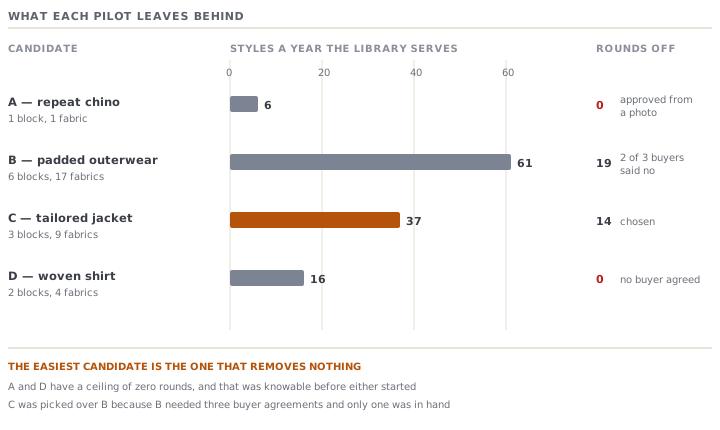
The column nobody had put in the table
Now add the column the steering group did not have. How many sample rounds could this pilot remove in its first year, if everything went perfectly?
For A the answer is 0. Marlstone approves that chino from a photograph and has done for four seasons. The physical proto Bezirhan makes is made for its own cutting room, to prove a marker, and no screen is going to stop it being made. A pilot on candidate A can succeed completely. A beautiful virtual sample, matched to the real garment, delivered in a day. And it removes nothing, because there was no round there to remove.
For D the answer is also 0, for a different reason. Neither Selbourne nor Marlstone had agreed to judge anything on a screen, and lesson 4 explains why a factory cannot decide that on its own.
For B it is 19. Not the 44 styles it develops, but the styles of the one buyer out of three who agreed. For C it is 14, out of 23, under the eligibility rule Wraysbury actually signed.
| Candidate | Rounds removable in year one | Hours per removable round |
|---|---|---|
| A | 0 | no answer exists |
| B | 19 | 10.57 |
| C | 14 | 7.41 |
| D | 0 | no answer exists |
Two of the four candidates could not remove a single round however well they went, and that was knowable on the day they were tabled. It took one question: which buyer has agreed, and to what? Nobody asked it, because it is not a question about software.
Representative has a definition, and it is not "typical"
C was chosen over B, even though B has more coverage and more removable rounds. The reason is the second half of representativeness. A pilot has to contain the thing that will break.
Bezirhan's development hours divide by construction: padded outerwear 39%, tailored jacket 31%, woven shirt 9%, chino 4%, everything else 17%. The two big ones are also the two the simulation handles worst, for opposite reasons. A canvassed jacket front behaves like four layers that are not stuck together. A quilted panel's stitching lines change how the wadding loads. If the pilot avoids both, year two starts from the beginning.
C contains the canvassed front. B contains the quilting, and B was rejected for a reason about people rather than cloth. It needed the approval conversation of lesson 4 run three times, with three technologists in three companies, before most of its 44 styles could give anything back. Bezirhan had one of those three conversations in hand, which is why its removable figure is 19 rather than 44. B was the better pilot on the arithmetic and the worse pilot on the calendar. Say that out loud, with the number written down, so B becomes the first thing added in year two rather than a road not taken.
The three questions that actually choose a pilot
- What share of next year's book will this library serve? Count styles, not fabrics. A library is only worth the work it is reused on.
- Does it contain the construction that will break? If your hardest garment is not in the pilot, you have piloted somebody else's factory.
- Which buyer has agreed, in writing, to judge what? If the answer is none, the pilot's ceiling is zero rounds removed. Fix that first, or call the exercise what it is: training, which is a legitimate thing to buy and a different thing to promise.
Ease is not on the list. It is worth knowing, because a pilot that cannot be staffed will not happen. But it belongs to the plan, not to the choice.
Check yourselfA pilot finishes on time, the virtual samples match the real garments, and the team wants to declare success. What single number tells you whether it succeeded?Show the answer
The number of sample rounds that did not ship, on real styles, in that pilot's own programme. A virtual sample that matches is a necessary condition, not an outcome. Matching is what the software is for. If the answer is zero, ask which of the two causes it was. Either no buyer had agreed, or there was no round there to remove. They lead to completely different next steps: one is a commercial conversation, and the other means you piloted the wrong programme.
Prompt · Score my pilot candidates on coverage, not on ease
When a steering group is choosing where to start and the small easy programme is winning.
Act as a programme manager who has watched a digital pilot succeed technically and remove nothing. Score my candidate pilots and tell me which to run. For each candidate: [NAME, PRODUCT, STYLES DEVELOPED A YEAR, DISTINCT FABRICS, BLOCKS INVOLVED, WHICH BUYERS, AND FOR EACH BUYER WHETHER THEY HAVE AGREED IN WRITING TO JUDGE A ROUND ON A SCREEN — YES, NO, OR NOT ASKED]. Also give me: [TOTAL STYLES DEVELOPED A YEAR ACROSS THE WHOLE BOOK], [FOR EACH CANDIDATE, HOW MANY OTHER STYLES IN THE BOOK USE ITS FABRICS OR ITS BLOCKS], [THE SHARE OF MY DEVELOPMENT HOURS EACH CONSTRUCTION TYPE REPRESENTS], [WHICH CONSTRUCTION MY PATTERN ROOM CONSIDERS HARDEST], [MY OWN HOURS TO DOCUMENT ONE BLOCK AND TO CHARACTERISE ONE FABRIC], [THE ROUNDS PER STYLE I SHIP TODAY AND THE COST OF ONE]. Do the following. First, for each candidate compute hours to build its library, styles a year that library then serves, that as a share of the book, and hours per style served. Second, add the column most steering groups leave out: rounds removable in year one. That is zero for any candidate whose buyers have not agreed, and zero for any round the buyer does not actually require. Third, say which candidates have a ceiling of zero and why, before anything is spent. Fourth, tell me which candidate contains the construction most likely to break, and what it costs me if my pilot avoids it. Fifth, if my highest-coverage candidate needs several buyer agreements I do not have, say so, and tell me what it would take to add it in year two. Sixth, look at my scoring criteria and tell me honestly how many of them are proxies for ease.
AI can make mistakes — check anything you act on.
What to take away
- A pilot buys a library. Its value is the share of the book that library keeps serving after the pilot ends.
- Cost per style served hardly varies between candidates, so the cheap pilot is cheap only because it buys less.
- Add the column for rounds removable in year one. Two of Bezirhan's four candidates scored zero on it before anything started.
- Representative means it contains the construction that will break, not that it is typical.
- A pilot with no buyer agreement has a ceiling of zero. Call that training, honestly, or go and get the agreement.
- If four of your five scoring criteria are stand-ins for ease, your sheet has already chosen.