Lessons · Lesson 1 of 3
A location you cannot name
Why a warehouse is a set of named places, what a location code has to carry, and how to work out what a bay will honestly hold.
Lesson 1 of 3 · 40 min
The store, the order, the basis
Every factory has a room full of things it has bought and not yet used. This lesson turns that room into a warehouse. A warehouse is a set of named places, so anything in it can be looked up. The lesson also shows how to work out what a building will honestly hold, using a tape measure. The quick way of guessing that number always says too much, and then the store starts stacking goods in the gangways.
Izabal Garment Works is a knitwear and woven-bottoms factory in Villa Nueva, Guatemala. It employs 780 people on six sewing lines and exports to North America. Everything in this course happens in one building on that site: the stores. It is a single-storey shed with 1,860 m² of internal floor, 62.00 m long and 30.00 m wide. Clear height — the distance from the floor to the underside of the roof steel — is 7.20 m.
Four people appear.
- Marisol Chavarria runs the stores.
- Elmer Sicajau is the receiving and putaway chargehand. Putaway is the job of taking a received pallet to its place in the racking.
- Dina Portillo is the plant controller. She owns the cost model in lesson 2.
- Rodrigo Batres is the plant manager and signs for space.
The order carried through all three lessons is BR-7712 for Brackenridge Stores, a North American mid-market chain: style IG-2240, a men's cotton jersey polo, 24,000 units.
Say the basis once, because every figure below depends on it. All money is US dollars, which is what Izabal quotes and buys in. Fully loaded labour in the stores is 3.06 dollars an hour. Fully loaded means the wage plus social charges plus a share of supervision. It comes from Izabal's own 2027 payroll, not from a country average. Every dimension is measured on site. Every price comes from a quotation Izabal actually holds. None of it is a market rate and none of it is a vendor's published price.
A warehouse is a set of locations
A room where stock is kept is not a warehouse. A warehouse is a set of named places. Each one can be written down, said over a radio, printed on a label and typed into a record. And each one holds one identifiable thing at a time.
That sounds like a definition of tidiness. It is not. It is what decides whether the store can answer the only two questions anybody ever asks it:
- Where is this?
- What is here?
Both are questions about a location, and a store whose places have no names cannot answer either. A pallet that is "in the warehouse" cannot be found. It can only be recovered, by walking about. Izabal's stores held 902 occupied pallet positions at the last count. Walking about is a search of up to 902 places.
The six areas, and why each has a different rule
Before any location gets a code, the building is divided into areas that do genuinely different jobs. It is tempting to read them as a floor plan. They are better read as six different answers to one question: who owns this stock right now?
| Area | Code | What is in it | The rule that makes it different |
|---|---|---|---|
| Receiving | RC | Goods off a truck, not yet counted or checked | Nothing here is stock yet. It is on the supplier's paperwork, not on ours |
| Quarantine | QH | Received but failed, doubtful or awaiting test | It is our stock and it is not available. Both halves matter |
| Bulk storage | BK | Full pallets in racking | Nothing enters without a location and nothing leaves without a record |
| Pick face | PK | Part-pallets and loose, at floor level | Quantity changes here constantly, so it is counted differently |
| Staging | ST | Picked and assembled against a shipment | It is committed. It is stock, but it is spoken for |
| Despatch | DP | Loaded or about to load | It is leaving. After the cut-off it is not ours |
The two areas people mix up are receiving and staging. Mixing them is the most common way a stock figure goes wrong. A pallet in receiving is physically present and not yet on the record. A pallet in staging is on the record and about to stop being present. Count the building on a Friday afternoon and both will be standing on the floor looking identical. Lesson 3 puts a price on exactly that mistake.
What a location code has to carry
Izabal's stores ran for four years on codes like A7-12 — a zone letter and a bay number. A bay is one section of racking between two uprights. That is not a location. It names a bay, and a bay holds eight pallets, so "in A7-12" is a search of eight places and an argument.
A code has to carry every coordinate that separates one pallet position from every other, and nothing else. At Izabal that is five fields:
BK - 03 - 12 - C - 1

BK   zone         two letters, from the six areas above
03   run          two digits, 01 to 08
12   bay          two digits, 01 to 17, numbered in travel order
C    level        one letter, A at floor level, D at the top
1    position     1 is the pallet nearer the low-numbered end of the run
Four properties are worth naming, because a code missing any one of them fails in a specific way:
- It is complete. Every field that separates two places is in the code. Drop the level and you have Izabal's old problem.
- It sorts into travel order. Sort the codes from low to high and a pick list walks the store instead of criss-crossing it. That is worth real money, and lesson 2 measures how much.
- It is clear when misheard. Izabal uses no letter O and no letter I in a zone code, because on a smudged label they read as zero and one.
- It fails loudly. A code typed wrong should not turn out to be a different real place. This one nearly manages that. The code space is exactly the size of the store, which is the next section, so most typing errors do land on a location that exists. Izabal accepts that, and so requires a scan rather than a typed entry at putaway.
The areas that are not racking get codes too, and this is the part usually skipped. Receiving has twelve dock positions, RC-01 to RC-12. Quarantine has six, staging twenty, despatch eight. The point is not tidiness. A pallet with no location is a pallet the record cannot describe, and "it is in receiving" is only an answer if receiving is itself a set of named places. Izabal has 1,088 racking positions and 46 other named locations, so 1,134 places in total, and no lawful resting place that is not one of them.
Working out what a bay honestly holds
Here is the arithmetic most people skip, and the rule of thumb they use instead.
Izabal stores on a flat pallet of 1,200 mm by 1,000 mm. That is one of the principal sizes set out in the international standard for intercontinental flat pallets. It is stored with the 1,000 mm face to the aisle and the 1,200 mm dimension going back into the rack. Loaded height, including the pallet itself, is 1.45 m.
Across the bay. Two pallets sit on one pair of beams. You leave 100 mm between the two pallets and 100 mm at each upright.
beam clear span = 2 x 1.000 + 3 x 0.100 = 2.300 m
bay pitch       = 2.300 + 0.100 upright frame = 2.400 m
Up the bay. This is where the rule of thumb goes wrong. Clear height is 7.20 m, so the temptation is to divide:
7.20 / 1.45 = 4.97, therefore five levelsThat answer ignores three real things, and Izabal can measure all three with a tape.
| What takes the height | Metres | Why it is there |
|---|---|---|
| Clear height to the underside of the roof steel | 7.20 | Measured |
| Sprinkler heads hang below the steel | 0.30 | Measured |
| Clear space required beneath a sprinkler head | 0.50 | Izabal's insurer's written requirement for this building |
| Highest point any load may reach | 6.40 | 7.20 less 0.30 less 0.50 |
| Load height, one pallet | 1.45 | Measured, and it is a policy: loads above this are cut down |
| Clearance above a load to get the forks out | 0.10 | Measured on Izabal's own trucks |
| Beam depth | 0.10 | From the racking quotation |
| Pitch, one level to the next | 1.65 | 1.45 plus 0.10 plus 0.10 |
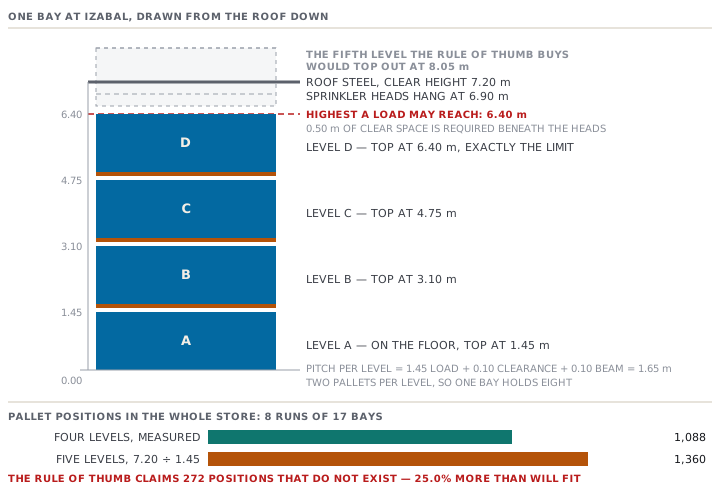
Now build the bay from the floor up. Level A sits on the concrete. Levels B, C and D sit on beams.
top of A = 1.45
top of B = 1.45 + 1.65 = 3.10
top of C = 3.10 + 1.65 = 4.75
top of D = 4.75 + 1.65 = 6.40   <- exactly the limit
top of E = 6.40 + 1.65 = 8.05   <- 1.65 m above a limit that is not negotiable
Four levels, not five. Two pallets per level, so eight pallet positions in a bay.
From a bay to a building
The storage zone is the 44.00 m by 30.00 m end of the shed, 1,320 m². The other 540 m² holds receiving, quarantine, staging and despatch.
Take the 30.00 m width first. Leave 0.50 m of clearance at each wall. Two runs placed back to back measure 2 x 1.20 + 0.10 flue = 2.50 m; the flue is the gap left between them. Izabal's counterbalance trucks need a measured 3.60 m aisle to stack at a right angle.
0.50 wall + 1.20 run 01 + 3.60 aisle
        + 2.50 runs 02-03 + 3.60 aisle
        + 2.50 runs 04-05 + 3.60 aisle
        + 2.50 runs 06-07 + 3.60 aisle
        + 1.20 run 08 + 4.70 spare + 0.50 wall = 30.00 m
Now the 44.00 m length. Leave 1.00 m of clearance at each end. That leaves 42.00 m, divided by the 2.40 m bay pitch, which is 17.5. So 17 bays a run, and 1.20 m left over.
8 runs x 17 bays x 4 levels x 2 positions = 1,088 pallet positionsThat 4.70 m spare strip is not a fifth aisle. Another pair of runs plus its aisle needs 6.10 m, and there is 4.70 m, so it is 1.40 m short. Izabal uses it for battery charging and floor-stacked empties, and calls it that on the plan rather than pretending it is storage.
Now compare with the rule of thumb. Five levels would have given 8 x 17 x 5 x 2 = 1,360 positions. The honest number is 1,088. The rule of thumb claims 272 positions the building does not have, which is 25.0% more than will fit — and 272 positions is more than a quarter of the store. A plan built on 1,360 does not simply run 25% tight. It runs out of locations, and then pallets start standing in aisles, which is where the whole discipline collapses.
Floor area per position is 1,320 / 1,088 = 1.21 m². That number is worth keeping. Lesson 2 turns it into money.
Fixed location or random location
Every store makes this choice, usually without noticing. Fixed location gives each item a permanent home. Random location puts a pallet wherever there is a suitable empty place, and records where it went.
The arithmetic that settles it is short, and almost nobody does it.
Fixed location must hold every item's peak at once. Random location only has to hold the peak of the total. Those are different numbers whenever two items peak at different times, which is nearly always.
| Item | March | June | September | December | Peak |
|---|---|---|---|---|---|
| Body jersey | 60 | 20 | 15 | 25 | 60 |
| Rib and collar | 12 | 40 | 18 | 10 | 40 |
| Fusible interlining | 8 | 10 | 34 | 12 | 34 |
| Export cartons | 25 | 30 | 22 | 55 | 55 |
| Polybags | 14 | 9 | 26 | 11 | 26 |
| Thread and trims | 18 | 22 | 16 | 30 | 30 |
| Total in store | 137 | 131 | 131 | 143 |
sum of the individual peaks     = 60 + 40 + 34 + 55 + 26 + 30 = 245
peak of the total, same records =                              143
space saved by random location  = 245 - 143 = 102, or 41.6%
Run the same calculation across all 310 of Izabal's stored items. The sum of the individual peaks is 1,412 positions, against a peak total of 936. Izabal has 1,088. Fixed location does not fit in the building Izabal owns — it is 324 positions short — while random location fits with 152 to spare.
What random location costs
It is not free, and the cost is specific: random location is only a location system while the record is right. Under fixed location the store's map is in people's heads and on the racking. Under random location the map exists only in the record, and a wrong record is not a slow search. It is a lost pallet.
| How the store is organised | Time to locate | What it depends on |
|---|---|---|
| Fixed, asked of somebody who knows the store | 0.0 min | That person being at work |
| Fixed, asked of relief or a new starter | 2.6 min | How well the racking is signed |
| Random, with a record that is right | 0.4 min | A lookup |
| Random, with a record that is wrong | unknown | Nothing you can plan around |
That last row is the honest one. In one quarter Izabal recorded nine items that took more than twenty minutes to find, and two that were never found and had to be re-ordered. The two re-orders are a measurable loss. The tail behind them cannot be measured from the records Izabal keeps, so it stays unknown rather than being filled in with an average.
Two things follow, and they are the bridge to the rest of the course. First, the 2.6 minutes on the fixed row is not zero. A fixed store is fast only for people who already know it, and that cost lands entirely on holiday cover and new starters. Second, random location buys back 41.6% of your building and pays for it with a dependency on the accuracy of a record. That is a thing you now have to go and measure. That is lesson 3.
Check yourselfIzabal is offered a second shed with 6.60 m of clear height, otherwise identical: same pallets, same trucks, same insurer's requirement. How many levels does it take, and what does that do to the cost per pallet position of the racking?Show the answer
Work the same budget. The highest point a load may reach is 6.60 less 0.30 for the sprinkler drop less 0.50 of clear space, so 5.80 m. Level A tops out at 1.45, B at 3.10, C at 4.75, and D would top out at 6.40, which is 0.60 m above the limit. So it takes three levels, not four. That is a 25% loss of positions for a 0.60 m loss of height, because levels come in whole units: the height either buys a whole level or it buys nothing. It also means the racking cost per position rises by a third, since an upright frame carrying three levels costs very nearly what one carrying four costs. The general lesson is that clear height only matters at the thresholds, and the thresholds are set by your load height plus 0.20 m, not by the roof.
Check yourselfA supervisor argues that random location is disorganised and that giving every item a fixed home would make the store easier to run. Using this lesson's numbers, what is the strongest version of his argument, and what is the answer to it?Show the answer
The strongest version is the 2.6-minute row turned around. Under fixed location a person who knows the store finds anything in zero time with no system at all. So the store keeps working when the record is wrong, the power is off, or the person with the tablet is on holiday. That is real resilience and it is not nothing. The answer is the space arithmetic. Fixed location at Izabal needs 1,412 positions and the building has 1,088. So the question is not which is nicer to run but which one fits, and fixed does not fit. It is 324 positions short, and the overflow would stand in aisles, which destroys the very orderliness the argument was made for. The honest middle is what Izabal does: fixed homes for the small number of very fast items in the pick face, where a person genuinely does learn the map, and random for the bulk.
Prompt · Design a location code for the store I actually have
Before labelling a single rack, and any time somebody says a pallet is "in the warehouse".
Help me design a location coding scheme for my store, and work out honestly what my building holds.

I will give you: the internal length, width and clear height of the building; how far the sprinkler heads hang below the roof and what clear space my insurer requires beneath them; my pallet footprint and my loaded pallet height; the beam depth from my racking quotation and the clearance my trucks need above a load to withdraw the forks; the aisle width my trucks need to stack at a right angle; and the areas I have set aside for receiving, quarantine, staging and despatch.

First build the height budget from the roof down and tell me how many levels fit. Show the top of each level, and the one that would breach the limit. Do not divide clear height by load height. Show me why that answer is wrong, and by how many positions it overstates my building.

Then lay out the width: perimeter clearance, single runs against the walls, back-to-back pairs with their flue, and aisles. Tell me what is left over, and refuse to call it storage if it is narrower than one more pair plus an aisle. Do the same along the length in whole bays.

Then propose the code. Give me the fields in order, say what each one separates from what, and check three things explicitly: that sorting the codes from low to high walks the store rather than criss-crossing it, that no character can be misread as another on a smudged label, and that the size of the code space equals the number of real places. Give receiving, quarantine, staging and despatch their own codes too, and tell me the total number of named locations in the building.

Two rules. Do not quote me any industry average for positions per square metre or for aisle width. Every number must come from my measurements or from a quotation I hold. And where I have not given you a measurement, write unknown and tell me how to go and take it, rather than filling it with a typical figure.
AI can make mistakes — check anything you act on.