Lessons · Lesson 2 of 3
Space costs money, movement costs more
How to cost a square metre of store from the accounts, why the same pallet costs different amounts in different places, and the crossover that decides whether cheap distant space is cheap.
Lesson 2 of 3 · 40 min
What a square metre costs
Storage feels free. Nobody sends a factory an invoice for leaving a pallet somewhere. So a pallet that has sat in a corner for a year looks as though it cost nothing. This lesson takes the store's own accounts apart and puts a price on both halves of what a warehouse sells. Those two halves are the room a thing occupies and the work of moving it. The second is the one people get wrong.
Dina Portillo pulled Izabal's 2027 stores costs out of the accounts. Six lines, every one of them a real payment.
| Cost | Basis | USD a year |
|---|---|---|
| Rent | 1,860 m² at USD 4.10 a m² a month | 91,512.00 |
| Racking | 1,088 positions at USD 58.00, over a 12-year life, straight line | 5,258.67 |
| Light and power | Metered | 9,840.00 |
| Two counterbalance forklifts | USD 27,500 each over 8 years, plus USD 3,704.00 each a year in fuel and maintenance | 14,283.00 |
| Insurance and property tax | Invoiced | 6,180.00 |
| Six stores people | 2,080 h each at USD 3.06 fully loaded | 38,188.80 |
| Total | 165,262.47 |
Divide by the floor area and the store costs USD 88.85 a square metre a year. That number is worth saying out loud in a meeting about whether to keep something. It is also the last time this lesson uses it, because a square metre is not what a warehouse sells.
Split the total by what actually drives it. Rent, racking, light and insurance are paid for having the room, whether anything moves or not. The forklifts and their two drivers are paid for movement. The other four stores people are paid for receiving, counting and issuing, which is neither.
space            91,512.00 + 5,258.67 + 9,840.00 + 6,180.00 = 112,790.67
forklift resource  14,283.00 + 2 drivers x 2,080 h x 3.06   =  27,012.60
other stores labour        4 people x 2,080 h x 3.06        =  25,459.20
                                                    total   = 165,262.47
Now spread the space cost over the 1,088 positions from lesson 1:
112,790.67 / 1,088 = USD 103.67 a position a year
103.67 / 52        = USD 1.99  a position a week
What a movement costs
A movement is one pallet taken from somewhere and put somewhere else. Dina timed 220 of them and built the cost from the clock rather than from a division.
| Element | Measured | Note |
|---|---|---|
| Fixed part of every movement | 1.80 min | Approach, engage the forks, lift clear, position, deposit, scan the location |
| Horizontal travel | 72 m a minute | Average including acceleration and turns, loaded and empty |
| Vertical, each level above A | 0.35 min each way | So 0.70 min a level, out and back |
| Driver | USD 3.06 an hour | USD 0.051 a minute |
| Truck ownership and running | USD 4.14 an hour | USD 7,141.50 a year over 1,725 productive hours, so USD 0.069 a minute |
| Cost of a forklift minute | USD 0.120 | 0.051 plus 0.069 |
A movement is a round trip: out loaded, back empty. So the model is
minutes = 1.80 + (2 x one-way metres) / 72 + 0.70 x levels above A
cost = minutes x 0.120The same pallet, three prices
Take two real locations in Izabal's store, measured from the point where the trucks pick up and set down.
| Location | Where | One-way distance | Level | Minutes | Cost a movement |
|---|---|---|---|---|---|
BK-01-02-A-1 | Nearest run, second bay, on the floor | 18 m | A | 1.80 + 0.50 + 0 = 2.30 | USD 0.276 |
BK-08-16-D-2 | Far run, near the end, top level | 72 m | D | 1.80 + 2.00 + 2.10 = 5.90 | USD 0.708 |
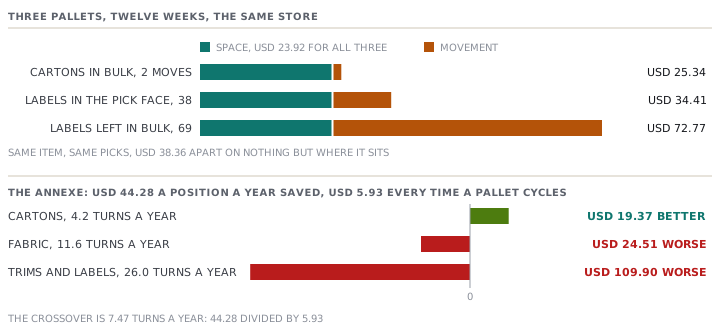
Now take three pallets, all in the store for twelve weeks. Space costs the same for all three: 103.67 x 12 / 52 = USD 23.92.
| Pallet | Where | Movements in twelve weeks | Space | Movement | Total |
|---|---|---|---|---|---|
| Export cartons, bulk | BK-08-16-D-2 | 1 putaway, 1 pick = 2 | 23.92 | 1.42 | USD 25.34 |
| Woven labels, pick face | BK-01-02-A-1 | 1 putaway, 3 replenishments, 34 picks = 38 | 23.92 | 10.49 | USD 34.41 |
| Woven labels, left in bulk | BK-08-16-D-2 | 1 putaway, then 34 fetch-and-return round trips = 69 | 23.92 | 48.85 | USD 72.77 |
Three things fall out of that table, and the second is the one people get wrong.
The far pallet is the cheapest of the three. The cartons sit in the most expensive place in the building to reach, and they cost less than either of the others, because they are touched twice. Distance is not the cost. Distance times frequency is the cost.
The same pallet, with the same picks, costs USD 38.36 more in the wrong place. Rows two and three are the same item, the same quantity, the same demand. Only the location differs, and the space cost cancels out exactly, so the whole USD 38.36 is movement.
The cheapest pallet and the dearest differ by 2.87 times on nothing but where they sit and how often they are touched.
Travel is the driver, and it is worth less than you think
Now the pick path, because walking distance is where the money is supposed to be.
Izabal's line-feed picker collects nine lines four times a day. Marisol measured the route two ways: first with the nine items in their scattered fixed homes across runs 01, 03, 05, 06 and 08, then after the fast movers were brought together into the pick faces of runs 01 and 02.
walking speed  58 m/min          picking time  0.85 min a line, both routes

scattered   232 m: 232/58 + 9 x 0.85 = 4.00 + 7.65 = 11.65 min
consolidated 87 m:  87/58 + 9 x 0.85 = 1.50 + 7.65 =  9.15 min
saving                                              =  2.50 min a round
Four rounds a day over 250 days is 1,000 rounds, so 2,500 minutes, 41.67 hours, USD 127.50 a year.
That is a trivial number, and it would be dishonest to build a case on it. At USD 3.06 an hour, walking is cheap. A proposal to reorganise a store that opens with the picker's footsteps will be refused, and refused correctly.
The money is in the forklift, for two reasons the walk does not have. A truck and driver cost USD 7.20 an hour against a picker's USD 3.06. And a truck goes up. Level D adds 2.10 minutes to every single movement, and no amount of walking speed touches that.
So Izabal reclassified 14 items — the ones with the most movements a year — out of bulk and into the pick faces. The measured effect:
| Movements a year | Minutes saved a movement | Cost change | |
|---|---|---|---|
| The 14 items moved in | 9,180 | 2 x 54 / 72 = 1.50 horizontal, plus 2 x 0.70 vertical = 2.90 | USD 3,194.64 saved |
| The slower stock displaced out, 42 m level B to 78 m level C | 1,140 | 2 x 36 / 72 = 1.00 horizontal, plus 0.70 vertical = 1.70 lost | USD 232.56 spent |
| Net | USD 2,962.08 a year |
The second row is the part usually left out, and leaving it out is how a store improvement gets reported as bigger than it was. Near locations are a fixed quantity. Putting something near means putting something else far, and the honest number is the difference, not the saving.
The counter-case: when cheap space is expensive
Rodrigo Batres is offered an annexe 400 m down the road: 300 m², USD 2.20 a square metre a month against the main store's 4.10, with 5.80 m of clear height.
Run lesson 1's height budget on 5.80 m. The highest a load may reach is 5.80 - 0.30 - 0.50 = 5.00 m. Level C tops out at 4.75 and level D would top out at 6.40, so it takes three levels, and the quotation shows 180 positions.
| USD a year | |
|---|---|
| Rent, 300 m² at USD 2.20 a m² a month | 7,920.00 |
| Racking, 180 positions at USD 58.00 over 12 years | 870.00 |
| Light, insurance and security, quoted | 1,900.00 |
| Total for 180 positions | 10,690.00 |
| Space cost a position a year | 59.39 |
Against the main store's USD 103.67, the annexe is USD 44.28 a position a year cheaper — 42.7% less. Across 180 positions that is USD 7,970.40 a year, and on those figures alone the annexe is obviously right.
Now the movement. Nothing walks 400 m, so every pallet that goes to the annexe and comes back needs a shuttle: a road truck running between the two buildings.
shuttle: 6 pallets a trip, 1.0 h door to door, truck and driver USD 14.50 an hour
  out and back      = 2 trips x 14.50 / 6 pallets  = USD 4.83 a pallet
  four extra forklift movements at 2.30 min each   = 9.20 min x 0.120 = USD 1.10
  cost of one pallet round trip to the annexe      = USD 5.93
So the annexe saves USD 44.28 a year on a position, and charges USD 5.93 every time a pallet cycles through it. Set the two equal and you get the only number that matters:
44.28 / 5.93 = 7.47 turns a yearThe annexe is cheaper only for stock that turns fewer than 7.47 times a year. A turn is one full cycle of the stock: in, then out again. Marisol's measured turns settle it item by item.
| What | Turns a year | Extra handling a position | Net against the main store |
|---|---|---|---|
| Export cartons and packaging | 4.2 | 4.2 x 5.93 = 24.91 | USD 19.37 better |
| Body and rib fabric | 11.6 | 11.6 x 5.93 = 68.79 | USD 24.51 worse |
| Trims, labels and thread | 26.0 | 26.0 x 5.93 = 154.18 | USD 109.90 worse |
The cheap space is genuinely cheap, and it is cheap for exactly one of the three things in the building. Put the trims out there — which is the tempting move, because they are small and they fill a lot of positions — and the annexe loses USD 109.90 a year on every position. That is more than twice what it saves.
Check yourselfAn item turns 6.0 times a year, so by this lesson's crossover it belongs in the annexe. Before agreeing, what would you check, and what could reverse the answer?Show the answer
Two things, and either can reverse it. The first is whether the turns figure is the whole movement count. A turn is a full cycle of the stock, but the pallet cost is driven by movements. An item that is picked from repeatedly generates far more movements than turns. The woven labels earlier turned modestly and were touched 38 times in twelve weeks. If the item is picked in part-pallet quantities, the annexe charges 5.93 for each fetch, not for each turn, and a crossover in turns is the wrong test. The second is urgency. The crossover assumes every pallet can wait for the next shuttle. If the item is a fabric that a cutting room can call for at an hour's notice, the relevant cost is not USD 5.93, it is a stopped line, and the crossover does not price that at all. The answer flips whenever movements and turns come apart, or whenever waiting is not allowed.
Check yourselfSomeone proposes reorganising the pick face and justifies it with the walking time saved. Using this lesson's figures, why is that the wrong argument, and what is the right one?Show the answer
Because walking is cheap. The measured saving on the pick path was 2.50 minutes a round, a thousand rounds a year, 41.67 hours, USD 127.50 — a real number and far too small to move anybody. The right argument is the forklift, where the same reorganisation was worth USD 3,194.64 in movements saved on 14 items. Two things make the difference: a truck and driver cost USD 7.20 an hour against a picker's USD 3.06, and a truck travels vertically, which adds 0.70 minutes for every level and is untouched by any amount of walking speed. And the right argument has to be stated net: the 14 items displaced slower stock further out at a cost of USD 232.56, so the honest figure is USD 2,962.08, not USD 3,194.64.
Prompt · Price a pallet position and a forklift minute from my own accounts
When somebody is about to take cheaper space further away, or to argue that stock already in the building is free to keep.
Build me a cost model for my store that separates space from movement, using only my own accounts.

I will give you: annual rent, or the imputed rent if I own the building, and the internal floor area; the installed cost of my racking, the number of positions and the life I am writing it off over; metered light and power; insurance and property tax; the purchase price, life, fuel and maintenance of each materials handling truck; and my stores headcount with the fully loaded hourly rate and how many of them drive.

Split the total three ways: space, forklift resource, and other stores labour. Give me space cost per position per year and per week. Then build a forklift minute from the driver rate and the truck rate, and state plainly how many productive hours a year you assumed for the truck. Then reconcile the two: tell me how much of the forklift resource the movement rate fails to recover, and say that it is unproductive paid time rather than hiding it.

Then give me a movement model: a fixed element in minutes, a horizontal travel speed, and a vertical time per level. Tell me which of the three I have to go and time myself. Price two real locations in my store — the nearest floor position and the furthest top-level one — and then price the same pallet in each at the movement frequency I give you.

If I am considering cheaper space somewhere else, do the crossover. Cost a position there the same way, get the annual saving per position, cost one pallet round trip to it including the shuttle and the extra handling at both ends, and divide. Tell me the number of stock turns a year below which the cheap space wins, and then ask me for my measured turns by item group rather than assuming them.

Three rules. Never present a saving without taking off what it displaced, because near locations are a fixed quantity. Never justify a reorganisation with walking time before you have costed the forklift movements, which are usually far bigger. And list what the model cannot price, including stock in transit between buildings, and mark each one unknown rather than leaving it out, because leaving it out prices it at zero.
AI can make mistakes — check anything you act on.