Lessons · Lesson 3 of 3
Counting is a method
How a count is designed so its result means something, the difference between a discrepancy and an error, and what a wrong stock figure costs the day it is discovered.
Lesson 3 of 3 · 38 min
Why counting is harder than it looks
A stock figure is a claim about the physical world. It says that if you walk to a shelf, a stated quantity will be sitting on it. This lesson is about how you check that claim, and what it means when the shelf and the record disagree. Counting sounds like the simplest job in a warehouse. It is also the easiest to do in a way that produces a number nobody can use.
Izabal counts two ways, and they do different jobs.
Two ways to count
A full stock-take counts everything at one moment. Izabal's runs on the second Friday of January: the store freezes, 22 people count for 11 hours, and the factory loses a production day.
| Cost | Basis | USD |
|---|---|---|
| Counting labour | 22 people, 11 hours, at USD 3.06 fully loaded | 740.52 |
| The production day | 6,200 garments, recovered later on overtime at a premium of USD 0.44 a garment | 2,728.00 |
| Total | 3,468.52 |
The second line is the one usually got wrong, and it goes wrong in both directions. If the order book had gaps in it, the lost day would cost the contribution on 6,200 garments and would be a very large number. Izabal's order book is full, so the day is recovered on overtime and the cost is only the premium. Which of those two applies is a fact about the order book, not about the count. Quote the wrong one and you either terrify the plant manager or let him believe a stock-take is nearly free.
Cycle counting counts a slice every day, forever, at a frequency set by how much each item matters. Izabal classes its 310 stored items by annual issue value — how much of each item leaves the store in a year, priced at cost.
| Class | Items | Share of annual issue value | Counted | Counts a year |
|---|---|---|---|---|
| A | 62 | 78% | Every 4 weeks | 806 |
| B | 118 | 17% | Every 13 weeks | 472 |
| C | 130 | 5% | Every 26 weeks | 260 |
| Total | 310 | 100% | 1,538 |
1,538 counts x 14 min measured a count = 21,532 min = 358.87 h
358.87 h x USD 3.06                                 = USD 1,098.13
investigation and recount, measured 62 h x USD 3.06 = USD   189.72
                                              total = USD 1,287.85
Spread over 250 working days that is 6.2 items a day. Izabal schedules 7 and uses the surplus for recounts. It costs USD 1,287.85 a year, against the take's USD 3,468.52.
Designing a count so the result means something
Three design decisions decide whether a count produces information or reassurance.
Blind counts
A count sheet that prints the expected quantity beside the item is not a count. It is a confirmation, and a tired person at the end of a shift confirms.
Marisol ran the comparison on the same 40 locations in one week. The sighted count, with expected quantities printed, found 3 discrepancies. The blind count of the same 40 locations, with no expected quantity and the counter writing down what was there, found 11. A third supervised recount confirmed 10 of the 11 as real.
real discrepancies in those 40 locations   = 10
found by the sighted count                 =  3, so 30% of them
found by the blind count                   = 10, so all of them
That 30% is a measurement at Izabal, on 40 locations, in one week. It is not a rate anybody may quote at another store, and it is not evidence that sighted counting always finds three in ten. It is evidence that at Izabal the sighted count missed most of what was there, and that was enough for Marisol to stop printing the quantities.
Cut-off
Every count is "as at" a moment, and that moment has to be a real one that both the shelf and the record agree on. Izabal's rule: the store freezes at 18:00 on the count date. The number of the last goods-received note posted before the freeze is written at the top of every count sheet. A goods-received note is the document that puts arrived goods onto the record. And the first movement after the freeze belongs to the next period.
Here is what it costs when the rule is not held. At the 2027 take, 14 rolls of fabric arrived at 17:40, were unloaded onto the dock, and their goods-received note was posted the following morning.
counted, because the rolls were physically in the building at 18:00   yes
on the record at 18:00, because the note was posted next morning       no
apparent overage = 14 rolls = 3,180 m at USD 2.70 = USD 8,586.00
Nobody gained anything and nobody stole anything. The "as at" moment simply had two different values in two places, and the store spent a morning proving that USD 8,586.00 of fabric it could see had not appeared from nowhere. The fix costs nothing: either the note is posted before the freeze, or the rolls are roped off and excluded. Whichever is chosen gets written on the count sheet.
What counts as counted
The third decision is the one from lesson 1: receiving and staging look identical on a Friday afternoon. Izabal counts staging and does not count receiving, because staging is stock and receiving is not. The count sheet says so at the top, so that a counter who finds pallets on the receiving dock knows what to do with them without asking.
A discrepancy is not an error
These two words get used as if they meant the same thing. They do not.
A discrepancy is a difference between the record and the shelf. It is a measurement.
An error is a discrepancy whose cause has been found. It is an explanation.
The distinction has a practical edge: a discrepancy adjusted without finding the cause is not corrected, it is hidden. The record now matches the shelf, and the mechanism that broke them apart is still running. So the same discrepancy comes back, and next time it looks like a new one.
Izabal's cycle-count year raised 214 discrepancies.
| Cause found | Count |
|---|---|
| Picked and not recorded | 62 |
| Put away to a location other than the one recorded | 44 |
| Recorded as picked and not actually picked | 21 |
| Unit of measure confused: rolls against metres, dozens against pieces | 19 |
| Receiving count wrong | 15 |
| Damage written off physically and not posted | 10 |
| Cause found | 171 |
| Adjusted with cause unknown | 43 |
The 43 are the honest number in that table. They are what the store does not understand about itself, and they are 20.1% of everything it found. Marisol reports them separately every month for exactly that reason. An adjustment log showing only the 171 would read as a store that understands its own errors. A store that understands 80% of its errors is a different place from one that understands all of them.
What accuracy percentage actually means
Now the question that matters most and gets asked least: accuracy of what?
Here are four accuracy figures for Izabal's stores. Same building, same count, same day.
| Measure | How it is worked out | Result |
|---|---|---|
| Piece accuracy | 4,200,000 units counted, 84,000 units of absolute difference | 98.0% |
| Value accuracy | USD 630,000 counted, USD 26,460 of absolute difference | 95.8% |
| Location accuracy, class A fabric | 230 locations counted, 20 with any difference | 91.3% |
| Location accuracy, all locations | 948 occupied locations counted, 132 with any difference | 86.1% |
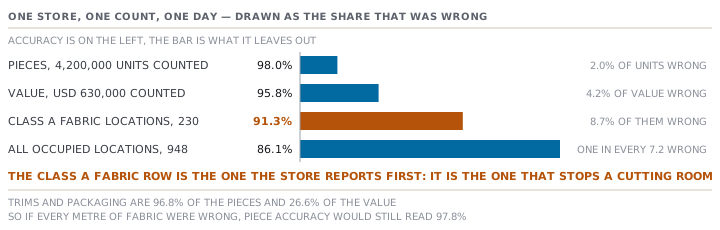
None of them is wrong, and they do not mean the same thing. The gap between the first and the last is the whole subject.
Look at what is in the building.
| Units counted | Share of pieces | Value counted, USD | Share of value | |
|---|---|---|---|---|
| Trims, labels, packaging | 4,064,000 | 96.8% | 167,600 | 26.6% |
| Body and rib fabric, metres | 92,000 | 2.2% | 248,400 | 39.4% |
| Finished garments | 26,000 | 0.6% | 192,400 | 30.5% |
| Thread, cones | 18,000 | 0.4% | 21,600 | 3.4% |
Piece accuracy is a weighted average, and the weights are pieces. Trims and packaging are 96.8% of the pieces and a quarter of the value, so piece accuracy is very nearly a statement about polybags.
Take it to the limit and the point is unmistakable:
if every single metre of fabric in the building were wrong:
  92,000 units of difference out of 4,200,000 = 2.2%
  piece accuracy would still read              97.8%
You could be wrong about every metre of fabric Izabal owns and still report 97.8% piece accuracy. That is why 98% can be excellent or useless. It is excellent if what you are protecting is a count of consumables. It is useless if what you are protecting is a cut date. The thing that stops a cutting room is a fabric roll, and the measure that sees fabric rolls is the third row of that table, not the first.
The general rule follows: choose the accuracy measure that predicts the failure you are actually afraid of. At Izabal the failure is a cutting room standing still, so the number on Marisol's board is location accuracy on class A fabric, 91.3%, and the other three are reported underneath it.
What a wrong figure costs downstream
Accuracy is not an end in itself. Here are the three traced consequences at Izabal in 2027.
A shortage discovered at the cut. Order BR-7712 had 22,000 polos left to cut at 0.42 m of body jersey a garment, so 9,240 m. The record showed 9,240 m. The shelf had 8,960 m.
| USD | |
|---|---|
| Replacement fabric, 280 m at USD 2.70 | 756.00 |
| Air freight and customs, 78 kg | 1,190.00 |
| One sewing line idle 4.5 h, 24 operators at USD 3.06 | 330.48 |
| Re-planning and expediting, 9 h at USD 6.80 | 61.20 |
| Total | 2,337.68 |
| Of which avoidable — the fabric was always going to be bought | 1,581.68 |
1,581.68 / 280 m = USD 5.65 a metre, which is 2.09 times what the fabric costsA 280-metre error cost more than twice the price of the fabric it was about, and 666 polos were held up by a number that was 3.0% wrong.
An over-order. Six cartons of woven labels, 5,000 each, were put away to a location nobody registered. The record read zero, so purchasing bought 40,000 more at USD 0.031. The labels are style-specific and IG-2240 did not repeat, so the 30,000 already in the building were written off: USD 930.00.
Found stock, which is not a gain. The take turned up 217 m of a discontinued fabric that the record had shown as issued 14 months earlier — USD 585.90 at cost. It looks like money appearing. It is not. The cost of that fabric was charged to an order that shipped and closed over a year ago. So the real finding is that a closed order's cost was wrong by USD 585.90, and nobody can now say which order it was.
three traced consequences = 1,581.68 + 930.00 + 585.90 = USD 3,097.58
a year of cycle counting  =                              USD 1,287.85
Resist the obvious conclusion. That is not a return on investment, because the counting did not prevent those three. Two of them were found by counting, and the third was found by a cutting room running out of cloth. The honest statement is smaller and more useful: three consequences that could be traced cost 2.41 times a year of counting, and the 43 discrepancies with no cause found have a downstream cost that is unknown. Unknown is not zero. It is the reason the argument for counting cannot be finished with arithmetic. It has to be finished with the sentence that opened this lesson. A stock figure is a claim about the physical world, and a claim nobody checks is not information.
Check yourselfA store reports 99.2% piece accuracy and its production planner says he cannot rely on the stock figures. Both can be true. Explain how, and say what you would ask for.Show the answer
Piece accuracy is weighted by pieces, so it is dominated by whatever is counted in the largest units — usually consumables like polybags, labels and fasteners. At Izabal 96.8% of the pieces are trims and packaging. If every metre of fabric in the building were wrong, the piece figure would still read 97.8%. So a very high piece accuracy is consistent with being wrong about most of the things that stop production. Ask for two other numbers. First, location accuracy: how many of the locations counted had any difference at all, which at Izabal was 86.1% against the same count's 98.0% piece figure. Second, that same location accuracy restricted to the items that stop a line — class A fabric at Izabal, 91.3%. If the planner is right, the gap between the piece figure and those two will be large, and the argument stops being about whether he trusts the system and starts being about which items to count more often.
Check yourselfA store adjusts every discrepancy it finds on the day it finds it, so the record always matches the shelf by close of business. What is right about that, and what is missing?Show the answer
What is right is real: the record is the thing people act on, and a known-wrong record left uncorrected causes the next shortage, so adjusting quickly is better than adjusting slowly. What is missing is the cause. An adjustment makes the difference disappear without touching whatever produced it. So the mechanism keeps running, and the same discrepancy returns looking like a new one. It also means the store can never tell a recurring problem from a series of unrelated accidents. Izabal's practice is the test: of 214 discrepancies, 171 had a cause found and 43 did not, and the 43 are reported separately every month rather than folded into the total. The 43 is the number that tells you what the store does not yet understand about itself, and a store that adjusts everything and investigates nothing reports 214 tidy corrections and knows exactly as much as it did before.
Prompt · Design a count whose result means something
Before the next stock-take, and any time an accuracy percentage arrives without saying accuracy of what.
Help me design a stock count and then read the result honestly.

First the design. Ask me these and do not proceed without them: whether the count sheets will show the expected quantity; what moment the count is as at, and how the store is frozen at that moment; which document number marks the cut-off; whether receiving and staging are counted or excluded, and how a counter will know which; and who recounts a difference, and how many times.

Then the plan. I will give you my item list with annual issue value. Split it into value classes, propose a counting frequency for each, and give me the total item-counts a year, the minutes each takes and what that costs at my labour rate. Set that beside what my annual full count costs me. Cost the production it stops in two ways — the contribution lost if the day cannot be recovered, and the overtime premium if it can — and tell me that which of those two applies depends on my order book, not on the count.

Then the reading. When I give you results, produce at least four accuracy figures for the same count: piece accuracy, value accuracy, location accuracy over all locations counted, and location accuracy restricted to the items that stop my production. Show the make-up of my stock by pieces and by value beside them. If the piece figure is dominated by consumables, say so, and work out what the piece figure would still read if every unit of my most critical item were wrong.

Then the discipline. Separate discrepancies from errors: report how many differences had a cause found and how many were adjusted with the cause unknown, and keep the unknowns as their own line every period. Never let an adjustment close an investigation.

Finally, price the consequences I can trace — a shortage found at the cut, an over-order caused by stock the record could not see, stock found that was charged to a closed order — and then refuse to present the total as a return on the counting. Say plainly which of them the counting found rather than prevented, and mark the downstream cost of the unexplained differences as unknown, not zero.
AI can make mistakes — check anything you act on.