Lessons · Lesson 3 of 3
Issue, return, reconcile
Issue material against a cut rather than against an order, keep committed and available apart, and read an end-of-order variance without inventing the reason for it.
Lesson 3 of 3 · 40 min
Material leaves a store the way it arrived: as objects, against a piece of paper. This lesson is about that piece of paper. Who is allowed to ask for cloth, and what the store may promise to somebody else while the cloth waits. At the end of an order you compare what you handed out with what the garments should have taken. That sum almost never comes out level.
Issuing against a cut, not against an order
Meaza's cutting room does not ask for cloth for order GD-5107. It asks for cloth for one cut: a named lay, a named marker, a stated number of plies, on a stated date. That distinction does most of the work in this lesson.
An order is a commercial object that lives for months. A cut is a physical event that happens on a table on a Tuesday. A store that issues against the order hands over rolls and loses sight of them. A store that issues against a cut can say afterwards which rolls went into which lay. Every question in the second half of this lesson is answerable only if it can.
Three rules follow, and none of them costs anything.
- Issue rolls, not metres. You cannot hand over 4,860.0 m. You hand over 27 rolls whose measured lengths sum to 4,871.3 m, and the issue note carries the roll numbers. Metres on an issue note are a summary of an event. Roll numbers are the event.
- Issue matched sets. The body lay and the small-parts lay of the same cut leave the store together, from the same shade lot. Otherwise the store has created lesson 1's USD 5,160.96 problem with its own hands.
- Nothing leaves without a note, including a sample. The 12 m the product-development room takes for a fit sample is 12 m the reconciliation will look for in five months' time.
Committed, available, and the number a merchandiser must never read
On 2 October, with delivery 1 in and delivery 2 still at sea, Dawit asked Tigist a simple question: how much of this poplin is spare? The store system said 26,703.0 m. That number is true and useless.
| Line | Metres | Why it is not available |
|---|---|---|
| On hand, measured | 26,703.0 | |
| Committed to released cut plans | 21,840.0 | The cut plans are issued and the cutting room is working to them |
| Quarantined: shade lot D | 1,251.8 | Outside Maravelle's 0.8 tolerance, awaiting a decision |
| Available to promise | 3,611.2 |
Available is 13.5% of what the shelf holds. A merchandiser who reads 26,703.0 and books a second order against it has committed the factory to cloth that is already spoken for. Nobody finds out until two cut plans want the same rolls in the same week.
Two words do the work here, and they are worth keeping straight, because systems use them loosely.
- Committed means a specific quantity is reserved for a specific plan. It is still physically on the shelf. It is not yours to give.
- Allocated hard means specific roll numbers are reserved, not just a quantity. This costs more discipline, and it is the only way to hold a shade block together. A soft reservation of 1,800 m will be filled from whatever rolls come to hand on the day. That is exactly how lot D gets into a lay.
Gudumale allocates fabric hard by roll number and trim soft by quantity. The reason is proportionate: a shade block is a garment defect, and a shortage of buttons is a phone call.
What comes back
Cloth returns from the cutting room in three forms, and only two of them are stock.
| What comes back | Definition at Gudumale | What the store does |
|---|---|---|
| A whole unopened roll | Never spread | Back on the rack at its measured length, allocation released |
| A usable remnant | 8.46 m or longer, so it can still carry the body marker | Back on the rack, remeasured, marked as a remnant with its roll number |
| A short remnant | 2.52 m up to 8.46 m, so it can carry the small-parts marker only | A separate remnant rack, and a real asset — small parts are where remnants go to be useful |
| Waste | Under 2.52 m | Not stock. It is weighed and sold, and it never re-enters the record as metres |
Those two thresholds are not general truths. They are Gudumale's two marker lengths, and every factory's are different. The general rule is the one underneath: a remnant's usefulness is defined by the shortest marker you own. A store that records remnants without recording that threshold is holding a number nobody can act on.
The reconciliation
GD-5107 closed on 8 March 2028. Here is the whole order in one table. It is the deliverable of this lesson. It takes an afternoon to build if the issue notes carry roll numbers, and a week if they do not.
| Line | Metres | How it is known |
|---|---|---|
| Invoiced by the mill across three deliveries | 80,100.0 | Three invoices |
| Measured in by the store | 79,345.6 | Every roll on the inspection machine |
| Short measure against invoice | 754.4 | 0.942% — deliveries ran 1.10%, 0.97% and 0.75% short |
| Issued to the cutting room | 79,050.0 | Issue notes, by roll |
| Returned from the cutting room | 412.6 | Return notes, 46 remnants |
| Net consumed by cutting | 78,637.4 | Issued less returned |
| Standard for the shirts actually cut | 77,128.2 | 47,610 shirts at 1.62 m |
| Variance | 1,509.2 over standard | 1.96% of standard, or USD 4,301.22 |
Two other facts belong beside it. The order was for 48,000 shirts and 47,610 were cut, so it finished 390 short. Completing it needs 631.8 m. Lesson 1 projected 524 short, on the assumption that every delivery would run 1.10% light. The second and third ran better, at 0.97% and 0.75%, and the cutting room came in under its planned allowance. So the real figure is 390. And 708.2 m of cloth was left: 295.6 m never issued, plus the 412.6 m returned. But that 412.6 m is 46 remnants averaging 15.4 m. So the physical cloth exists, and the lays needed to cut it do not come free. Whether to run the last 390 shirts off remnants is a merchandiser's decision about cutting cost, not a store shortage. The store's job was to say plainly that the cloth is there and what shape it is in.
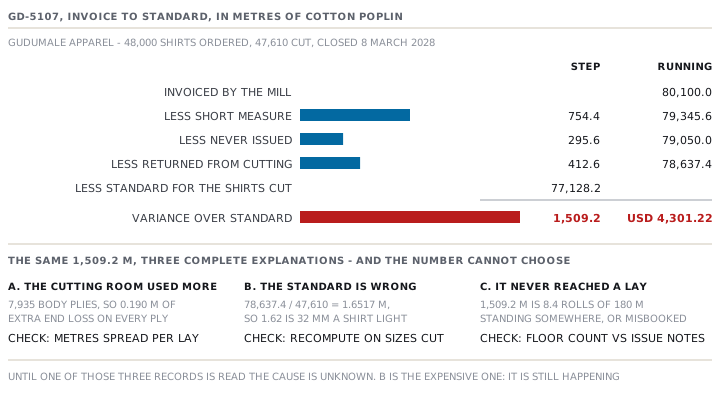
Three stories, one variance
Here is where most factories stop, write "cutting-room waste 1.96%" in a report, and move on. That sentence is a guess dressed up as a measurement. And it is a guess with an interesting property: it names a department that is not the one writing the report.
The variance of 1,509.2 m has at least three complete explanations. Each of them accounts for the whole of it. Each is entirely plausible. And the variance itself cannot distinguish between them.
| Story | What it would have to look like | Evidence that would settle it |
|---|---|---|
| The cutting room consumed more than the marker | 47,610 shirts is 7,935 body plies, so 1,509.2 m is 0.190 m of extra end loss on every single ply — 190 mm a ply, which a spreading study would see immediately | Lay records with the actual metres spread per lay, against marker length times plies plus the end allowance |
| The standard is wrong | Net consumption is 78,637.4 divided by 47,610, which is 1.6517 m a shirt. If the true consumption for the size ratio actually cut is 1.6517 rather than 1.62, the variance is zero and the standard is understated by 32 mm a shirt | Recompute the standard on the size ratio actually cut and the markers actually used — including the re-planned 1.665 m markers from lesson 2 |
| The cloth never reached a lay | 1,509.2 m is 8.4 rolls of 180 m. Eight rolls issued and standing in a corner of the cutting room, or booked to the wrong order, produce exactly this line | A physical count of cutting-room floor stock on the closing date, and the issue notes matched roll by roll to the lay records |
Gudumale could answer none of the three for GD-5107. The issue notes recorded metres rather than roll numbers. The lay records recorded plies rather than metres. And nobody had recomputed the standard against the sizes actually cut. So the correct entry in the closing report is not "cutting-room waste USD 4,301.22". It is "variance USD 4,301.22, cause unknown", followed by the three changes that would make the next one answerable. Only one of them costs anything at all.
Check yourselfYour store shows 14,200 m of a fabric on hand. Two merchandisers both want it: one has a released cut plan for 9,600 m starting Monday, the other wants to book 6,000 m for a new order. What do you tell the second one, and what would you need before you could tell them anything different?Show the answer
You tell them 4,600 m is available, not 14,200 m. The 9,600 m is committed to a released plan, and committed stock is physically present and not yours to give. That is a subtraction, not a judgement. Before you could offer more you would need two things. First, whether any of the 14,200 m is quarantined or out of shade tolerance. That is a second subtraction nobody remembers to make, and it produced a further 1,251.8 m of unavailable cloth on GD-5107. Second, whether the released plan will really take its full 9,600 m. But that is a question for the cutting room and the merchandiser who owns it. Until one of them releases the commitment in writing, the store must keep treating it as gone. A store that quietly lends out committed stock because it looks unused will be right most times and catastrophically wrong once.
Check yourselfAn order closes with a fabric variance of 2.4% over standard. Your production manager says it is cutting-room waste and asks the cutting room for a plan. What is wrong with that, and what would you do first?Show the answer
Nothing is wrong with the number and everything is wrong with the attribution. Over-consumption in the cutting room is one of at least three explanations that fit the same variance exactly. The marker consumption standard could be understated for the size ratio actually cut. Or cloth could have been issued and never spread. All three produce an identical line in the reconciliation, so the line cannot choose between them, and the one chosen here belongs to another department. First, recompute the standard on the size ratio actually cut and on the markers actually used. That costs an hour, and it is the story with the largest consequence. If the standard is wrong you are underquoting every order, not just this one. Then count the cutting room's floor stock and match the issue notes to the lay records. Only if both come back clean is it safe to say the cloth went into lays and did not come out.
Prompt · Read a material variance without inventing its cause
At the close of any order, and any time a reconciliation is about to be reported as waste.
Build my end-of-order material reconciliation, and then refuse to tell me the cause of the variance until the evidence supports one.

I will give you: the quantity invoiced by the supplier, the quantity my store measured in, the quantity issued to cutting, the quantity returned from cutting, the units actually produced, and the standard consumption a unit with the marker and size ratio it was built on.

Build the reconciliation as a single table, line by line, from invoiced down to standard. The variance is the closing line, in quantity, as a percentage of standard, and in money at my material price. Show the short measure against invoice separately from the variance. They are different failures and they get confused constantly.

Then give me at least three complete explanations for the variance, each of which accounts for ALL of it. Express each one as a number I could go and check: extra consumption per ply or per lay, an understated standard in millimetres a garment, and material issued but never converted, in whole rolls or cartons. For each one, name the specific record that would confirm or eliminate it.

Then the rule I actually want from you. Do not attribute the variance to any of them. Tell me the cause is unknown until one of those records has been read. Say which of the three has the largest consequence if true — usually an understated standard, because that one is still happening on every order I quote. If I press you for a single cause, or if I have already written waste in the report, push back and ask which record I read.

Finally, list the changes that would make the NEXT variance answerable, marking which of them cost money and which are just a different thing written on the same piece of paper.
AI can make mistakes — check anything you act on.