Lessons · Lesson 2 of 3
What the store does to the goods
Store cloth and trim so the material reaching the cutting table is the material you bought. Then price the three ways a store quietly damages its own stock.
Lesson 2 of 3 · 40 min
Cloth is not inert. Between the day it arrives and the day it is cut, it changes. The way it is stacked changes it. So does the air around it, and the time it waits. This lesson is about the damage a store does to its own stock. None of that damage appears on an invoice, and all of it appears in the cutting room.
What this store is actually holding
Tigist's store is 640 square metres. It holds two completely different inventory problems under one roof.
| Fabric | Trim | Whole store | |
|---|---|---|---|
| Stock-keeping units | 44 | 687 | 731 |
| Share of the units | 6.0% | 94.0% | |
| Value on the shelf | USD 341,000 | USD 42,600 | USD 383,600 |
| Share of the value | 88.9% | 11.1% | |
| Picking lines in 2027 | 1,180 | 9,340 | 10,520 |
| Share of the picking | 11.2% | 88.8% |
Read the last two rows against the first two and the shape of the job becomes clear. Fabric is where the money is. Trim is where the work is. A store designed only around the money — big racks, careful roll handling, a controlled aisle — solves 11.1% of the value problem and none of the 88.8% of the transactions. A store designed only around the transactions has nowhere safe to put a roll. Both halves need their own answer. The rest of this lesson gives fabric's answer first, because fabric is where the largest single loss came from.
Where the weight goes
A roll of poplin 180 m long is 31.75 kg of cloth wound round a cardboard core. That mass has to rest on something. There are only three choices, and they are not equivalent.
| How it is stored | What carries the load | What it does to the goods | Where it is right |
|---|---|---|---|
| Standing on one end | One selvedge of the entire roll, over its whole length | The bottom edge is compressed flat and creased. The damage runs the full length of the roll and cannot be cut around, only cut off | Short-term parking of light, short rolls. Never for weeks |
| Stacked flat in a pyramid | A contact line along the roll beneath, carrying every roll above it | A crease line down the whole length of the bottom rolls, permanent on a pile fabric or a coated one, and a distorted core | Very light rolls, two high, with nothing above |
| Horizontal on a cantilever rack or a bar through the core | The core, or two supports under the roll | Nothing. The cloth carries no load at all | Everything else, which is why it is the answer |
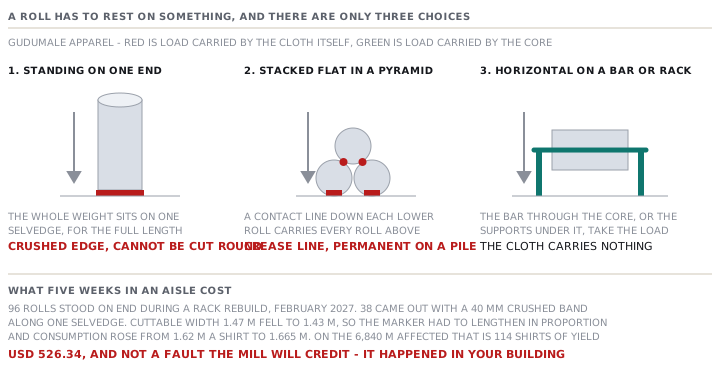
Gudumale learned this in the most ordinary way. In February 2027 the store's cantilever racks were being rebuilt, and 96 rolls were stood on end in an aisle for five weeks. When they came out, 38 of them carried a crushed and creased band about 40 mm wide along one selvedge, running the whole length of the roll.
The arithmetic follows from one fact. The marker is planned on the cuttable width, and the cuttable width had fallen from 1.47 m to 1.43 m. A marker on narrower cloth must be longer in proportion. So consumption rises from 1.62 to 1.62 times 1.47 divided by 1.43, which is 1.665 m a shirt.
cloth affected   = 38 rolls x 180 m = 6,840 m
yield at 1.62 m  = 6,840 / 1.62 = 4,222.2 shirts
yield at 1.665 m = 6,840 / 1.665 = 4,108.1 shirts
lost yield       = 114 shirts = 184.68 m = USD 526.34
USD 526.34, for standing rolls up for five weeks during a rack rebuild. Nobody made a decision. The aisle was the only free floor. And notice what the loss is not. It is not a fabric fault the mill will credit, because the mill's inspection passed the cloth and the damage happened in your building. Under the four-point system, this is a fault you scored on yourself.
The air is a variable, and it is in your invoice
Textile fibres take water out of the air and give it back. The amount they hold depends on the humidity around them. That is not a curiosity: on any material bought by weight, the air is part of what you paid for.
Gudumale's store logged relative humidity between 45% in the dry months and 72% in the wet ones, with no conditioning of any kind. Yonas ran oven-dry tests on the same poplin in both seasons. He measured a moisture regain of 6.0% in the dry store and 10.5% in the wet one. Take the nominal roll:
nominal roll at the conditioned 8.5% regain = 180 x 1.47 x 0.120 = 31.75 kg
oven-dry mass                               = 31.75 / 1.085 = 29.263 kg
the same roll at 6.0% regain                = 29.263 x 1.060 = 31.02 kg
the same roll at 10.5% regain               = 29.263 x 1.105 = 32.34 kg
The same cloth, the same metres, 1.32 kg apart. That is 4.1% of the roll's weight, decided by the month. On poplin bought by the metre, that is an argument about nothing. On the interlock and the ribbing Gudumale buys by the kilogram, it is 4.1% of the quantity. It is also why a knit delivery weighed on a wet morning disagrees with the same delivery weighed on a dry one.
What happens to cloth after it is spread on the cutting table is the relaxation that makes a knit garment come out short and wide. That belongs to course 5.2 and is not this lesson's subject. The store's contribution to it is simply this. The cloth arrives at that table having been conditioned by whatever air the store happened to have. A store that does not know its own humidity has handed the cutting room an uncontrolled variable.
Trim is a different problem wearing the same roof
Fabric is a few things in enormous quantity. Trim is hundreds of things in small quantity, and almost every property flips.
- Value per unit is trivial and value per stock-out is not. A shirt cannot ship without its size label. USD 300 of missing labels holds up a USD 80,000 shipment.
- Counting is by weight or by carton, not by unit. Nobody counts 480,000 buttons. You weigh a sample, you count the cartons, and you accept a tolerance. That means trim quantities are always estimates, and they should be recorded as such.
- Trim is where the buyer's own property lives. Nominated labels and badges are frequently supplied by the buyer. That changes the store's legal position, and it is lesson 3's subject.
- Trim is where shelf life lives. Fabric rarely expires. Elastics, adhesives, some prints and coatings do.
That last one produced the largest single avoidable loss in the store's 2027 accounts. It is worth costing properly rather than sighing about.
Some materials expire while they wait
| Material | What ages | What the store must hold | How it is checked before use |
|---|---|---|---|
| Bare and covered elastane, elastic tape | The elastomer loses recovery: it stretches and does not come back | The maker's declared life from date of manufacture, not from date of receipt | Stretch a specimen to its rated elongation, release, measure the return |
| Fusible interlining | The adhesive resin ages and the bond weakens | Declared life, plus dry storage away from heat | Fuse a sample at the specified time, temperature and pressure, then a peel test and a wash |
| Pigment prints and polyurethane coatings | The binder or the film embrittles and cracks | Declared life, away from light and heat | Flex and crock the sample, then a wash |
| Woven and printed labels, buttons, zips | Effectively nothing, in a dry store | Nothing beyond a dry shelf | Nothing routine |
In March 2026 Gudumale bought 8,400 m of 40 mm knitted elastic waistband tape at USD 0.31 a metre, USD 2,604.00 in total. It was for an order the buyer then cut back. The tape sat. When it was pulled in May 2028 for another style, it was 26 months old against a declared life of 24 months. It failed on the test in the table above. A fresh specimen stretched and released returns to 100.8% of its original length, the specification allows 102.0%, and the aged tape returned to 104.3%.
write-off      8,400 m at USD 0.31       = USD 2,604.00
salvage        8,400 m at USD 0.06       =   USD 504.00
net loss                                 = USD 2,100.00
Now the part that matters, because "a buyer cancelled an order" is not what went wrong here. The tape was inside its declared life for 24 of the 26 months it sat. In that window, four other Gudumale orders used the same 40 mm tape and consumed 11,900 m of it between them. The tape was not lost to a cancellation. It was lost because nothing in the store ever looked at a date.
The control that would have caught it is embarrassingly small. Add a declared-life column to the store card. Then give the clerk 25 minutes a month to produce a list of everything within 90 days of its date. That is 5 hours a year at USD 1.05, or USD 5.25 a year, against a single observed loss of USD 2,100.00. The ratio is 400 to one.
Check yourselfYour store is full and the only free space is a corner of the aisle. You need to put 60 rolls of a heavy coated nylon somewhere for three weeks. What do you do, and what do you write down?Show the answer
Not on their ends and not stacked flat, which are the two things a full store makes tempting. Standing a heavy roll on end crushes one selvedge for the whole length of the roll, and on a coated fabric the crease sets in the film and does not recover. Stacking flat puts every roll's weight on a contact line down the bottom rolls. On a coating that is the same permanent damage in a different place. If there is genuinely no rack, lay them horizontally in a single layer with nothing on top. That costs floor area and damages nothing. Then write down what you did and when, because in three weeks nobody will remember which rolls spent time in the aisle. And if damage does show up at the cutting table, you want to be able to tell a storage fault from a mill fault. That distinction decides whether you have a credit claim or a loss.
Check yourselfA mill's certificate says a knit delivery weighs 2,400 kg. Your weighbridge says 2,331 kg, which is 2.9% less. The mill says nothing is missing. Before you raise a claim, what do you check, and what would settle it?Show the answer
Check the humidity each weight was taken at. A 2.9% difference is inside the range moisture alone can produce on a cellulosic knit. A textile's weight is a function of the air around it. This store measured the same poplin at 6.0% regain in the dry season and 10.5% in the wet one, a 4.1% swing on the identical cloth. A mill certificate is produced in a conditioned laboratory atmosphere. A container that crossed the Red Sea and a store with no conditioning are not that atmosphere. What settles it is an oven-dry test on a specimen from the delivery. It removes the water from both sides of the argument and compares the actual fibre. If the oven-dry weights agree, you have no claim, and you have learned what your store does to a number. If they do not, you have a real claim and now you can prove it.
Prompt · Price the damage your own store is doing
After any storage-related loss, and before arguing for racking, conditioning or a shelf-life report.
Audit what my raw material store is doing to its own stock, and price it.

I will tell you what I hold: how many fabric and trim stock-keeping units, the value of each half, how many picking lines each half generated last year, and how my rolls are physically stored — standing on end, stacked flat, on cantilever racking, on bars through the core, or on the floor.

Start with orientation. For every roll not carried by its core or by supports under it, tell me what part of the cloth is carrying the load and what damage that produces. Then price it the way a cutting room would: if an edge is crushed, my cuttable width falls, my marker must lengthen in proportion, and my consumption a garment rises. Ask me for the cuttable width before and after and the metres affected, and give me the lost yield in GARMENTS and in money. Do not express it as a percentage of anything.

Then the air. Ask me for the relative humidity range my store actually sees, and whether I have ever run an oven-dry test on a material I buy by weight. Show me what my measured regain range does to the weight of one unit. Where I have no measurement, tell me plainly that the figure is unknown rather than a textbook value.

Then shelf life. Ask which of my materials carry a maker's declared life — elastics, fusibles, coatings, prints — and whether my store card records a date of manufacture at all. For any expiry loss I have had, separate the trigger from the cause: an order being cancelled is a trigger, and nobody reading a date is the cause.

Two rules. Price the CONTROL as well as the loss, in hours a year at my labour rate, so I can see both sides. And if I have only one recorded event, say the expected annual loss is unknown and refuse to turn one event into a rate, however good the ratio looks.
AI can make mistakes — check anything you act on.