Lessons · Lesson 1 of 3
A roll is not a number
Treat a delivery of cloth as physical objects whose length, width and colour are claims to be checked. Then decide when checking them is worth what it costs.
Lesson 1 of 3 · 40 min
A garment factory buys cloth in rolls. The paperwork says how many metres each roll holds, what colour it is, and how wide it is. All three are measurements somebody else made, on somebody else's machine. This lesson is about the hour or two between the lorry and the shelf. That is when your store either checks those claims or accepts them.
The factory, the order, the basis
Gudumale Apparel is a shirt factory in the Hawassa industrial park, Ethiopia. It employs 1,100 people, runs six sewing lines, and has one raw material store of 640 square metres. Everything in this course happens in that store.
Four people appear.
- Tigist Alemu runs the store. She signs a delivery in or refuses it.
- Yonas Tadesse is the receiving clerk. He is the one holding the tape.
- Meaza Girma runs the cutting room. She is the store's only real customer.
- Dawit Bekele is the merchandiser. He owns the order and talks to the buyer.
The order runs through all three lessons. It is GD-5107, a women's cotton-poplin shirt, style MV-118, for Maravelle, a French mid-market retailer: 48,000 units in five sizes, spring 2028.
Say the basis once, because every figure below depends on it. All money is US dollars. Store labour costs USD 1.05 an hour fully loaded, meaning wage, social charges and a share of supervision. That rate comes from Gudumale's own 2027 payroll, not from a country average. The cloth is a cotton poplin at 120 grams a square metre. Its cuttable width is 1.47 m and it is delivered at USD 2.85 a metre. The approved markers consume 1.62 m a shirt: 1.41 m in the body marker, which holds 6 shirts over 8.46 m, and 0.21 m in the small-parts marker, which holds 12 shirts over 2.52 m. Cutting carries a 3% allowance, so the order was placed at 1.62 times 1.03 = 1.6686 m a shirt. PO 4471 was raised for 80,100.0 m against a requirement of 80,092.8 m. That is 7.2 m of headroom on a purchase order worth USD 228,285.00, and it is the first thing worth noticing about this order.
What actually arrives
A store card is a row in a system. A roll is an object about the size of a person. It carries four separate claims, and each one can be wrong on its own.
- Length. The metres printed on the roll ticket. They were measured on the fabric mill's inspection machine, under the mill's tension, in the mill's air.
- Width. Usable width, which is not the width the invoice states. The invoice usually gives the full width, including the selvedges you cannot cut.
- Shade. A fabric mill dyes in machine loads. Two loads of the same colour reference are two different colours. They are close enough to pass and not close enough to sit in the same garment.
- Condition. Faults, dirt, creases, water marks, a crushed edge. The mill scores faults on its own inspection machine before it ships, under the four-point system that course 2.3 sets out.
Delivery 1 of PO 4471 arrived on 14 September in 150 rolls, invoiced at 27,000.0 m. Yonas measured every roll.
| What was claimed | What the store found | Difference |
|---|---|---|
| 150 rolls, 27,000.0 m invoiced | 150 rolls, 26,703.0 m measured | 297.0 m short, or 1.10% |
| Average 180.0 m a roll | Average 178.0 m a roll | 2.0 m a roll |
| One colour, reference MV-118 Chalk | Four mill shade lots, coded A, B, C and D | three more lots than the paperwork mentions |
| Cuttable width 1.47 m | 1.47 m on 143 rolls, 1.44 m on seven | seven rolls the approved marker will not fit on |
Nothing in that table is a scandal. The mill is not stealing 297.0 m. Roll length drifts for three ordinary reasons. Cloth is measured under tension and relaxes once it comes off the machine. The last wrap of a roll is an estimate. And a metre counter is an instrument, so it has an error. The point is not that the claims are dishonest. The point is that they are claims, and the store is the last place anyone can act on them cheaply.
Measuring is a decision, not a formality
Checking costs money, so it has to earn its place. Build the cost the way you would build any machine cost.
Gudumale's fabric inspection machine cost USD 9,600.00 and is written off over eight years, so USD 1,200.00 a year. It runs about 1,600 hours a year, which is USD 0.75 an hour. Add USD 0.10 an hour of power and consumables, and the operator at USD 1.05. One roll then costs the store the following.
machine + labour  = 0.85 + 1.05 = USD 1.90 an hour
time per roll     = length / 30 m per minute + 4 minutes to load, ticket and off-load
cost per roll     = minutes x 1.90 / 60
A 180 m roll takes 6 minutes of running and 4 minutes of handling. That is 10.0 minutes, and it costs USD 0.3167. The whole delivery is 1,500 minutes, or 25.0 hours: USD 26.25 of labour and USD 21.25 of machine, USD 47.50 in total.
Now the other side. What you can recover depends on the contract. Gudumale's fabric contract allows the mill a 1.0% tolerance on roll length, so only the shortfall beyond that band is credited. The creditable part of a 1.10% shortfall is therefore 0.10% of 27,000.0 m. That is 27.0 m, worth USD 76.95. Against USD 47.50 of measuring, the credit clears the cost by USD 29.45.
That gives the rule, and the rule is the deliverable of this lesson:
break-even shortfall = cost of measuring one roll / (metres a roll x price a metre)
                     = 0.3167 / (1.80 x 2.85)          per percentage point
                     = 0.0617 percentage points
threshold            = contract tolerance + break-even
                     = 1.0000% + 0.0617% = 1.0617%
Above that threshold, measuring pays for itself out of credits alone. Below it, it does not. The poplin sits at 1.10%, which is 0.0383 percentage points above its own threshold. That margin is worth exactly the USD 29.45 above.
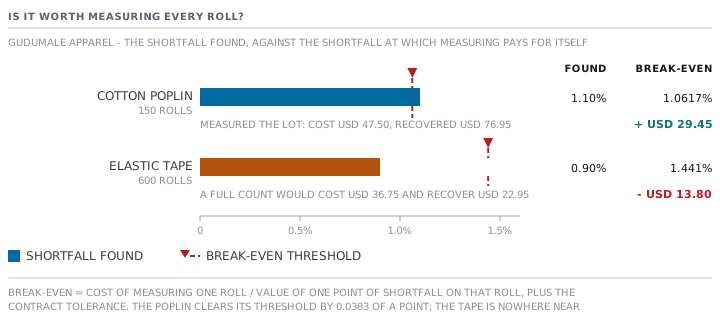
Run the same rule over the elastic waistband tape that arrived the same week. It gives the opposite answer.
| Cotton poplin | Elastic waistband tape | |
|---|---|---|
| Delivery | 150 rolls, 27,000.0 m | 600 rolls, 30,000.0 m |
| Price | USD 2.85 a metre | USD 0.085 a metre |
| Value of the delivery | USD 76,950.00 | USD 2,550.00 |
| How it is measured | inspection machine, 10.0 min a roll | hand winder, 3.5 min a roll |
| Cost of measuring one roll | USD 0.3167 | USD 0.06125 |
| Contract length tolerance | 1.0% | none — the trim contract has no length clause |
| Break-even shortfall | 1.0617% | 1.441% |
| Shortfall actually found | 1.10%, measured on all 150 | 0.90%, estimated from 30 rolls |
| Verdict | measure every roll | do not |
The elastic is the honest case, and it is worth doing the arithmetic rather than asserting it. Counting all 600 rolls costs USD 36.75 and would recover USD 22.95 of short measure. You would lose USD 13.80 by looking. The sample of 30 rolls that produced the 0.90% cost USD 1.84, and it is the whole of the checking the elastic deserves.
One caveat about that sample, because a mean from 30 rolls is not a fact. The 30 ranged from 0.2% over to 2.6% short, with a standard deviation of 0.80 percentage points. So the standard error on the mean is 0.80 divided by the square root of 30, or 0.146 percentage points. Two standard errors either side puts the true shortfall between 0.61% and 1.19%. That sits comfortably under the 1.441% threshold, which is why the answer is safe. Had the sample come back at 1.3%, the interval would have straddled the threshold. The honest answer then is measure more rolls, not decide anyway.
The credit is not the reason
Here is the part that changes how a store manager argues for the inspection machine. It took Tigist two seasons to see it.
The credit on delivery 1 was USD 29.45 net. Nobody buys a USD 9,600.00 machine to earn USD 29.45 a delivery. What measuring actually bought was 58 days of notice.
Suppose deliveries 2 and 3 run short at the same 1.10%. PO 4471 will then land 79,218.9 m against a plan of 80,092.8 m. At the planned 1.6686 m a shirt, that is 47,476 shirts, which is 524 short of the order. Finding that out on 14 September leaves 58 days before the first cut. That is enough for an email to the mill, a top-up on the same sea freight, and no drama at all. Finding it out when the last lay comes up short leaves an air freight and a conversation with Maravelle.
Be honest about the status of the 524. It is a projection from one delivery of three, not a fact. Deliveries 2 and 3 are unknown until they are measured. Lesson 3 shows what they actually did.
Shade: the loss you cannot see until the shop
Delivery 1 carried four mill shade lots, and the store's job is to keep them apart. Gudumale's laboratory reads each lot against the approved lab dip on a spectrophotometer and reports a CMC colour difference. Maravelle's specification for this style allows 0.8.
| Lot | Rolls | Metres measured | Colour difference | Inside Maravelle's 0.8 |
|---|---|---|---|---|
| A | 62 | 11,048.4 | 0.3 | yes |
| B | 48 | 8,530.2 | 0.5 | yes |
| C | 33 | 5,872.6 | 0.6 | yes |
| D | 7 | 1,251.8 | 1.4 | no |
Lot D is the problem. It is a small problem that becomes an expensive one, and it does so by one specific mechanism. Most people get that mechanism wrong.
A lay is cut through every ply at once. So one garment's body panels all come from one ply, and therefore from one roll. Shade does not mix inside a garment at the body marker. It mixes in two other places. The first is the small-parts lay for collars, cuffs and plackets. That lay is spread separately, from separate rolls, and the parts are married to bodies at bundling. The second is the carton, where garments from two lots end up on the same shop rail. So the store's real obligation is not "keep the lots apart" in the abstract. It is to issue a matched set of rolls for the body lay and the small-parts lay of the same cut, and to record which lot went into which carton.
Lot D at 1,251.8 m would cover the small parts of 5,960 shirts. There are three ways out, and Dawit costed all three before choosing.
| Route | What happens | Cash cost | What is unknown |
|---|---|---|---|
| Ask Maravelle for a deviation | Lot D ships as its own shade block, cartons marked | USD 0.00 in material | whether it is granted, and how long the answer takes |
| Return it and top up by air | Mill credits 1,251.8 m at USD 3,567.63; replacement cloth costs the same; 220.82 kg flown at USD 4.10 a kilo | USD 905.35 | whether the mill accepts the return without argument |
| Use it in the small-parts lays | 1,209.6 m of lot D is cut into two cuts of 2,880 shirts; the mismatch is found at final inspection; collars and cuffs are unpicked and replaced at 17 minutes a shirt | USD 5,160.96 | nothing — this one is fully known, and it is the one that happens by accident |
The third row is 5.7 times the second. It is made of USD 3,447.36 of scrapped small parts and USD 1,713.60 of rework labour. It is also the route a store takes when nobody looks at the shade tickets. That is why the cheapest control in this lesson is a physical one. Lot D goes behind a red tape line on the floor, and no requisition can be filled from behind it without Tigist's signature.
Check yourselfA delivery of 400 rolls of lining arrives, 120 m a roll, at USD 1.10 a metre. Your inspection machine runs at 30 m a minute and handling is 4 minutes a roll; machine and labour together cost USD 1.90 an hour. The supply contract allows a 1.5% tolerance on roll length. At what measured shortfall does re-measuring the delivery pay for itself, and what would make you measure anyway below that?Show the answer
Time a roll is 120 divided by 30, plus 4, which is 8.0 minutes. That is USD 0.2533 a roll. One percentage point of shortfall on one roll is 1.20 m at USD 1.10, or USD 1.32. The break-even is 0.2533 divided by 1.32, which is 0.1919 percentage points. So the threshold is 1.5% plus 0.19%, that is 1.69%. Below that the credits do not pay for the measuring. You would measure anyway when the shortfall changes what you can cut. If this lining is on a purchase order with no headroom, the metres you do not have are garments you cannot ship. The value of measuring is then the notice period rather than the credit. You would also measure anyway on a first delivery from a new mill. You have no shortfall estimate at all, and the threshold rule needs one.
Check yourselfYour store receives one colour in three mill shade lots. The cutting room asks for rolls for a cut of 2,400 shirts and you have enough metres in lots A and B but not in either alone. What do you do, and what does the answer depend on?Show the answer
Do not fill the requisition from A and B mixed until you know which markers the metres are going into. Body panels for one garment come from one ply and therefore one roll. So mixing lots between body lays is survivable, as long as each carton stays single-lot and the packing list says so. Mixing between the body lay and the small-parts lay of the same cut is not survivable. A collar from lot B is sewn onto a body from lot A, and the difference sits at the neck seam under shop lighting. So the answer depends on two things. First, the measured colour difference between A and B against the buyer's tolerance. Second, whether the cut can be split into an A cut and a B cut, each with its own matched small-parts lay. If it cannot, the question goes to the merchandiser as a deviation request, not to the cutting room as a shortage.
Prompt · Work out what your receiving inspection is worth
Before deciding to measure every roll of a delivery, or before defending the decision not to.
Help me decide how much of an incoming delivery my store should actually measure, using my own numbers rather than a policy.

I will give you, for each material: how many rolls or cartons arrived, the quantity claimed on the paperwork, the price a unit, how the material is measured or counted and how long that takes a roll, my fully loaded store labour rate an hour, and the cost an hour of any machine used. I will also tell you what length or quantity tolerance my supply contract allows, and whether the supplier has ever actually credited a shortfall.

First build the cost of measuring one unit, with every component visible: running time, handling time, labour, machine. Then compute the break-even shortfall. That is the cost of measuring one unit divided by the value of one percentage point of shortfall on that unit. Add my contract tolerance to it, because only the excess over the tolerance is recoverable. Give me that threshold as a percentage, per material, and put it beside whatever shortfall I have actually measured or sampled.

Then do the part that decides it. Convert the shortfall into UNITS OF PRODUCT I cannot make, using my consumption a garment and my order quantity. Tell me how many days of notice measuring today buys me against finding out at the cutting table. Say plainly if the credit does not justify the measuring but the notice period does.

Four rules. If I give you a shortfall from a sample, ask me the sample size and the spread, compute the standard error, and tell me if the interval crosses the threshold. If it does, the answer is measure more, not decide. If a material has no contract tolerance, say so rather than assuming one. Do not use any industry-typical shortfall figure; if I have not measured, the answer is unknown and the first action is a sample. And never recommend measuring everything as a default: tell me which materials fail the test and should not be measured at all.
AI can make mistakes — check anything you act on.