Lessons · Lesson 3 of 3
Finished, and not available
See why one pile of finished goods answers to four different numbers, work out what it costs to convert stock committed to one buyer, and find where the money in ageing finished goods really is.
Lesson 3 of 3 · 38 min
The easiest stock to count
Finished goods are the one kind of stock a factory can count without argument. They are in cartons, the cartons are labelled, and a garment is either there or it is not. That is exactly why they are dangerous. A number that is easy to produce gets believed. The number that matters is not how many garments are in the room. It is how many of them anybody is allowed to sell.
Course 23.2 drew this line for cloth, where committed stock is committed and that is the end of it. Finished goods behave differently in one decisive way, and that difference is the subject of the middle of this lesson.
Ranomena Garments at 30 November 2027. The finished goods store holds nothing but RN-4180. The padded jacket is in its third season, and four orders' worth of it are in the building at once, alongside the overs from nine orders that are closed. Overs are the pieces left when an order ships its full quantity and the cut cover was not all needed.
| Order | Buyer | Jackets | Packed | Days in the store | Status |
|---|---|---|---|---|---|
| HF-3308 | Halvorsen Friluft | 18,062 | 24 November | 6 | 18,000 booked on a vessel sailing 4 December, 62 excess |
| CS-2214 | Cordilheira Sport | 4,380 | 8 November | 22 | Missed its 18 November vessel; buyer rebooked for 2 December |
| HF-3260 | Halvorsen Friluft | 1,240 | 26 September | 65 | Shipped short; the buyer refused the balance late |
| CS-1907 | Cordilheira Sport | 806 | 12 June | 171 | Last season's colourway. Nobody has asked about it |
| Overs from nine closed orders | various | 1,930 | various | 118 average | Cut cover that was never needed |
| Total | 26,418 |
Four numbers, one pile
Ask how much finished stock Ranomena has and there are four defensible answers. Every one of them is correct. Every one of them is used by somebody. And for any one question, three of the four are wrong.
| The number | What it answers | Jackets | At cost, USD |
|---|---|---|---|
| Physically present | What a stock count would find, and what the insurer covers | 26,418 | 355,641.76 |
| Allocated to a confirmed order | What is spoken for | 22,380 | 301,281.80 |
| Booked on a confirmed shipment | What can actually leave in the next fortnight | 18,000 | 242,317.80 |
| Free to sell to anybody today | What a merchandiser may promise without asking permission | 80 | 1,076.97 |
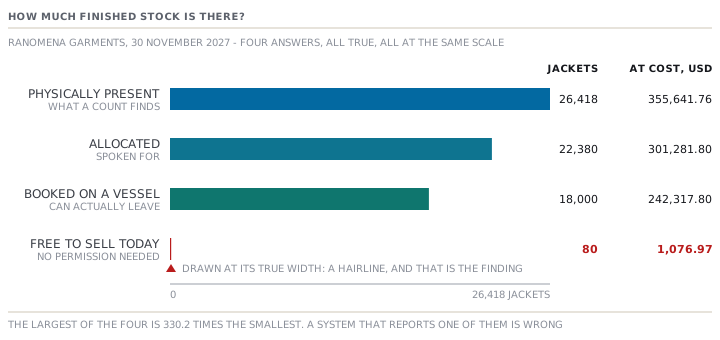
26,418 / 80 = 330.2The largest of the four numbers is three hundred and thirty times the smallest. A system that reports one figure for finished goods reports the wrong one, whichever it picks. The free figure does not collapse to 80 because of allocation. It collapses for a physical reason. Every other jacket in the building has a buyer's woven main label sewn into its neck, and that buyer's price ticket on the cuff. Only the 80 unlabelled overs from a cancelled make-up are anonymous garments.
That is the difference from cloth. A metre of poplin committed to one order is physically identical to a metre committed to another. A finished jacket is not. Cloth is released by changing a record. A jacket has to be taken apart.
The double promise
Ranomena's stock system holds finished goods by style, colour and size. That combination is called a stock-keeping unit, or SKU. On 30 November the system reported this for RN-4180 in Slate, size M.
| Who it belongs to | Jackets | Why it is not free |
|---|---|---|
| HF-3308, allocated, sails 4 December | 1,860 | Halvorsen main label sewn in, Halvorsen price ticket attached |
| CS-2214, allocated, awaiting the rebooked vessel | 1,240 | Cordilheira label and ticket; refused for the original sailing |
| Overs, unlabelled | 80 | Nothing. These are free |
| On the stock record as one line | 3,180 |
A merchandiser reading 3,180 and promising 900 of them to a third buyer has done nothing careless. The system told him 3,180. It is the only number the system has. It stores a quantity against an SKU, and an SKU has no idea whose label is inside the garment. The order is confirmed and the jackets exist. Then on the day they are picked, the store discovers that 820 of the 900 have somebody else's brand in the neck.
Committed is a price, not a wall
Here is where finished goods stop resembling cloth, and where the useful answer lives. Those 820 jackets are not unavailable. They are convertible, and the conversion has a price anybody can work out.
| Step | Minutes | USD |
|---|---|---|
| Unpick the main label, sew the replacement | 2.40 | |
| Remove the price ticket, change the polybag | 1.10 | |
| Repack and re-carton | 0.65 | |
| Finishing labour | 4.15 | 0.0650 |
| New woven label and price ticket | 0.2100 | |
| New polybag | 0.0430 | |
| Share of a new carton | 0.0960 | |
| Total a jacket | 0.4140 |
The labour line is 4.15 minutes at Ranomena's fully loaded rate of USD 0.94 an hour.
820 jackets x USD 0.4140 = USD 339.48
820 x 4.15 min = 3,403 min = 56.72 hours = 7.09 operator-days
making 900 new jackets instead = 900 x 13.4621 = USD 12,115.89
converting 900 already made    = 900 x 0.4140  = USD 372.60, which is 3.08% of making them
So the answer to the merchandiser is not no. It is this: eighty are yours today. Another eight hundred and twenty need one of two buyers to release them. They cost USD 339.48 to convert and seven operator-days of finishing capacity, and here is the calculation. That is a conversation a buyer can have. "The stock is committed" is not, and it is also not quite true.
What standing still costs
Now the other half of a finished goods store: time. Build the carrying cost — what it costs to keep a garment sitting still — for one jacket for one week, from Ranomena's own accounts.
| Component | How it is built | USD a jacket a week | Share |
|---|---|---|---|
| Space | The store's annual cost over its area, over its storage density | 0.002482 | 7.83% |
| Capital tied up | The jacket's cost at Ranomena's borrowing rate | 0.028478 | 89.88% |
| Insurance | The jacket's cost at the insured rate | 0.000725 | 2.29% |
| Total | 0.031685 | 100.00% |
space:     store 1,240 m² at USD 41,300.00 a year = USD 33.31 a m²
           480 jackets a pallet in 1.86 m² including aisle share = 258.06 jackets a m²
           33.31 / 258.06 = USD 0.1291 a jacket a year, / 52 = USD 0.002482
capital:   13.4621 x 11.0% / 52 = USD 0.028478
insurance: 13.4621 x 0.28% / 52 = USD 0.000725
The warehouse is 7.83% of the cost of warehousing a jacket. The rest is the money the jacket is standing on. That is worth knowing before the next argument about racking. It is also the first of three reasons this lesson does not end where a warehouse course usually ends.
| Order | Jackets | Days in the store | Weeks | Carrying cost, USD |
|---|---|---|---|---|
| HF-3308 | 18,062 | 6 | 0.8571 | 490.51 |
| CS-2214 | 4,380 | 22 | 3.1429 | 436.17 |
| HF-3260 | 1,240 | 65 | 9.2857 | 364.83 |
| CS-1907 | 806 | 171 | 24.4286 | 623.86 |
| Overs | 1,930 | 118 | 16.8571 | 1,030.85 |
| Total | 26,418 | 2,946.22 |
USD 2,946.22 is what the whole store has cost to hold, for every jacket in it, since each was packed. Keep that number. Two others are about to make it look small.
The two costs that are not in the warehouse's accounts
The first is the missed vessel. CS-2214 sat for 22 days because it missed its sailing on 18 November. Cordilheira's contract puts a price on lateness directly: 2.5% of the value of the late portion for one to ten days, 6.0% for eleven to twenty-one days, and a right to cancel beyond that. The rebooked vessel sails 2 December, fourteen days late.
4,380 jackets at FOB USD 19.40 = USD 84,972.00
late-delivery discount at 6.0% = USD  5,098.32
carrying cost of the same jackets for the same 22 days = USD 436.17
The discount is 11.7 times the carrying cost. It is booked, but not against the warehouse. It lands on the order's margin as a price reduction. So the finished goods store can watch a jacket cost the company eleven times what its own ledger shows, and never see a figure move.
The second is what the goods are still worth. CS-1907's 806 jackets have been in the store for 171 days, in last season's colourway. Ranomena has one offer. A stock jobber — a trader who buys surplus stock cheaply to resell — will pay USD 5.20 a jacket, taking them as they are, provided the buyer's branding is removed. Stock is carried at the lower of cost and net realisable value. Net realisable value is the price you can get, less the cost of getting there.
offer                                   USD 5.2000
less relabelling to remove the branding USD 0.4140
less freight to the jobber              USD 0.1900
net realisable value                    USD 4.5960
cost                                    USD 13.4621
write-down a jacket                     USD 8.8661
806 jackets                             USD 7,146.08
The cost of selling is not a detail. Leaving it out gives a write-down of USD 6,659.25, and overstates what the stock is worth by USD 486.82. You cannot sell a Cordilheira-labelled jacket to a jobber with the label in it.
one write-down, 806 jackets           = USD 7,146.08
the entire store's carrying cost      = USD 2,946.22
One lot of 806 jackets loses nearly two and a half times what the whole store of 26,418 has cost to hold. The cost of ageing finished goods is not the space, the racking or the handling. It is the price you can still get, and it falls while nobody is looking at it.
Check yourselfYour finished goods system reports 12,400 units of one style and colour. A merchandiser wants to book 3,000 against a new order. Set out the questions you would ask, in order, and say what each one can change.Show the answer
First: how many are already allocated to a confirmed order, and of those, how many are booked on a confirmed shipment. That splits the 12,400 into three populations and usually removes most of it. Second: of what remains, how many carry a buyer's branding — main label, price ticket, buyer-specific polybag or carton mark. That is the question an SKU record cannot answer and the store can, and it is the one that decides whether the stock is convertible or free. Third: for the branded ones, what does conversion cost a garment, and how much finishing capacity does it need. Then you can go to the current owner with a proposal instead of going to your own merchandiser with a refusal. Fourth, and only now: what would it cost to make 3,000 new, so the buyer's release has a number to be compared against. The order matters, for two reasons. Each question shrinks the population the next one has to be asked about. And asking the fourth question first is how factories end up making stock they already own.
Check yourselfYour controller wants to reduce the finished goods carrying cost and proposes negotiating a cheaper rate on the outside warehouse. Using this lesson's structure rather than its numbers, why is that likely to be the smallest available saving, and what would you look at instead?Show the answer
Because space is the smallest of the three parts of carrying cost. At Ranomena it is 7.83% of the total and capital is 89.88%. So halving the rent saves under four per cent of the carrying cost, and leaves the money tied up in the goods untouched. Carrying cost is itself the smallest of the three costs of ageing. The whole store's carrying cost to date was USD 2,946.22, against one late-delivery discount of USD 5,098.32 and one write-down of USD 7,146.08. So work down this ranking: what are the goods still worth, then what does lateness cost under the contract, then what does the money cost, and only then the rent. What you would look at instead is the age profile — which lots are past the age at which a buyer stops wanting them — and the shipment dates that were missed. Both of those move much larger numbers than the rent. Run the same three parts on your own store before accepting the ranking. A factory with a very high borrowing rate, or a very expensive city warehouse, will get different shares. The point is the method, not the percentages.
Prompt · Work out what of my finished goods I may actually sell
Before promising a buyer stock from a system report, and any time a finished goods figure is quoted as one number.
Take my finished goods position apart and tell me which of it I may actually sell, then price the difference rather than refusing.

I will give you what my system reports by style, colour and size, and for each lot: which order it was made against, whether it is allocated, whether it is booked on a confirmed shipment, what buyer-specific branding is physically on or in the garment, when it was packed, and what it cost me to make.

Give me four numbers, not one: physically present; allocated to a confirmed order; booked on a confirmed shipment; and free to sell to anybody today with nobody's permission. Show all four at cost as well as in units. Tell me the ratio between the largest and the smallest, because that ratio is the size of the mistake a single-number report invites.

Then do the part that matters. For the stock that is committed but not shipped, work out what it would cost a garment to CONVERT it to another buyer: unpicking and re-sewing the label, the ticket, the polybag, the carton share, and the finishing minutes at my labour rate. Give me the total for the quantity in question, the finishing capacity it needs in operator-days, and the comparison with making the same quantity new. Then tell me plainly that the price is not permission, that the current owner has to release the goods and may own the labels, and that the number exists so I can make a proposal instead of an apology.

Then ageing. Build my carrying cost a garment a week from space, capital and insurance separately, and show the share each one carries. Age every lot from its pack date, and give me the carrying cost each has incurred. Then set that total beside two things it is usually smaller than: any contractual late-delivery discount I have taken, and any write-down the oldest lot needs. For a write-down, use the lower of cost and net realisable value, and take the cost of SELLING off the offer price first — removing branding, and freight to the buyer of last resort — before comparing with cost.

Two rules. If I have fewer than a handful of past clearance lots, refuse to build me a decay curve and say the rate is unknown, then tell me what to do anyway that does not need the rate. And never report a single finished goods figure back to me, however hard I ask for one.
AI can make mistakes — check anything you act on.