Lessons · Lesson 2 of 3
Where the pieces go
Find physical loss inside work in progress — a short bundle, an uncounted rework pile and a subcontractor's return — and price each loss at the point on the line where it actually happened.
Lesson 2 of 3 · 42 min
A ticket is a claim
Work in progress is the easiest stock in a factory to lose. It is also the hardest to notice losing, because it has no shelf. It moves in tied stacks called bundles, each with a ticket saying what should be inside. For most of its life nobody opens a bundle to check. This lesson goes looking for the pieces that are not there, before the last lay of the order finds them.
Same factory, same order. Ranomena Garments in Antsirabe is running HF-3308 for Halvorsen Friluft: 18,000 padded jackets, style RN-4180. Lesson 1 built the value of one jacket at every point on the line. Those values do all the pricing here.
in the cut store, bundled     USD  9.2700
section 1 cleared             USD  9.5906
section 2 cleared, trim in    USD 12.3933
section 3 cleared             USD 12.7527
section 4 cleared             USD 13.0623
off the line                  USD 13.4621
A piece lost at the packing bench costs 45.2% more than the same piece lost at the cutting table. So where a loss happens is a commercial fact, not only an operational one. A factory that counts its losses without recording where they happened has thrown away the half of the number that decides what to fix first.
What a bundle audit finds
A bundle ticket says 24. Nobody re-counts a bundle in normal running. Re-counting every bundle at every section would cost more than the pieces are worth. So Njaka Andriamanana audits a sample instead. Over four weeks he opened and counted 240 bundles as they cleared section 3. That is 5,760 pieces, if every ticket were true.
| What the count found | Bundles | Pieces out |
|---|---|---|
| Exactly the ticket quantity | 222 | none |
| Short by one or two | 15 | 19 short |
| Short by three or more | 2 | 7 short |
| Over, carrying a piece from another bundle | 1 | 2 over |
| Total | 240 | 24 net short |
bundles that disagreed with their ticket = 18 / 240   = 7.50%
pieces missing                           = 24 / 5,760 = 0.42%
Both numbers are true, and they sound like they are about different factories. Course 23.1 made this point about locations rather than bundles. The reason to raise it again is what comes next. Neither figure tells you whether the pieces are lost or merely somewhere else. That distinction is the only thing an investigation can act on. So Njaka chased all twenty-four.
| What was found | Pieces | Is the piece lost |
|---|---|---|
| In a rework pile at another section, never returned to its bundle | 9 | No |
| Cut as a replacement panel, sewn, never re-bundled against the ticket | 4 | No |
| Damaged and thrown away without a scrap note | 6 | Yes, and the record never knew |
| Not found at all | 5 | Unknown |
| Total | 24 |
Only five of the twenty-four are genuinely unaccounted for. Thirteen are physically present and in the wrong place on the record. Six are gone and were never written down. The record cannot tell the three cases apart. On the day the order is short it does not matter which it is — the line still has to stop and wait for a recut. What the split changes is the fix. Thirteen pieces want a rule about returning pieces to their bundle. Six want a scrap note. Five want an investigation nobody has run.
The pile that is in no bucket
Every factory has a rework area — the place where garments go to be repaired. It is the one place where work in progress piles up without a section, a bundle board or an owner. A garment goes there when it fails the end-of-line audit, and it comes back when somebody repairs it. Between those two events it belongs to nothing.
On 31 October Voahangy Rasolofo had the rework area physically counted, across all orders on the floor. It held 1,483 garments. The rework register said 906.
| Where the gap came from | Garments |
|---|---|
| Sent to rework by the end-of-line auditor with no rework note raised | 214 |
| Returned to rework after a failed repair: counted out, never counted back in | 168 |
| Belonging to an order that closed in August, never scrapped and never shipped | 195 |
| Total unrecorded | 577 |
577 garments x USD 13.4621 = USD 7,767.63 standing in a corner of the buildingThe third line is the one to stop on. Those 195 garments were written off when their order closed. The variance was reported, the accounts took the charge, and the garments are physically standing there. Ranomena has already expensed USD 2,625.11 of goods it still owns. Whether they are worth anything is a separate question, and lesson 3 answers it. What is certain is that the factory believes it does not have them.
Out of the building, and back
The body panels of RN-4180 are quilted before they are sewn, and Ranomena does not own a quilting machine. A panel here is one cut piece of the garment, before any of them are joined. The panels go 22 km to Betafo Quilting, come back quilted, and only then reach the sewing line. Four panels make one garment's set, and the sets travel bundled 24 to a bag.
This leg is the sharpest test in the course of whether a store can count. Two units of measure are in play at once, and the subcontractor is paid in one of them.
| Line | Sets | Panels |
|---|---|---|
| Sent to Betafo | 18,314 | 73,256 |
| Returned as complete sets | 18,207 | 72,828 |
| Returned loose, not making a set | 156 | |
| Returned in total | 72,984 | |
| Never returned | 272 | |
| Complete sets rebuilt from the loose panels | 21 | 84 |
| Loose panels left over, of no use to anybody | 72 | |
| Usable sets received | 18,228 | |
| Sets short | 86 |
Three different loss figures come out of one delivery, and each of them is correct.
panels not returned    272 / 73,256 = 0.371%
sets short              86 / 18,314 = 0.470%
The panel figure is the one on the delivery note. The set figure is the one that decides how many jackets exist. The gap between them is the 72 orphans: panels that came back, were paid for, and cannot be used. A set is only as complete as its scarcest panel.
Now price it, and notice what does not move.
paid to Betafo, on panels returned quilted: 72,984 x USD 0.058 = USD 4,233.07
cost a usable set:                          4,233.07 / 18,228  = USD 0.232229
quoted price of a set, four panels at 0.058:                     USD 0.232000
Losing 86 garments' worth of panels raised the price of a usable set by 0.09%, while the shortage measured in sets was 0.47%. Had Ranomena contracted per complete set delivered instead of per panel quilted, it would have paid USD 4,228.90 and saved USD 4.17 on the whole leg. The contract structure is not where the money is. The money is the 86 sets, and the damage is worse than 86 sets of quilted panel. The sleeves, collar, lining and remaining shell for those 86 jackets were cut at the same time. They are still in the factory with nothing to join. Ranomena found no spare sets to match them to, so they were scrapped at the end of the order.
loss a set short = cut goods 9.27 + quilting paid 0.232 = USD 9.502
86 x 9.502                                              = USD 817.17
The whole order, cut to packed
Here is HF-3308 end to end, in pieces. It is the work in progress version of the fabric reconciliation in course 23.2: same discipline, different unit. It takes an afternoon if the section board and the scrap notes are kept, and a fortnight if they are not.
| Line | Pieces | Note |
|---|---|---|
| Ordered | 18,000 | |
| Cut and bundled | 18,432 | 768 bundles of 24; cut cover, the extra cut to absorb losses, 2.40% of the order |
| Rejected at cutting inspection | 118 | Fabric faults found on the table after cutting |
| Panel sets sent to quilting | 18,314 | |
| Usable sets received | 18,228 | 86 short |
| Sewn, off the line | 18,141 | 87 lost across the five sections |
| Rejected at the end-of-line audit | 402 | Sent to rework |
| Recovered from rework | 371 | |
| Scrapped from rework | 31 | |
| Passed to finishing | 18,110 | |
| Packed | 18,062 | 48 lost in finishing and packing |
| Booked to ship | 18,000 | On the vessel sailing 4 December |
| Left over as excess finished goods | 62 |
total loss, cut to packed = 118 + 86 + 87 + 31 + 48 = 370 pieces
                          = 370 / 18,432 = 2.01% of what was cut
cut cover provided        = 432 pieces = 2.40% of the order
margin the order made it on   = 62 pieces = 0.34% of the order
The order made its quantity, and it made it by sixty-two jackets. The cut cover was set at 2.40% by a rule of thumb older than anybody now in the building. This reconciliation is the first evidence that the rule of thumb is roughly right. One bad quilting delivery would have wiped out the margin.
Now the same losses in money, each at the value it had reached when it was lost.
| Where the loss happened | Pieces | Value a piece, USD | Loss, USD | Loss rate at that step |
|---|---|---|---|---|
| Cutting inspection | 118 | 9.2700 | 1,093.86 | 0.64% |
| Quilting subcontract | 86 | 9.5020 | 817.17 | 0.47% |
| Sewing lines, across five sections | 87 | mixed | 1,046.62 | 0.48% |
| Scrapped from rework | 31 | 13.4621 | 417.33 | 7.71% |
| Finishing and packing | 48 | 13.4621 | 646.18 | 0.27% |
| Total | 370 | 4,021.16 |
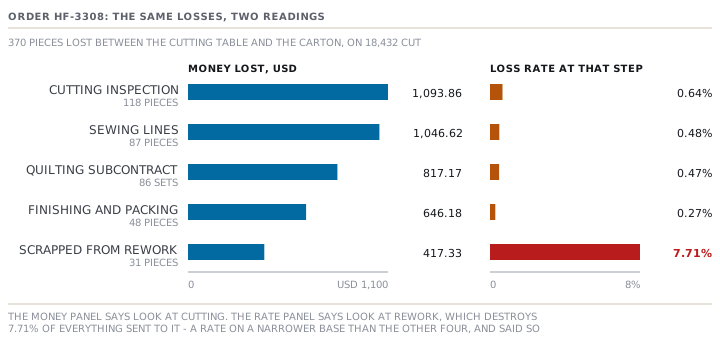
The sewing line's 87 pieces are priced at the section each was lost from: 21 at section 1, 18 at section 2, 26 at section 3, 14 at section 4 and 8 at section 5.
loss a jacket shipped = 4,021.16 / 18,000              = USD 0.2234
as a share of the order's gross margin, USD 5.9379 a jacket = 3.76%
The rate column reorders everything, and it is the column nobody keeps. By pieces and by money the biggest loss is at cutting inspection. By rate the worst step in the factory, by a distance, is rework. It destroys 7.71% of everything that enters it, while accounting for the smallest loss in the table. Both readings are useful and they point at different projects. The money says look at cutting. The rate says look at whether a garment sent to rework ever comes back.
Check yourselfYour subcontractor's delivery note says 40,000 panels quilted and your store counts 40,000 panels. Four panels make a set. Name three ways the order can still be short of garments, and say which record would show each one.Show the answer
First, broken sets. The 40,000 panels may not form 10,000 complete sets, because loose panels of the same type cannot be paired. The store's set count on receipt shows it. The panel count never will. Second, the wrong panels. A set is four different pieces, so 40,000 panels made up of too many left fronts and too few right fronts is a shortage disguised as a full delivery. Only a receipt counted by panel type shows that, which is why the receiving count has to be by type and not by piece. Third, damage in the process. A panel can come back quilted and unusable, and it is on the delivery note either way. That one shows up at the sewing line days later, unless the store inspects a sample on receipt. Underneath all three is the same rule. Count the unit that decides whether a garment can be made. Pay on whichever unit you like, but never confuse the two.
Check yourselfA plant manager reads the loss table and proposes to cut the 2.40% cutting cover to 1.50%, on the grounds that the order made its quantity with 62 jackets to spare. What is right about that and what is wrong with it?Show the answer
What is right is that cover is expensive. 432 extra jackets at USD 13.4621 is USD 5,815.63 of material and work, made to be thrown away or held. So it is worth challenging rather than inheriting. What is wrong is the sample size. This is one order, and 62 spare pieces out of 18,000 is a margin of 0.34%. The cover was almost exactly used up, which is evidence that 2.40% is about right, not that it is generous. Cutting it to 1.50% would have given 270 pieces against a loss of 370, so the order would have been 100 short. That means recutting, a second quilting trip and possibly an air freight. The right move is to reduce the loss first and the cover second, in that order, and to measure the loss on several orders before touching either. The reconciliation is the instrument that makes that argument possible. Without it the cover is a number nobody can defend or challenge.
Prompt · Reconcile my order from the cutting table to the carton
At the close of an order, after any shortage, and before anybody sets or defends a cutting cover percentage.
Build me a piece-by-piece reconciliation of one order from the cutting table to the packed carton, and price every loss at the point on the line where it happened.

I will give you: the ordered quantity, the quantity cut and the bundle size, rejects at cutting inspection, anything sent out to a subcontractor and what came back, pieces lost on the sewing line by section where I have it, pieces sent to rework and how many were recovered and scrapped, pieces lost in finishing and packing, and the quantity finally packed and shipped. I will also give you the value of a garment at each checkpoint, or the inputs to build it.

Build the reconciliation as one table, line by line, so every piece is accounted for from cut to packed. Then produce a second table of losses with three columns: pieces; money at the value the piece had reached when it was lost; and the loss RATE at that step, which is pieces lost over pieces that entered the step. Rank the table by each of the three, and tell me where the rankings disagree. That is where the argument about what to fix is actually settled.

For any subcontracted leg, insist on two units of measure. Ask what unit I paid in, and what unit decides whether a garment can be made. Reconcile both, and count anything returned that cannot be used. An odd panel from a broken set is stock I paid to process and cannot convert. Tell me what the loss did to my unit price, and separately what it did to my piece count. Those two numbers are usually nothing like each other.

Three rules. If a rate is measured on a different base from the others, say so on the same line rather than letting me compare them; give me both versions where a second base exists. Compare the total loss with the cutting cover I actually provided and tell me the margin in pieces, not as a percentage, then refuse to recommend a change to the cover from a single order. And where a piece is missing rather than destroyed, keep the two apart: tell me how many are lost, how many are misplaced on the record, and how many are unknown.
AI can make mistakes — check anything you act on.