Lessons · Lesson 1 of 3
What a half-made garment is worth
Value work in progress from your own operation bulletin, find where along the line the money really enters, and see why the halfway convention is nearly right for the wrong reason.
Lesson 1 of 3 · 40 min
The factory, the order, the basis
Between the cutting table and the packing bench sits a quantity of garments. They are neither material nor product. The trade calls this work in progress: stock that has been started and is not yet finished. It is the only stock that moves while you count it. This lesson puts a number on it, and shows where along the sewing line that number arrives. Get the number wrong and the month-end accounts describe a building nobody in the factory would recognise.
Ranomena Garments is a woven outerwear factory in Antsirabe, Madagascar. It employs 640 people. It has nine sewing lines, a cutting room, a finishing hall and its stores. It exports padded jackets and shells to Europe. This course lives in three rooms of that site: the cut store where bundles wait for a line, the sewing floor itself, and the finished goods store at the far end.
Four people appear.
- Voahangy Rasolofo runs the stores, raw material through to finished goods.
- Njaka Andriamanana is the bundle control clerk. He owns the board this lesson reads.
- Fetra Randrianja is the plant controller. The cost model below is hers.
- Hery Rakotomalala manages the sewing floor.
The style carried through all three lessons is RN-4180, a padded woven jacket in its third season. The order is HF-3308 for Halvorsen Friluft, a Norwegian outdoor chain: 18,000 jackets at USD 19.40 free on board (FOB — the price with the goods loaded on the ship, before sea freight).
Say the basis once, because everything below rests on it. All money is US dollars, which is what Ranomena quotes and is paid in. Fully loaded labour on the sewing floor is USD 0.94 an hour. Fully loaded means wage, social charges and a share of supervision. That figure is from Ranomena's own 2027 payroll, not a country average. Every standard minute comes from Ranomena's own bulletin for RN-4180, measured on its own line. A standard minute is the time one operation should take at a normal working pace. The bulletin is the list of every operation in the garment with its standard minutes. Every price is one Ranomena actually pays.
What one jacket costs to make
Two costs go into a jacket and they behave completely differently. Material arrives in one or two lumps, at moments you know. Conversion is labour, supervision and the share of factory overhead charged to production. It dribbles in a minute at a time, across every operation.
Material first, from the bill of materials for RN-4180.
| Component | USD a jacket | Issued at |
|---|---|---|
| Shell fabric | 5.62 | Cutting |
| Wadding | 1.94 | Cutting |
| Lining | 1.71 | Cutting |
| Trim: zip, cord, sliders, labels, thread | 2.57 | Operation 12, the trim issue |
| Total material | 11.84 |
Cut goods are USD 9.27 of that and the trim is the other USD 2.57. Hold on to the two figures; they turn out to matter more than anything else in this lesson.
Now conversion. Fetra builds one rate for the whole sewing and finishing floor, from the 2027 accounts and the 2027 attendance.
| Line | Basis | Value |
|---|---|---|
| Sewing and finishing operators | headcount | 412 |
| Days worked | 245 | |
| Attended hours | 412 x 245 x 8.0 | 807,520 |
| Direct wages, fully loaded | 807,520 h at USD 0.94 | USD 759,068.80 |
| Line supervision, mechanics and inline QC | from the accounts | USD 96,400.00 |
| Factory overhead absorbed into conversion | from the accounts | USD 214,600.00 |
| Total conversion cost | USD 1,070,068.80 | |
| Attended minutes | 807,520 x 60 | 48,451,200 |
| Measured floor efficiency | standard minutes earned over minutes attended | 58.0% |
| Standard minutes produced | 28,101,696 |
conversion cost a standard minute = 1,070,068.80 / 28,101,696 = USD 0.038078RN-4180's bulletin runs to 38 operations and 42.60 standard minutes.
conversion in one finished jacket = 42.60 x 0.038078 = USD 1.6221
factory cost of one finished jacket = 11.84 + 1.6221 = USD 13.4621
Two shares fall out of that, and the first one is the whole lesson.
material   11.84 / 13.4621 = 87.95%
conversion 1.6221 / 13.4621 = 12.05%
All thirty-eight operations of sewing are worth twelve per cent of the jacket. Everything else was bought before a machine was switched on.
Where the money enters
Ranomena's line is organised in five sections. Njaka's bundle board records which section a bundle has cleared. That gives you five honest checkpoints instead of a guess about where a bundle is.
| Section | Operations | Standard minutes in it | Cumulative standard minutes | Material in by then | Value a jacket, USD |
|---|---|---|---|---|---|
| In the cut store, bundled, not yet on a line | none | 0.00 | 0.00 | 9.27 | 9.2700 |
| 1 Front and pocket assembly | 1 to 9 | 8.42 | 8.42 | 9.27 | 9.5906 |
| 2 Back, shoulder and trim issue | 10 to 16 | 6.11 | 14.53 | 11.84 | 12.3933 |
| 3 Sleeves and shell close | 17 to 24 | 9.44 | 23.97 | 11.84 | 12.7527 |
| 4 Lining and bagging | 25 to 31 | 8.13 | 32.10 | 11.84 | 13.0623 |
| 5 Collar, hem and closing | 32 to 38 | 10.50 | 42.60 | 11.84 | 13.4621 |
Each value is the material issued so far, plus the cumulative standard minutes at USD 0.038078. Section 2 contains operation 12, where the trim goes in. So the jump from the first section to the second is a jump in material, not in work. Operation 12 sits at 11.20 cumulative standard minutes, which is where the step in the drawing below falls.
Read the same column as a percentage of the finished jacket and the shape is stark.
in the cut store, nothing done to it   9.2700 / 13.4621 =  68.86%
section 1 cleared                      9.5906 / 13.4621 =  71.24%
section 2 cleared                     12.3933 / 13.4621 =  92.06%
section 3 cleared                     12.7527 / 13.4621 =  94.73%
section 4 cleared                     13.0623 / 13.4621 =  97.03%
off the line                          13.4621 / 13.4621 = 100.00%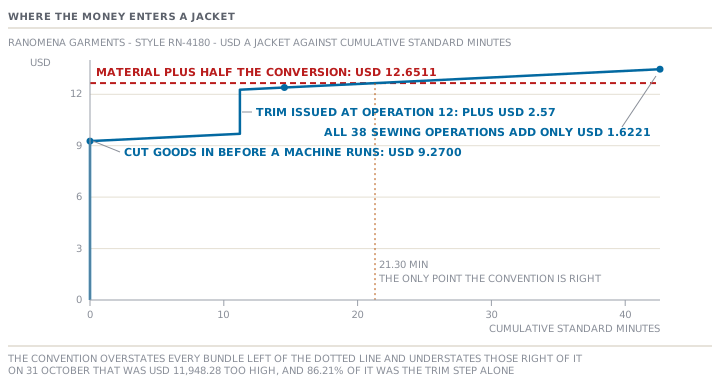
A bundle that has had nothing whatever done to it is already carrying more than two thirds of its final cost. By the time it has cleared section 2 it is carrying more than nine tenths. The sewing floor is the part of the factory everybody watches, measures and worries about. It adds the last twelve per cent, in a shallow ramp, over thirty-eight operations.
That is not an argument against watching the sewing floor. Sewing decides whether the jacket exists at all and how many hours it took, and lesson 2 shows it is where pieces go missing. It is an argument about valuation. If you are working out what your work in progress is worth, sewing progress is almost the least useful thing you can know about it. Where the material was issued is almost the most useful.
One month end, valued twice
On 31 October 2027 Njaka's board carried 419 bundles of RN-4180 at 24 jackets a bundle. Here it is at the section values above.
| Where the bundle is | Bundles | Jackets | Value a jacket, USD | Value, USD |
|---|---|---|---|---|
| Cut store, bundled, not issued | 96 | 2,304 | 9.2700 | 21,358.08 |
| Section 1 cleared | 71 | 1,704 | 9.5906 | 16,342.38 |
| Section 2 cleared | 88 | 2,112 | 12.3933 | 26,174.65 |
| Section 3 cleared | 63 | 1,512 | 12.7527 | 19,282.08 |
| Section 4 cleared | 54 | 1,296 | 13.0623 | 16,928.74 |
| Off the line, waiting for pressing and pack | 47 | 1,128 | 13.4621 | 15,185.25 |
| Total | 419 | 10,056 | 115,271.18 |
Now the shortcut almost every factory uses, called the halfway convention: material plus half the conversion. The reasoning is that the average bundle is somewhere in the middle of its work.
convention value a jacket = 11.84 + (0.5 x 1.6221) = 11.84 + 0.8111 = USD 12.6511
10,056 jackets x 12.6511                            = USD 127,219.46
against the section-by-section figure               = USD 115,271.18
overstatement                                       = USD  11,948.28, or 10.37%
Here the arithmetic goes against what you would expect, and it is worth saying plainly. You would think the error must be small. Conversion is only 12.05% of a jacket, and the convention is only wrong about half of that. It is not small, and almost none of it comes from the thing the convention argues about. Split it.
| The assumption | What it does | USD | Share |
|---|---|---|---|
| Every jacket has had half its sewing minutes | Overstates the bundles before section 3, understates those after | 1,647.72 | 13.79% |
| Every jacket has had its trim issued | Credits USD 2.57 of trim to 4,008 jackets that have had none | 10,300.56 | 86.21% |
| Total | 11,948.28 | 100.00% |
The 4,008 jackets are the 2,304 sitting in the cut store plus the 1,704 that have cleared section 1 only. That is everything standing before the trim issue at operation 12.
4,008 x 2.57 = USD 10,300.56The percentage everybody argues about is worth USD 1,647.72. That is 130.2 jackets, or 5.43 bundles out of 419. Whether it should be fifty per cent or sixty is a question about five bundles. Whether the trim has actually been issued is a question about ten thousand dollars. Nobody asks it, because it does not look like an accounting question. It looks like a warehouse question.
What the number is actually for
Three people ask for a month-end work in progress figure, and they want three different things. A factory that produces one number for all three has answered at most one of them.
| Who asks | What they need | Whether the money figure answers it |
|---|---|---|
| The accounts, for the balance sheet | Material plus conversion earned, at cost, never above what the goods will fetch | Yes. This is the figure above |
| The floor manager | How many pieces are queued in front of each section, in pieces and hours | No. He needs the bundle count, not the money |
| The merchandiser on HF-3308 | How many of my jackets are in the building and how far along | No. He needs the same board cut by order, not by section |
All three readings come off the same board. That is the argument for keeping the board, not for building three systems. What must never happen is the third reader being handed the first reader's number. The accounts value is a total across every order on the floor. A merchandiser who reads it as his own position has read a number that includes somebody else's jackets.
Check yourselfA second style on the same line has material of USD 6.10, all of it issued at cutting with no separate trim issue, and 51.20 standard minutes. Using Ranomena's conversion rate, what does the halfway convention get wrong for that style, and how does the answer differ from RN-4180's?Show the answer
Conversion in a finished garment is 51.20 x 0.038078 = USD 1.9496. So the factory cost is 6.10 + 1.9496 = USD 8.0496, and the convention value is 6.10 + 0.9748 = USD 7.0748. All the material enters at cutting, so the trim error — the whole of RN-4180's problem — does not exist for this style. Only the conversion assumption is left, and it now matters more, because conversion is 1.9496 / 8.0496 = 24.22% of this garment against 12.05% of the jacket. So the convention is a good approximation for RN-4180 for the wrong reason, and a worse one here for the right reason. On this style you really are arguing about where the bundles are. The answer depends on how they are spread across the line, not on a stock issue. The general rule is that the convention's error is driven by the shape of the material issue first and the labour content second. That is the reverse of how it is usually discussed.
Check yourselfYour controller proposes to stop valuing by section and simply take the total pieces on the floor at material plus half conversion, saying the difference is not material to the accounts. On Ranomena's October numbers, what is the strongest version of that argument and what would you need to know before agreeing?Show the answer
The strongest version is that USD 11,948.28, on a plant that turns over hundreds of thousands of dollars a month, may well be below the auditor's materiality threshold — the size below which an error does not change anybody's decision. It adds that the section board is kept by a clerk whose time has a cost. That is a real argument, and it is about materiality rather than accuracy. You would need three things before agreeing. First, whether the error is stable. It is driven by how many jackets stand before the trim issue, and that changes with the cutting plan. So October's 10.37% is one observation, not a rate, and a month with a big cut and a stalled line would be much worse. Second, which way it runs. It overstates stock and understates cost of sales every time, so it is a one-way bias rather than noise, and biases build up. Third, whether the board is being kept for the accounts at all. It is not. The floor manager and the merchandiser need it anyway, so the extra cost of using it for the valuation is one multiplication.
Prompt · Value my work in progress from my own bulletin
At a month end, or the first time somebody asks what the floor is worth and the answer is a percentage rather than a calculation.
Help me value the work in progress on my sewing floor from my own operation bulletin rather than from a convention.

I will give you: my total conversion cost for a year with direct wages, supervision and absorbed factory overhead shown separately; my attended hours and my measured floor efficiency; the standard minutes in the style's bulletin; the bill of materials with a cost against each component AND the operation at which each component is actually ISSUED; and, from my bundle board, how many bundles sit at each section of the line with the section's cumulative standard minutes.

First build the conversion cost a standard minute, showing the division. Then build the value of one garment at every checkpoint on the board: material issued so far, plus cumulative standard minutes at that rate. Show the material share and the conversion share of the finished garment as percentages. The ratio between them decides everything that follows.

Then value my floor twice: once section by section, and once with the convention of material plus half the conversion. Give me the difference in money and as a percentage. Then SPLIT that difference into the two assumptions the convention makes: the assumption about sewing progress, and the assumption that every garment has had every material issued. Tell me which of the two carries the larger share. Express the smaller one in bundles, so I can see whether it is worth arguing about.

Four rules. Tell me which way the error runs. A convention that overstates stock flatters the balance sheet, and that error survives longer than one that does not. Do not recompute my conversion rate from a single bad month's output; say plainly that fixed overhead is absorbed at normal capacity and that recomputing it would capitalise idleness. If I cannot tell you when a component is issued, say the valuation is unknown until I can, and do not assume it goes in at cutting. And do not tell me to improve the percentage: tell me what one extra field on the bundle board would remove the larger error entirely.
AI can make mistakes — check anything you act on.