Lessons · Lesson 3 of 3
What you can hand over, and what you cannot
Which parts of a distribution operation a third party does better, which parts nobody can contract for, and the clauses that decide which of the two you receive.
Lesson 3 of 3 · 42 min
Two different kinds of work
Some of the work in a warehouse is muscle and space. Some of it is judgement about your own product. A contract can buy the first easily and the second not at all. This lesson separates the two. Then it looks at the clauses that decide which one you get.
Lesson 2 left Ognen Pandev with an answer he did not much like. At today's volume the Venlo operation is cheaper by EUR 19,706.32 a year. Below 77.2% of today's volume it is not. And the lease means the decision cannot be acted on for three years anyway. That is a cost answer. It is not a capability answer, and the two can point in opposite directions.
What a third party is genuinely better at
Three advantages here are real and measurable, and none of them is efficiency. They all come from the same source: a third party is sharing something with somebody else, and Tikvesh cannot share with itself.
It rents you the peak by the week
Venlo's parcel volume is not flat. Rothenkamp issues uniforms at the start of the industrial year, so eight weeks carry a load the other forty-two do not.
42 ordinary weeks x   800 parcels = 33,600
 8 peak weeks     x 2,000 parcels = 16,000
                                    49,600
The peak week is 2.5 times the ordinary one, and everything Tikvesh owns has to be sized for it.
Take the space first. Venlo needs 108.49 pallet positions at the peak and 77.49 on average. So 31 positions exist only for those eight weeks. At Tikvesh's own occupancy cost of EUR 423.33 a position, that headroom costs EUR 13,123.23 a year. On the rate card the same 31 pallets are charged only while they are there.
own headroom for the peak   31 x EUR 423.33            = EUR 13,123.23 a year
rate card                   31 x EUR 9.60 x 8 weeks    = EUR  2,380.80 a year
The third party charges EUR 2,380.80 for a peak that costs Tikvesh EUR 13,123.23. Nothing clever is happening. It has other customers whose peak is not in September.
It staffs your peak without the agency premium
The same shape appears in labour. A peak week needs 6.90 people at Venlo's measured 290 parcels a person-week, and Tikvesh has three.
peak weeks   8 x 6.8966 = 55.17 person-weeks needed, 24 held, 31.17 short
other weeks 42 x 2.7586 = 115.86 needed, 111 held after holidays, 4.86 short
The peak shortfall alone is 1,246.90 agency hours. Lesson 2 measured the agency rate at EUR 31.50 against a permanent equivalent of EUR 23.11. So EUR 10,461.49 of that is premium rather than work. A third party moving people between customers pays no such premium, because for it the hours are not a peak at all.
It may already be where you want to be
Lesson 1 turned down a fifth point at Zaragoza. It lost by EUR 27,640.34, and the line that killed it was the flat EUR 34,800 account and systems charge for having a point at all.
But that charge is a price, not a cost. A third party already operating in Zaragoza is adding a location to an account it runs anyway. Run the fifth-point test backwards and it gives Menka Stojanoska a number to negotiate against.
outbound saved                                      37,926.00
line-haul rise                                      22,425.00
inventory rise                                       8,341.34
what is left for an account charge                   7,159.66
A fifth point passes if, and only if, the charge for it is under EUR 7,159.66 a year. That is a far more useful sentence than "we looked at Iberia and it did not work".
What it can never do
Now the other half. It is not a list of complaints about service. It is one specific thing, and it has a number.
Rothenkamp's sites order for real people. 3.1% of orders hit a size that is short at Venlo, which is 1,538 orders a year. Wiebe Doornbos's team rings the site, asks whether the wearer will take the next size, and usually ships one parcel. A third party working to a rate card ships what it has and closes the order line.
second parcels a year   1,538
cost of one             EUR 6.40 + 0.021 x 178 km = EUR 10.138
                        EUR 15,592.24 a year
EUR 15,592.24 is the visible part, and it is the smaller part. The larger part is that the service level reads as met. The parcel went out the same day. The order line was despatched. Every number on the monthly report is green, and a Rothenkamp site has a new joiner in the wrong trousers.
This is not a thing a third party is bad at. It is a thing no contract has asked it to do. It can be instructed, and that is the honest version: write the substitution rule down and it will follow it. But writing it down is the work. Tikvesh's rule would have to cover 42 style and size combinations, and Rothenkamp revises its specification twice a year. Judgement handed over becomes a document somebody has to maintain, and that maintenance is the cost nobody quotes for.
The clause that decides which one you get
A rate card is a price list. What Tikvesh actually receives is decided by four clauses, and one of them is worth more than the whole price negotiation.
The minimum-volume clause
The draft contract commits Tikvesh to pay for at least 90% of the forecast volume, whatever it ships. That single line does something specific. It turns the variable side of lesson 2's comparison into a fixed cost.
quotation, no minimum, at m   = 34,800.00 + 297,220.75 m
quotation, 90% minimum, m<0.9 = 34,800.00 + 297,220.75 x 0.90 = 302,298.68
Now put the own operation beside it. At 90% of volume Venlo costs EUR 289,574.08, and it costs less than that at every lower volume. The floored quotation does not move at all.
So under the clause, the quotation is never cheaper anywhere below 90%. The whole region where the third party won has gone.
| Volume, as a share of today | Venlo | Quotation, no minimum | Quotation, 90% minimum |
|---|---|---|---|
| 75% | 263,935.96 | 257,715.56 | 302,298.68 |
| 77.18% | 264,195.38 | 264,195.17 | 302,298.68 |
| 90% | 289,574.08 | 302,298.68 | 302,298.68 |
| 100% | 312,314.43 | 332,020.75 | 332,020.75 |
At 75% of volume the clause moves the answer by EUR 44,583.12 a year, and it reverses it. Without the clause the third party is cheaper by EUR 6,220.40. With it, Venlo is cheaper by EUR 38,362.72.
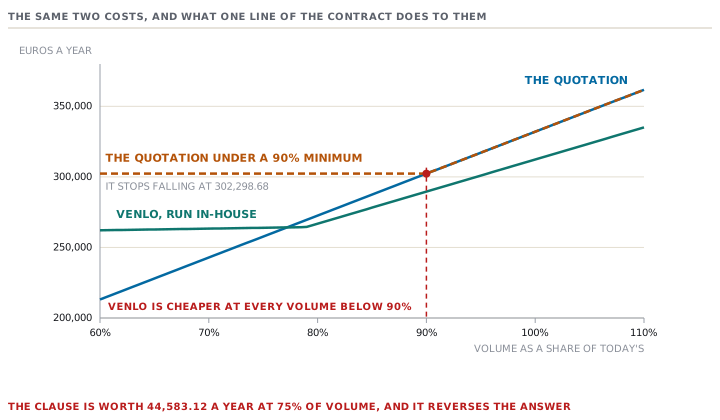
Read that as what the clause is for, rather than as a trap. The third party's low variable rate is only affordable to it because it can move the space and the people to another customer. A customer that halves its volume without notice takes that away. The minimum is how the third party gets paid for the flexibility it sold. Tikvesh is entitled to buy less of that flexibility and pay less for it, and that is the negotiation: a lower minimum with a longer notice period, or a minimum that steps down over the term.
The general lien
A lien is a right to hold on to your goods until you pay. The standard forwarding conditions give the operator a general lien over goods in its possession. Read the word general carefully. A particular lien secures the charges relating to the goods held. A general lien secures all sums due on the account, including sums that have nothing to do with the goods being held, and including sums Tikvesh disputes.
Venlo carries EUR 528,141.03 of stock on an average day.
stock exposed at Venlo        EUR 528,141.03
a disputed surcharge          EUR   4,180.00
ratio                                126.4 to 1
The EUR 4,180 is a real example. It is a charge for non-conforming inbound after a run of over-height pallets, which Tikvesh believes it does not owe. Under a general lien, refusing to pay it can stop the programme. A billing dispute becomes a supply failure, and the amount at stake is not the amount in dispute.
Three amendments are worth asking for, and none of them is unusual. Narrow the lien to charges relating to the goods held. Exclude sums under a notified dispute. And allow release against a bank guarantee for the disputed amount.
The service credit
The draft promises 99.0% of parcels despatched on the day of order, with a credit of 5% of that month's charge if it is missed. That reads like a remedy. Price it.
A peak month at Venlo is four peak weeks: 8,000 parcels, 120,000 garments and 250 pallets received.
account and systems      2,900.00
storage 108.4855 x 9.60 x 4 weeks   4,165.84
receipt 250 x 6.80       1,700.00
despatch 8,000 x 1.85   14,800.00
pick 120,000 x 0.21     25,200.00
month                   48,765.84   credit at 5% = 2,438.29
Now the failure. A 5% miss in that month is 400 late parcels, and Rothenkamp's own contract charges Tikvesh EUR 45 for every late order line.
Tikvesh pays Rothenkamp   400 x 45 = 18,000.00
Tikvesh recovers                      2,438.29
recovery                                13.55%
A service credit is a discount on the service that failed. It is not compensation for what the failure did. It is also capped: at 10% late the credit does not change, and the charge-backs double. The clause worth negotiating is not a bigger credit. It is a right to terminate on repeated failure, because the only real protection against a supplier who cannot perform is being allowed to leave.
Exit and transition
The third party quotes EUR 18,500 to implement and EUR 24,000 to build the systems interface, so EUR 42,500 to start. Notice is six months. That EUR 42,500 is paid again on the way out, to whoever comes next.
The clause that matters here is not the notice period. It is the one about the opening balance. On the day the stock transfers, a count is taken and becomes the third party's opening position. Every discrepancy afterwards is measured against it. If the count is wrong, the two parties spend the contract arguing about a difference neither of them created, and neither can prove anything.
What has to be true inside the building first
This is the last course in the track, so it is worth saying plainly what the first five were for. None of the arithmetic in this course can be done by a factory that has not done them.
| From | What you must already have | What its absence does here |
|---|---|---|
| Warehouse fundamentals | Your own cost per position and per movement, from your own accounts | Without it there is nothing to compare a rate card with, and the quotation wins by default |
| The raw material store | Receipts that are counted and recorded correctly | You are billed per receipt. An uncheckable receipt count is an uncheckable invoice |
| Work in progress and finished goods | An honest split of finished, committed and unavailable stock | You pay storage on everything held, including what you cannot sell |
| Inventory control and accuracy | A record that agrees with the shelf | The transfer count becomes the opening balance, and an inaccurate one poisons the whole contract |
| Warehouse systems and barcoding | The ability to exchange stock, despatch and receipt data | The interface cost and the manual reconciliation swamp the rate difference |
There is a reason to put that table at the end rather than the beginning. Outsourcing is often proposed as a way to escape a store that does not work. It is the opposite. A third party is a supplier who bills you for exactly the transactions you can count, on stock you have declared, against a balance you agreed. Every one of those is a discipline the earlier courses build. Hand over a store you cannot measure and you have not removed the problem. You have made it somebody else's, and given up the ability to see it.
Check yourselfThe third party offers a lower pick rate, EUR 0.19 instead of EUR 0.21, in exchange for raising the minimum volume from 90% to 95%. Should Tikvesh take it?Show the answer
Price both halves. The rate cut saves 744,000 times EUR 0.02, which is EUR 14,880 a year at today's volume, and it is the single most valuable rate to cut, because picking is 47.06% of the bill. The minimum costs nothing at all today, because Tikvesh is at 100% of forecast. So on this year's numbers the offer is worth EUR 14,880 for nothing. That is exactly why it should be refused as offered. The minimum only bites when volume falls, and the whole reason for buying a rate card rather than owning a warehouse was to pay less when volume falls. Price it at 80% of volume. The cheaper pick rate drops the variable side to EUR 282,340.75, and the 95% floor puts the bill at EUR 34,800 plus 0.95 of that, which is EUR 303,023.71. Venlo would cost EUR 266,833.74. So the third party is dearer by EUR 36,189.97 in exactly the year the flexibility was supposed to pay. The trade is a certain small gain against an uncertain large loss, sold as a discount. The counter is to take the rate cut against something Tikvesh controls, such as a longer term or a firmer forecast, and leave the minimum alone.
Check yourselfRothenkamp asks Tikvesh to hold two weeks of extra stock at Venlo so that new joiners can be served the same day. Tikvesh's sales director says it costs nothing because the warehouse is only 46% full. What does this course say?Show the answer
It costs something, and the sales director has picked the one cost that is genuinely zero. Two weeks of extra cover on the North area is 29,760 garments, which is 62 pallets. Venlo has 168 positions and 77.49 are used on average, so the pallets do fit and no rent changes. That part is right. What is not free is everything else. Capital, obsolescence and insurance run at EUR 1.9951 a garment a year, so 29,760 garments cost EUR 59,374.18 a year to own. That is three times the entire annual difference between running Venlo and buying it in. There is also a peak to check. Average occupancy would go to 139.49 of 168 positions, and the peak to 170.49, which does not fit. So the eight weeks that already need agency labour would need overflow space as well. And the honest answer to Rothenkamp is not no. It is that same-day service for new joiners is a thing worth about EUR 59,374.18 a year, and the conversation is whether Rothenkamp will pay for it, not whether the shelf is empty.
Prompt · Read a logistics contract for the clauses that decide the price
When a rate card looks acceptable and the contract behind it has not been priced.
Read this logistics or warehousing contract with me and price the clauses, not the rates.

I will give you the draft, my volumes, my own cost of doing the work, and what my customer charges me when a delivery is late.

Find and price these five, and say plainly when the contract is silent on one, because silence usually favours the party that drafted it.

One. Any minimum volume, take-or-pay or committed throughput. Work out the charge at that floor, set it against my own cost at the same volume, and tell me whether the clause removes the flexibility I am buying. Show me the volume at which the answer reverses, with and without the clause.

Two. The lien, which is the operator's right to hold your goods until you pay. Tell me whether it is general or particular, whether it covers sums I dispute, and whether it covers sums unrelated to the goods being held. Then give me the ratio of the stock value exposed to a plausible disputed invoice, and tell me what release against a guarantee would be worth.

Three. The service level and its remedy. Convert the credit into money on a real month, then price what the same failure costs me under my own customer contract, and give the recovery as a percentage. Tell me whether the credit is capped, and whether repeated failure gives me a right to terminate.

Four. Exit. Implementation and interface fees, notice period, who owns the data, who owns the stock record, and how the opening balance is agreed on the way in. Tell me what a transfer count that is wrong would cost me over the term.

Five. Rate review. What is fixed, for how long, against which index, and with what cap.

Then two judgements. Tell me which tasks in the scope are rule-followable and which require judgement I have not written down, and price the writing down of the rules rather than assuming it is free. And tell me the single amendment worth the most money, so I can spend my negotiation there rather than on the storage rate.
AI can make mistakes — check anything you act on.