Lessons · Lesson 2 of 3
Your cost, and the rate card
How to cost a warehouse you already own so that a per-pallet, per-receipt and per-pick quotation can be compared with it honestly.
Lesson 2 of 3 · 42 min
The unit at Venlo
A warehouse of your own never sends you an invoice. That is why it feels cheap. It is also why a comparison with a quotation is usually lost before it starts. A quotation shows every charge on one page. Your own operation hides most of its charges inside other people's budgets. This lesson digs them out.
Lesson 1 priced four network shapes on one rate card and picked four points. Three of those points are bought from a third party. The fourth is Venlo. Tikvesh runs it itself, in a leased unit, with its own people. Wiebe Doornbos has led it since it opened. The third party has now quoted for that work too, and Ognen Pandev wants to know whether to accept.
Venlo serves the North area on its own. Everything below comes from that one point.
garments a year   744,000
parcels a year     49,600
pallets received    1,550
safety stock       22,313.03 garments
cycle stock        14,880 garments
average stock      37,193.03 garments, worth EUR 528,141.03
The safety stock reproduces from lesson 1: 1.96 times a weekly deviation of 3,600 times the square root of a ten-week protection interval, which is 1.96 times 3,600 times 3.1622777.
What it costs, in five buckets
Ilija Trpevski built the model below from the 2027 accounts. The buckets are not accounting categories. They answer a different question: what would actually change, and when.
| Bucket | What is in it | Amount |
|---|---|---|
| Building and occupancy | Rent on 640 m² at EUR 82; service charge at EUR 13.50; local property charges EUR 6,900; building and liability insurance EUR 3,100 | 71,120.00 |
| Fit-out | Racking EUR 41,000 over twelve years; two powered pallet trucks EUR 26,000 over seven; truck maintenance EUR 2,200; benches, printers and scanners EUR 14,800 over five | 12,290.96 |
| Establishment abroad | Warehouse system licence EUR 6,900 and line and support EUR 2,400; management time and travel EUR 13,560; accountancy and statutory filings EUR 7,300 | 30,160.00 |
| Permanent people | Three operatives at EUR 41,600 fully loaded, and four tenths of a supervisor | 141,440.00 |
| Volume-driven | Agency hours EUR 45,403.47; metered utilities EUR 7,300; carrier account work, claims and returns EUR 4,600 | 57,303.47 |
| Total | 312,314.43 |
Two lines in that table are the ones a factory usually leaves out. Together they are worth EUR 20,860.
Management time and travel, EUR 13,560. Menka Stojanoska spends six hours a week on Venlo. At a fully loaded EUR 34.80 an hour over 50 weeks, that is EUR 10,440. Four trips a year at EUR 780 add EUR 3,120. Nobody invoices Tikvesh for any of it, so it appears in no warehouse report. It is real, it stops if the work is handed over, and it is therefore part of the comparison.
Accountancy and statutory filings, EUR 7,300. A warehouse in another country is a legal establishment. It files, it is audited, and somebody has to keep it registered. That cost belongs to the decision to have a warehouse there, and it goes when the warehouse goes.
And one line that is on an invoice and still gets misread: agency hours, EUR 45,403.47. Venlo picks and packs at a measured 290 parcels a person-week, and an operative works 45 weeks a year after holiday and absence.
person-weeks needed = 49,600 / 290 = 171.0345
person-weeks held   = 3 x 45      = 135
shortfall           =                36.0345, being 1,441.38 hours
agency cost         = 1,441.38 x EUR 31.50 = EUR 45,403.47
Look at what the two rates say side by side. A permanent operative costs EUR 41,600 for 45 weeks of 40 hours, which is EUR 23.11 an hour. Agency labour costs EUR 31.50, which is 36.3% more. Flexibility bought this way is not free. Tikvesh pays EUR 12,091.57 a year for it in premium alone.
The rate card
The third party quotes four rates and a charge for existing.
| Charge | Rate | Basis at Venlo | Amount |
|---|---|---|---|
| Storage | EUR 9.60 a pallet a week | 37,193.03 garments, at 480 to a pallet | 38,680.75 |
| Receipt | EUR 6.80 a pallet in | 1,550 pallets | 10,540.00 |
| Despatch | EUR 1.85 a parcel | 49,600 parcels | 91,760.00 |
| Pick | EUR 0.21 a garment | 744,000 garments | 156,240.00 |
| Account and systems | EUR 2,900 a month | twelve months | 34,800.00 |
| Total | 332,020.75 |
The storage line is worth converting, because it is the only rate that can be compared with a holding cost. EUR 9.60 a pallet a week is EUR 499.20 a pallet a year, and on 480 garments that is EUR 1.04 a garment a year. Set that beside the EUR 1.9951 of capital, obsolescence and insurance from lesson 1. Physically keeping a garment somewhere costs about half of what owning it costs.
The naive answer, and why it is not the answer
own operation      EUR 312,314.43
quotation          EUR 332,020.75
own is cheaper by  EUR  19,706.32
Six per cent. That is close enough that the answer is decided by whatever you left out, which is why the two forgotten lines matter so much. Drop the management time and the filings, as most models do, and the own figure falls to EUR 291,454.43. The gap widens to EUR 40,566.32. The decision looks safer, and the safety is manufactured.
But the deeper problem is not accuracy. It is that a single-point comparison cannot answer this question at all, because the two things being compared have different shapes.
Where the bill actually comes from
Before that, look at how the quotation is built up. It tells you where to spend a negotiation.
picking                  156,240.00   47.06%
despatch                  91,760.00   27.64%
storage                   38,680.75   11.65%
account and systems       34,800.00   10.48%
receipt                   10,540.00    3.17%
Handling is 74.69% of the bill and storage is 11.65%. Ten per cent off the two handling rates is worth EUR 24,800 a year. Ten per cent off the storage rate is worth EUR 3,868.08. The handling rates are worth 6.41 times as much. And the storage rate is the one every factory argues about, because storage is the thing a warehouse looks like it does.
Space is the line the third party wins, and it is the small line
Venlo has 168 pallet positions. Average stock is 77.49 pallets and the peak is 108.49. So the unit runs at 46.12% occupancy on average, and 64.57% at its fullest.
own occupancy cost      EUR 71,120 for 168 positions = EUR 423.33 a position a year
per pallet ACTUALLY held EUR 71,120 / 77.4855        = EUR 917.85 a year
rate card                EUR 9.60 x 52               = EUR 499.20 a year
The rate card is 45.61% cheaper than Tikvesh's own space, per pallet actually held. The reason is not that the third party has cheaper rent. It is that Tikvesh pays for 168 positions and uses 77. The unit is oversized because 640 m² was the smallest thing available on that estate, and because it has to hold the peak.
That is the real structural difference between owning and buying, and it is not about efficiency. The third party charges for what you occupy. You pay for what you leased. Everything else follows from that one sentence, including the next section.
Fixed against variable: the volume at which the answer flips
Split both sides by how they behave when volume moves.
| Does not move | Moves with volume | |
|---|---|---|
| Own operation | 255,010.96, being building, fit-out, establishment and permanent people | 57,303.47, being agency, utilities and carrier work |
| Quotation | 34,800.00, being the account and systems charge | 297,220.75, being storage, receipt, despatch and pick |
81.7% of the own operation does not move, and 89.5% of the quotation does. They are not two prices for one thing. They are a fixed cost and a variable cost that happen to be equal at today's volume, and that is a coincidence of this year's order book.
Write both as a straight line, where m is volume as a share of today's, and solve.
own       = 255,010.96 + 11,900 m
quotation =  34,800.00 + 297,220.75 m
equal when 220,210.96 = 285,320.75 m
m = 0.7718
Below that point the own operation is running three permanent operatives with no agency at all. That is why its slope there is only the utilities and carrier lines.
The two are equal at 77.2% of today's volume, at about EUR 264,195 each. Above that, keeping Venlo is cheaper. Below it, the quotation is. PRG-4408 has four customer sites contracted annually, and the largest is 31% of the volume. One non-renewal takes Tikvesh past the crossover.
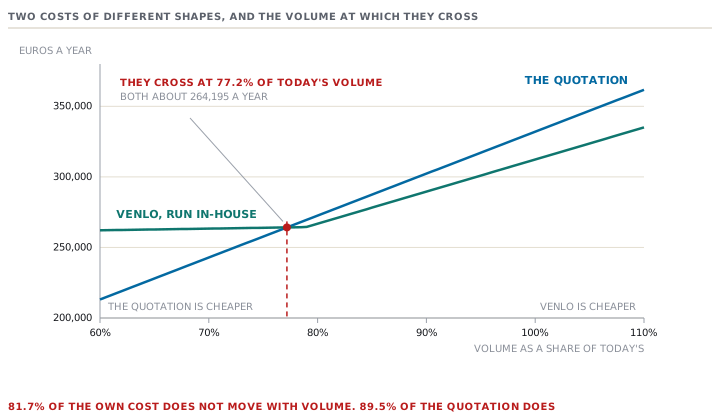
Notice what leaving out those two lines does here, rather than to the headline. Without them the fixed side falls to EUR 234,150.96 and the crossover moves to 69.9%. So the forgotten lines do not just make the own operation look EUR 20,860 cheaper. They hand the decision 7.3 percentage points of headroom that do not exist.
What leaving actually costs
Annual cost is not cash, and the decision is about cash. The Venlo lease has three years to run with no break clause. Dutch employment law and the contracts give three point four full-time equivalents a redundancy exposure. Tikvesh's advisers put it at EUR 46,000.
| Year one | Three years | |
|---|---|---|
| Quotation | 332,020.75 | 996,062.25 |
| Lease, service charge and property charges still payable | 71,120.00 | 213,360.00 |
| Redundancy | 46,000.00 | 46,000.00 |
| Residual management of the contract, being two hours a week and two trips | 5,040.00 | 15,120.00 |
| Winding up the foreign establishment | 7,300.00 | 7,300.00 |
| Warehouse system licence to the end of its term | 6,900.00 | 6,900.00 |
| Sale of racking and trucks | -18,000.00 | -18,000.00 |
| Moving | 450,380.75 | 1,266,742.25 |
| Staying | 312,314.43 | 936,943.29 |
| Moving costs more by | 138,066.32 | 329,798.96 |
The racking and trucks are worth naming separately. The racking is five years into twelve and the trucks four into seven, so the written-down value is EUR 35,059.53. The best offer is EUR 18,000, so the books take a EUR 17,059.53 loss. That loss is not a reason to stay. It has already happened; the sale merely records it. The EUR 18,000 is the only part of it that is a decision.
Now run the crossover again with the exit cost in it. Over the three years of the lease, moving is cheaper only if the annual saving covers EUR 270,680 of committed and one-off cash. That is EUR 90,226.67 a year.
own - quotation = 90,226.67
220,210.96 - 285,320.75 m = 90,226.67
m = 0.4556
Mid-lease, moving pays only below 45.6% of today's volume. More than half the programme would have to go. So the honest conclusion is not "keep it" or "move it". It is that the decision belongs at the lease break. Between now and then, the only question worth asking is what the volume will be in three years.
What is still unknown
The 290 parcels a person-week is Venlo's number, not the third party's. Tikvesh has no measurement of what the third party achieves, and the rate card does not reveal it. EUR 1.85 and EUR 0.21 are prices, and a price contains both a productivity and a margin. The two cannot be separated from outside. Whether the quotation is cheap work, or dear work sold well, is unknown. The only way to find out is a site visit with a stopwatch, and a willingness to be refused.
The peak is priced here as though it were flat. Storage is charged on average stock, and Venlo's stock is not average in September. Lesson 3 takes that apart, because it is the one place where a third party has an advantage Tikvesh cannot copy at any price.
Check yourselfIlija Trpevski is asked to redo the comparison with the racking and trucks left out, on the ground that they are already paid for and their depreciation is a book entry rather than cash. Is he right to leave them out?Show the answer
For this decision, mostly yes, and the reasoning matters more than the answer. Depreciation is not cash and the assets are already bought, so EUR 12,290.96 a year is not money that stops if Venlo closes. Two parts of it are not sunk, though. Truck maintenance of EUR 2,200 is real cash that does stop, so it stays in. And the assets have a resale value of EUR 18,000, which is cash that only arrives if Venlo closes, so it belongs in the exit table where it already is. Leave out the depreciation and the own operation falls to EUR 302,223.47 a year, the gap against the quotation widens to EUR 29,797.28, and the crossover moves from 77.2% down to 73.6%. But notice the trap. If Tikvesh keeps Venlo, the racking reaches twelve years old at some point and has to be replaced, and the replacement is entirely cash. Treating an asset as free because it is already bought is how a factory arrives at a year in which three of them need replacing at once. The right treatment is to leave the depreciation out of this decision, and put the replacement in the cash forecast for the year it falls due.
Check yourselfWiebe Doornbos argues that the quotation cannot be trusted, because a third party quoting EUR 0.21 a garment to pick must be assuming a productivity it will not hit, and will come back for more within a year. What in this lesson bears on that, and what does not?Show the answer
What bears on it is how the bill is made up. Picking and despatch are 74.69% of the quotation, so the whole of Wiebe's suspicion lands on three quarters of the bill, and a rate revision there moves the answer far more than anything else could. What does not bear on it is Venlo's own 290 parcels a person-week, which is the temptation. That number is a fact about Venlo's layout, its people and its parcels. It says nothing about a building Wiebe has not seen. Using it to judge the quotation would be assuming the answer. The useful move is to convert the rates into an implied productivity under stated assumptions, then take the result to the third party as a question rather than as an accusation. And then to look at the contract, because the real protection is not being right about the rate. It is a rate that is fixed for a stated term, with a named index and a stated cap on any rise, which is lesson 3.
Prompt · Cost my own warehouse so a rate card can be compared with it
Before answering a per-pallet, per-receipt and per-pick quotation, and any time somebody says the space is already paid for.
Build me an honest cost of a warehouse I run myself, so that a third party's rate card can be set beside it.

I will give you: rent, service charge, property charges and building insurance; the installed cost, age and life of my racking and handling equipment; my warehouse system licence and support; my people, their fully loaded cost and their working weeks after holiday and absence; my agency hourly rate; metered utilities; and my measured throughput in units, parcels and pallets received.

Ask me for two things I will probably not offer. First, how many hours a week somebody outside the warehouse spends managing it, and what travel and professional fees the site incurs because it is in another country. Second, my measured picking rate in parcels or lines a person-week, taken from a real period rather than from a target.

Then present my cost in five buckets: building and occupancy, fit-out, establishment, permanent people, and volume-driven. Do not use accounting categories. The buckets must answer what would actually change, and when.

Warn me about two double counts. If I already carry stock insurance inside a holding rate, it must not appear again in the warehouse cost. If consumables would be re-charged by the third party, either put them on both sides or on neither.

Then convert the quotation to a total on my volumes and compare. Give me the composition of the quotation as percentages, and tell me which rate is worth negotiating by showing what ten per cent off each one is worth in money.

Then split both sides into what moves with volume and what does not, write each as a straight line, and solve for the volume at which they cross. Tell me how far that is from where I am now, and what one customer leaving would do.

Finally, do the cash. Tell me what is committed whatever I decide, including any lease term still to run and any redundancy exposure, and give me year one and the full remaining term both ways. Then tell me the volume below which moving would pay even after those committed costs. If that volume is implausible, say so plainly: the decision belongs at the lease break, not today.
AI can make mistakes — check anything you act on.