Lessons · Lesson 1 of 6
The event, and the unit you can never change
Choose the unit a production event is recorded in, see why that choice cannot be undone, and price the three options before anybody quotes.
Lesson 1 of 6 · 19 min
The situation
Elmarj Garments runs eleven sewing lines. In February it takes order BRV-2214 from Brantvik, a clothing chain that buys most of its basics from two suppliers. The order is 48,600 pieces of HD-745, a brushed-fleece crew sweatshirt. It has nineteen sewing operations and a standard minute value of 14.2. Standard minute value, or SMV, is the work in one garment measured in minutes.
Adel Kholoussy owns the plant. He has agreed to put recording terminals on Line 4 and see what happens. Ramez Doghmi, the industrial engineer, is asked to write the specification. He comes back with one question, and it is the right one.
What is an event?
Not what the screen should show. Not how fast the data should arrive. What is the thing that gets recorded, and in what unit is it counted? Everything else in this course follows from that answer. It is also the only decision in the whole project that cannot be changed later.
An event has five fields, and only three of them are free
A production record says five things: what was worked on, how many there were, which operation was done, who did it, and when.
Read those five again and sort them by how they arrive.
- Which operation is free. It is the station where the record was made. Nobody has to say it.
- When is free. It is the clock.
- What is free if the thing carries its own identity, such as a bundle with a ticket or a garment on a hanger with a carrier number.
- How many is not free. Somebody or something has to state a quantity, and a quantity has nothing to check itself against.
- Who is not free either. A station is not a person. Two operators share a station across a shift, a helper covers a break, an operator moves at 11:00.
So two of the five fields are the whole problem. Every difficulty in the rest of this course lives in those two. Course 5.2 covers what a bundle ticket is and what belongs on it in the cutting room. Here it is a data carrier on the sewing floor, and it is being asked to carry two fields it was never designed for.
Three candidate units
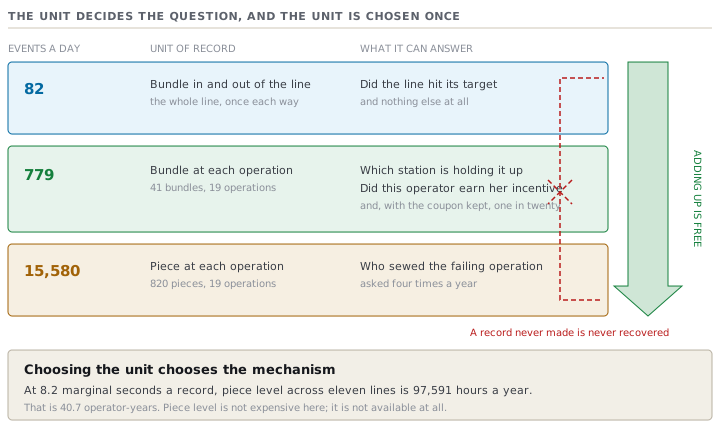
Line 4 makes 820 pieces a day in 480 attended minutes, in bundles of 20. That is 41 bundles a day across nineteen operations.
| Unit of record | Events a day, Line 4 | Events a year, eleven lines |
|---|---|---|
| Bundle in and out of the line | 82 | 225,500 |
| Bundle at each operation | 779 | 2,142,250 |
| Piece at each operation | 15,580 | 42,845,000 |
Piece level is 190 times the volume of line level. Sit with that ratio. It is not a difference in how much data you hold. It is a difference in what the data can be asked.
Adding up goes one way, and this is the sentence that costs money
You can always turn piece records into bundle records, and bundle records into line records. Adding up is free. You can do it at any time, including two years later.
You can never go the other way. A record that was never made cannot be recovered from records that were.
Elmarj ran fourteen weeks at line level before anybody tested that sentence. In June, Brantvik returned 96 garments with the same fault: a shoulder seam sewn 4 mm narrower than the specification allows, all from one shipment. The quality manager asked the ordinary question. Which operator? Which machine? Which hours? The record could not answer. It said only that 820 pieces entered Line 4 that day and 812 left it.
No processing recovers that. No amount of storage, no cleverness, no later upgrade. Those fourteen weeks are simply mute.
And the trap on the other side of the ladder
The obvious lesson is this: record at the finest unit and you will never be caught out. Price it before you believe it.
A piece at each operation is 42,845,000 events a year across the plant. In the next lesson we measure what one manual scan really costs: 8.2 seconds of extra time. Multiply.
events a year                              42,845,000
extra seconds each                                8.2
seconds a year                            351,329,000
hours a year                                   97,591
operator-years at 2,400 hours                    40.7
Forty operator-years of scanning, in a factory with 462 sewing operators. That is not expensive. It is impossible, and the finding is useful: choosing the unit chooses the mechanism. Piece-level records exist only where the piece carries itself past a reader, such as a hanger, a conveyor, or an automatic counter on the machine. Where they do, they cost nothing. Where they do not, piece level is not an option that lost on price. It was never an option.
The test that actually decides it
Ramez did not argue about units. He wrote down every question the factory asks of production data, how often it is asked, and the finest unit that can answer it.
| The question | How often it is asked | Finest unit that answers it |
|---|---|---|
| Will this line hit today's target | every hour | line, by hour |
| Which station is holding the line up | every hour | operation, by hour |
| Did this operator earn her incentive | every day | operator, by day |
| Which bundle is a short size sitting in | most weeks | bundle |
| Who sewed the operation on a rejected garment | four times a year | piece, by operation |
Four of the five are answered by a bundle record at each operation. One needs piece level, and it is asked four times a year.
That is the decision, and it is not a compromise. Record at the finest unit that a question you really ask needs. Buy finer than that only where it is free.
The cheap carrier that buys back the fifth question
The fifth question does not have to be abandoned. The bundle already carries a ticket. Elmarj now leaves the coupon in the bundle all the way to end-line inspection, instead of pulling it at the last sewing operation. A rejected garment reaches the inspector with the bundle number still attached.
That does not identify the piece. It identifies the bundle of 20. And because the operation-level record says who did each operation on that bundle, it identifies the operator on the operation that failed. One in twenty rather than one in one, for the price of not throwing a piece of card away.
Against 96 rejects, that is the difference between an unanswerable question and five bundles, three operators and a two-hour window.
Check yourselfA supplier offers to add piece-level tracking for a small extra fee, because the terminals can already do it. What do you ask before saying yes?Show the answer
Ask who makes the extra events, and when. If the piece-level record is a by-product of something already happening, such as a garment passing a fixed reader or a counter on the machine, the extra fee may be the whole cost. Then it is probably worth it, because detail above your needs is free insurance. If it means an operator handling each piece at a terminal, the fee is a rounding error next to the real price. The real price is measured in seconds at the station that sets the line's speed. The question is never what the system can record. It is who records it, and out of whose minute.