Lessons · Lesson 4 of 6
The ceiling: how often can you actually re-plan
Work out the ceiling your own re-planning frequency puts on the value of any real-time feed, and find how many decision points the cost of acting can afford.
Lesson 4 of 6 · 20 min
Ten lines, the same equipment, and nothing at all
Line 4's pilot worked, so Adel rolled the terminals out to the other ten lines in September. Same hardware, same software, same training, same 0.7-minute feed.
After a full quarter, output on those ten lines was unchanged. Not slightly better. Unchanged, well inside the normal shift-to-shift variation.
The obvious explanations were all checked and all wrong. Completeness was fine at 96.8%. The screens worked. The supervisors could read them. Nothing was broken.
What was different was a standing instruction. On lines 1 to 3 and 5 to 11, the balance is set at the 07:15 meeting and is not touched afterwards. Adel had put that rule in himself two years earlier, after a fortnight in which supervisors moved people around all day and the plant lost more than it gained. Every one of those ten lines has exactly one decision point in a shift, and it is at the start.
The arithmetic that says the result was inevitable
Write D for the interval between the moments a decision can actually be taken. Keep the rule from the last lesson that only productive minutes count.
With one decision point per shift, at its start, an event that happens at minute t of the shift is acted on at the start of the next shift, whatever else is true. The productive minutes lost are the minutes left in the shift, plus the time for the action to bite:
lost = (480 - t) + ALook at what is not in that expression. `d` does not appear. The data speed is not small in it. It is not a rounding error in it. It is absent. Whether the number arrived forty-two seconds after the event or nine hours after it, the same minutes are lost, because in both cases the event is fixed at the same moment: the next morning's meeting.
Averaged over the shift, the mean is 240 plus the 26 minutes of action: 266.0 minutes. That is the answer for every data speed faster than a shift.
The whole grid, computed the same way
Working minute by minute across the shift, for four re-planning frequencies and two data speeds:
| Decision points in a shift | Hourly hand count | Minute-level feed | What the feed adds |
|---|---|---|---|
| 1, at the start | 266.00 | 266.00 | nothing |
| 2 | 176.00 | 146.50 | 29.50 |
| 4 | 131.00 | 86.75 | 44.25 |
| 8 | 108.50 | 56.88 | 51.63 |
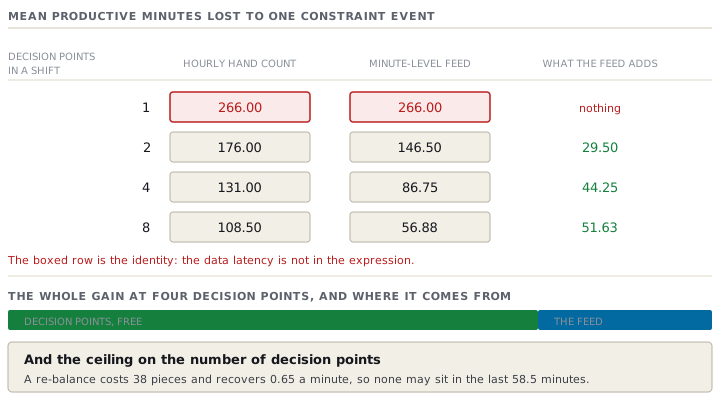
Read the top row again. It is the whole lesson. A factory that re-plans once a shift gains nothing at all from minute-level data. This is not a rule of thumb and it is not a caution. It follows directly from the fact that d is not in the expression.
Then read down the last column. The value of the feed is created by the decision points, not by the feed. At one decision point it is zero. At eight it is 51.63 minutes. The same hardware, on the same floor, is worth nothing or worth a great deal, depending entirely on a standing instruction that costs nothing to change.
So change the instruction? Only up to a point, and the point can be calculated
Adel's rule was not stupid. A re-balance is not free. Moving an operator, opening a second machine at a station, redistributing a bottleneck: it takes about 22 minutes to have effect, and then the line takes a further half hour to settle back into rhythm. Elmarj measured the whole disturbance at 38 pieces.
So a re-balance only pays if there is enough shift left for the recovered rate to earn those 38 pieces back:
disturbance                                 38 pieces
recovery rate                    0.65 pieces a minute
minutes of shift needed                          58.5
No decision point may sit inside the last 58.5 minutes of a shift. Inside that window, taking the decision destroys value even when the decision is correct. On a 480-minute shift that allows points at 0, 120, 240 and 360. Four of them, comfortably clear of the line. Eight points would put one at 420, right on the edge of the dead zone.
This is the ceiling, and it is set by the cost of the action, not by the cost of the data:
The useful data interval is bounded below by the decision interval, and the decision interval is bounded below by what it costs to act. Buying data faster than that buys nothing, and no amount of money moves the bound.
What the split actually is
Against the ten lines' baseline of 266.00 minutes:
four decision points, hourly hand count       131.00   gain 135.00 min   USD 82.48 an event
four decision points, minute-level feed        86.75   gain 179.25 min   USD 109.52 an event
The decisions deliver 75.3% of the whole available gain, and they are free. They are a paragraph in a standing instruction. The feed delivers the remaining 24.7%, and in the last lesson of this course we price what it costs.
That ordering is the most reliable finding in this subject. It survives almost any change to the numbers, because it comes from the shape of the expression rather than from Elmarj's particular figures.
The half of it that permission cannot buy
Nothing above says a real-time feed is worthless. It says the feed cannot deliver what the decision points deliver. There is one thing it delivers that no decision frequency can, and it is worth naming precisely: it tells you which station the loss came from.
An hourly count at the end of the line says the line is sixty pieces down. It does not say which of nineteen stations. Ramez checked the supervisors' unaided guesses against the coupon record afterwards. They named the right station in 11 of 34 cases. With operation-level records the same supervisors were right in 31 of 34.
A wrong diagnosis is not a neutral event. It costs a re-balance, the same 38 pieces, that fixes nothing. Then it costs the whole cycle again before anybody realises. So the decision points are worth having with a hand count, and worth substantially more with a record that says where to point them.
Check yourselfYour plant re-balances once a shift and a supplier is quoting for a live feed. What do you do first, and what do you say in the meeting?Show the answer
Ask what the plant would do differently, and when it would be allowed to do it. If the answer is still "at the morning meeting", then on the plant's own numbers the feed changes nothing. The honest thing to say is that the quotation should be held while a free change is tried first: three extra decision points, with a named person allowed to act at each. Run that for a month with the counting you already do. If it moves output, you have a measured baseline against which the feed can be judged. If it does not move output, you have just saved the cost of finding that out expensively.