Lessons · Lesson 4 of 5
What actually stops a shipment
The buyer gates an order carries, the three tiers of refusal, who may override each of them, and which quality problems only warn.
Lesson 4 of 5 · 22 min
What this lesson is about
A quality system earns its keep at the loading bay. Everything before that is a record. At the bay somebody presses a button, and either the goods go or they do not. This app has three different kinds of refusal, and they behave nothing like each other. One of them nobody can get past. One needs the right person. And several things that look like refusals are only warnings: the goods go anyway.
Sardor has the cartons on the dock. Nigora opens ORD-1427 and presses Mark shipped. What happens next depends on a set of gates chosen by a buyer months ago, and on how much of the work actually got recorded.
What the buyer can demand
A buyer's quality profile can require a short, chosen set of checks. There are five, and the set is deliberately short: these are the classic buyer demands, not the whole catalogue of ten types from lesson one. A buyer can require a pre-production approval, a DUPRO, a final AQL, a pre-shipment inspection or metal detection. No buyer can require a cutting-room check, because no buyer asks for one.
The set travels the same chain as the AQL level: buyer to style, style to order at confirmation, frozen there. Anything stored that is not one of the five is silently dropped when the set is read. So a stray value can never invent a gate the buyer did not choose.
Two of the five are safety gates: the final AQL and metal detection. When a buyer requires one of those and it is not satisfied, the shipment is hard-blocked, and only an Owner or a QA lead may override it. The other three, when required and missing, produce a named warning and let you ship.
Three tiers, in the order the app checks them
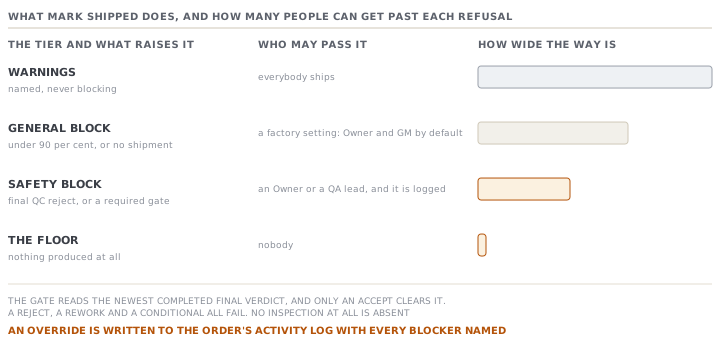
The floor, which nobody can cross. If nothing at all has been produced on the order, the shipment is refused for every role, with or without an override. The message says so in as many words and points at where to record the real output. This is not a judgment call. Shipping early or shipping partial is a judgment call, and an order with literally nothing made is not one. The application does not even offer the override button while this holds.
The safety block, which needs the right person. A final quality check that computed a reject always blocks, whether or not the buyer required one, because a recorded reject is positive evidence that the lot is bad. Separately, a buyer-required final AQL with nothing accepted blocks. So does a buyer-required metal detection with no recorded pass, or with a failure nothing has cleared. Each of these can be overridden by an Owner or a QA lead, and the override is written to the order's activity log with every blocker named.
The general block, which your factory scopes. Production must be nearly complete, and a shipment must be booked. Nearly complete means at least 90 per cent of the ordered quantity recorded as produced. Overriding this is a legitimate ship-early or ship-partial decision. Who may do it is a factory setting under Sign-off rules, and it defaults to the Owner and the general manager.
Only an accept counts
The gate reads the most recent completed final-phase inspection, which means a final AQL or a pre-shipment check. Then it applies a rule worth stating on its own.
Accept clears the gate. Reject, rework and conditional all fail it. A conditional verdict is not a soft yes. It is the app saying it does not have enough to clear the lot, and lesson three showed how easily an inspection lands there. No completed final inspection at all is neither a pass nor a fail. It is honestly absent, and if the buyer did not require one it produces no blocker.
The newest relevant inspection wins. Re-inspect a rejected lot after the rework and the new accept clears the gate. The rejected inspection stays in the record for ever, and it is only its effect on the gate that clears.
Metal detection, and what a failure means
Metal detection is not an inspection. It is a control log: a running list of needle issues, breakages, reconciliations and detector calibrations, plus a separate record of pass and fail results against a lot or carton reference. Every entry stores who recorded it and writes a line to the order's activity.
The gate logic is the real factory procedure, not a simplification. A recorded failure stays unresolved until a later pass is recorded. Isolate the lot, find the source, re-screen everything, then record the pass that closes it. Recency is judged by row order, so a failure recorded after a pass reopens the gate. And the failing row is never deleted. Only its effect on the gate clears. That is exactly what an auditor wants, and the opposite of what a tidy-minded person would do.
When the buyer has not required metal detection, a missing pass or an uncleared failure becomes a warning instead. It names the problem, it does not block, and the goods can go.
The things that only warn
Several real quality problems never touch the ship gate. They are named on screen, they are not hidden, and they let the shipment through.
- A failed mid-production or DUPRO check with no passing final inspection after it. The fault may well have been fixed on the line, so the app asks you to prove it with the final AQL rather than refusing.
- A buyer-required pre-shipment inspection that was never conducted. A conducted-and-rejected one already blocks through the verdict rule, so this warning exists only for the case where nobody ran it.
- Packing that is not ready. Cartons are physical, and an incomplete planning form must never dead-end a real shipment.
- Produced pieces that are not shippable pieces. An order can make its quantity and still grade part of it as seconds or scrap. Where a grade breakdown has been reported, the warning names that shortfall against the agreed tolerance band.
The gate that is not at the bay
One quality signal acts much earlier and is easy to miss. A completed incoming inspection that computed a reject stops that order's material from being issued to the line.
It is a soft gate. The refusal names the inspection number and offers three ways out: re-inspect, get the buyer's written concession, or tick Issue anyway and have the override recorded. Only an explicit reject fires it, so a rework or conditional incoming check does not. A later passing re-inspection clears it, by the same newest-wins rule metal detection uses.
It deliberately never gates receiving. The dock is physical and the lorry is there. Refusing to book goods you are already holding records nothing and helps nobody.
Check yourselfORD-1427's final AQL computed a reject. The buyer did not require a final AQL. Nigora is an Owner and decides to ship anyway under a written concession. What does she have to do, and what will the record show?Show the answer
She can do it. It is a safety-gate override, so she needs to be an Owner or a QA lead, and she qualifies. The refusal is not about the buyer's requirements at all: a recorded reject blocks whether or not the buyer asked for the inspection, because the app has positive evidence the lot is bad. Using the separate ship-anyway control writes a line to the order's activity naming her, the time, and the blocker she overrode. That line is the strongest audit record in this whole area. It is worth adding the concession reference as a comment on the order beside it, because the app has nowhere to file the concession itself.
Check yourselfAn order is at 84 per cent produced, has a booked shipment, an accepted final AQL and a recorded metal-detection pass. Mark shipped refuses. Who can get it through, and is this a safety override?Show the answer
It is not a safety override. Both safety gates are satisfied, so the only blocker is the general one: production is below the 90 per cent threshold. That means the Owner-or-QA rule does not apply, and the factory's own setting does. By default that is the Owner and the general manager, and your Owner can widen or narrow it under Sign-off rules. The reason the tiers are scoped differently is worth understanding. Shipping at 84 per cent is a commercial judgment about a short delivery. Shipping past a failed metal detector is a safety decision. The same person need not be trusted with both.
Prompt · Explain why this order will not ship, and who can get it through
When Mark shipped refuses and the reason is not obvious from the message.
Help me understand why a MerchandiserOS order is refusing to be marked shipped, which tier of refusal I am hitting, and who can legitimately get it through.

I will tell you: the blockers and warnings the screen is showing; how much of the order is recorded as produced; whether a shipment is booked; the result of the most recent completed final AQL or pre-shipment inspection; whether any metal-detection pass or failure is recorded; which inspections the buyer requires on this order; and my own role.

Sort what I gave you into three tiers. The absolute floor is an order with nothing produced, which nobody can override. A safety block is a recorded final quality reject, a buyer-required final AQL with nothing accepted, or a buyer-required metal detection with no pass or an uncleared failure. Only an Owner or a QA lead may override those. A general block is production below the ninety per cent threshold, or no booked shipment. Who may override that is a factory setting, defaulting to the Owner and the general manager.

Say which tier applies, whether my role can act, and if not, who I have to ask.

Then list separately the things on my screen that are only warnings and will not stop the shipment at all, so I stop trying to clear them.

Finally, tell me what an override will write to the order's activity log, and what I should add as a comment beside it that the app has nowhere to file.
AI can make mistakes — check anything you act on.