Lessons · Lesson 5 of 5
A margin report about quotations
Why the cost sheet never meets the order, what the margin report is really counting, what the variance panel actually compares, and why a shipped order is green whatever it earned.
Lesson 5 of 5 · 20 min
What this lesson is about
The last question is the one an owner asks. Did this order make money. It sounds like the simplest question in the course. It is the hardest one to answer here, and the reason has nothing to do with the quality of the costing.
The costing engine in this application is genuinely good. It builds a garment cost from the bottom up, layer by layer. Every input is flagged as estimated or confirmed. A blank never turns into a zero. Several currencies roll into one at a dated exchange rate. None of that is in question. The question is what it is pointed at.
The cost sheet has no order
A cost sheet is a row in its own table with sixteen columns. It carries a quantity band, a variant, a version, a reporting currency, an as-of date, the whole priced input as stored text, and three computed headlines: ex-factory, the price at the chosen margin, and the margin itself.
It hangs off two things. A request-for-quotation line, which is required, and a style, which is optional.
There is no order column. Not nullable, not unused. It does not exist.
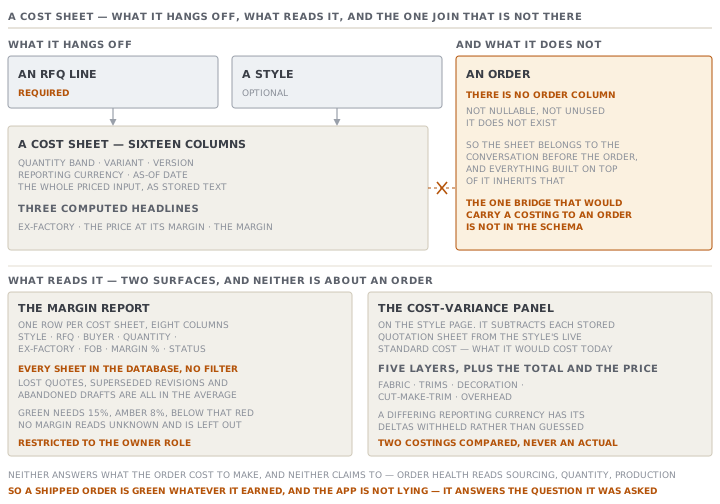
So a cost sheet belongs to the conversation before the order. It is a quoting instrument, and everything built on top of it inherits that.
The margin report, read carefully
The application has one report about margin, and its name says what it is: costing and margin analysis. Its own definition of itself is worth reading, and it is one row per cost sheet.
| Column | What it holds |
|---|---|
| Style | The style the sheet was costed for |
| RFQ | The quotation request reference |
| Buyer | The buyer the request came from |
| Quantity | The sheet's quantity band, not any ordered quantity |
| Ex-factory | The built cost, in the sheet's reporting currency |
| FOB | The price at the sheet's margin |
| Margin % | Coloured, and the reason for the colour is below |
| Status | Draft or final |
Four things about that table decide how to read the report.
- There is no order column, because there is nothing to join on.
- The quantity is the band the sheet was costed at. A sheet costed at one volume and ordered at another shows the costed one.
- The rows come from a call that lists every cost sheet in the database, with no filter of any kind.
- The report is restricted to the owner role, so nobody else in the factory sees it at all.
Point three is the one worth sitting with. Every sheet ever written is in there. Quotations that were lost. Superseded revisions. Drafts abandoned halfway. Sheets for styles that never became an order. The average margin at the top of the page is an average over all of them.
The colours are earned rather than defaulted, which is the app's rule everywhere. Green needs a margin of at least 15%. Amber needs at least 8%. Below 8%, or negative, is red. A sheet with no margin at all reads unknown and grey, and it is left out of the average rather than counted as zero. The summary strip also counts how many sheets are under the 8% line, and names the thinnest one.
What the variance panel compares
The style detail page carries a cost-variance panel, and its name invites a reading it does not support.
It compares each of the style's stored quotation cost sheets against the style's live standard cost, meaning what the style would cost to build today at current inputs. Five layers are compared one by one, plus the ex-factory total and the price. The layers are fabric, trims, decoration, cut-make-trim, and overhead.
The source is explicit about what this is, and the comment is worth quoting, because it is the clearest statement of the boundary in the whole application. It says the panel compares two costings, that a true production-actual capture from receipts and floor efficiency is a larger piece of work, and that nothing here is fabricated as actual.
So the panel answers a real and useful question. Has this quote drifted from what the style costs today. It does not answer what the order cost to make, and it does not claim to.
Two more honesty details in the same panel. A sheet whose reporting currency differs from the standard's is shown with its deltas withheld, because subtracting across currencies would be meaningless. And a style with no standard cost, or with no stored sheets, produces no panel rather than an empty one.
Green says nothing about money
The last piece closes the loop with the first lesson. The application has one source of truth for whether an order is healthy, and every surface reads it.
Its rule is strict in the right direction. Green has to be earned from three pieces of positive evidence: purchase orders raised, quantity confirmed, and production recorded. Missing any of them gives an explicit not-started rather than a reassuring colour, and any flagged exception overrides everything.
Read the list again. Sourcing, quantity, production. Not one financial input, because there is no financial input available to it.
And the first line of the function is the one to remember. A shipped order returns green, with the reason that the order is complete. That is correct for what the verdict is about, which is delivery. An order that shipped at a loss, shipped after an air-freight bill nobody recorded, and shipped with a claim about to arrive is green on every screen in the application. The app is not lying. It is answering the question it was asked.
Check yourselfSanjeewa wants a monthly figure for what the factory earned. Say what he can get out of the app, what it will actually mean, and what he has to build outside it.Show the answer
He can get the margin report, which is owner-only and gives one row per cost sheet with ex-factory, price and margin, coloured against 15% and 8%, worst first. What it means is the margin the factory quoted at, across every sheet ever written, including lost quotations, superseded revisions and drafts. It is a picture of pricing intent and not of earnings. He can get the variance panel per style, which tells him whether a quote has drifted from what the style costs today. What he has to build outside is everything else. The realised revenue, the actual cost of the order, any deduction, and the extraordinary costs. The only bridge is the order number, which the payment feed already matches on, so the honest design is to key the outside spreadsheet on it.
Check yourselfORD-1358 is marked shipped after an override and a part air-freight. Describe what each surface in the app says about it, and say why none of them is wrong.Show the answer
Order health returns green with the reason that the order is complete, because shipped is a terminal state and the verdict is about delivery. My Work shows no exception for it, because the exception readers look at live orders and a shipped one is closed. The margin report does not mention it, because that report has one row per cost sheet and nothing joins a sheet to an order. The order's own activity feed carries the override line naming every blocker that was not met, and the accountability line has gone from the board with the exception. None of those is wrong, because each answers a different question and none of them was ever asked about money. The mistake would be to read the green as a financial statement, and the defence against it is knowing that the verdict is built from sourcing, quantity and production alone.
Prompt · What is this margin number actually counting?
Before quoting the margin report to a partner, a lender or a buyer.
Help me state precisely what a number from the MerchandiserOS margin report means, and what it does not.

I will tell you: the figure I am looking at, whether it is the average or a single row, and who I am about to tell.

The report has one row per cost sheet. A cost sheet hangs off a request-for-quotation line and optionally a style, and it has no order column at all. The rows come from a call that lists every cost sheet in the database with no filter, so lost quotations, superseded revisions and abandoned drafts are all in there. The quantity column is the band the sheet was costed at, not any ordered quantity. Margin is coloured green at fifteen per cent or more, amber at eight or more, and red below eight or negative. A sheet with no margin reads unknown and is excluded from the average rather than counted as zero. The report is visible to the owner role only.

Write me one sentence that states the figure with its real denominator, in words a person outside the factory would understand.

Then list what would move that figure without anything about the actual work changing.

Then tell me what question my audience is probably really asking, and whether this figure answers it.

If it does not, say what would have to be measured instead, and where that measurement would have to come from, given that this application holds one money amount per order and no record of cost, deduction or receipt.
AI can make mistakes — check anything you act on.