Lessons · Lesson 2 of 6
A preference is a condition you meet, not a discount you claim
What duty-free access really costs to qualify for, the quantity below which it stops being worth having, and the origin where the cheaper decision is to refuse it.
Lesson 2 of 6 · 19 min
The sentence that ends the argument too early
Hoda Selim at Amriya Apparel answered Marek's costing request in two lines. The first was the FOB. The second was: we ship duty-free into Lyddenmark.
Both lines are true. Neither is a price. What Amriya holds is access to an arrangement between Egypt and Lyddenmark that lets goods originating in Egypt enter free of duty. The word doing the work is originating. It is a legal test about where the work was done, not a description of where the invoice was raised.
To pass that test on a polo, Amriya cannot use the cheapest cloth on the market. It has to buy from Nihal Knitting Mills, whose piqué is knitted and dyed inside the agreement's reach. Nihal's cloth is dearer. That difference is the price of the preference, and it belongs in the cost sheet next to the duty it avoids.
What an origin rule asks, and what it does not
An origin rule asks a factual question: what work was done, and where. For apparel it almost always reaches back past sewing. A garment cut and sewn from cloth bought anywhere is usually not enough on its own. How much further back the rule reaches is exactly the thing that differs from agreement to agreement. Some stop at the cloth. Some carry on to the yarn. Some let inputs from named partner countries count as if they were local, which is a mechanism worth learning by name, because it turns a neighbour's mill into a qualifying mill.
Three consequences follow, and they are worth more than any number:
- The rule belongs to the agreement, not to the exporting country. The same factory, using the identical fabric, can originate for one market and fail for another.
- You cannot reason from one agreement to another. A condition satisfied under one tells you nothing about a second.
- A preference is an option, not an obligation. Nobody makes you claim it. Paying the duty is always available, and sometimes it is the cheaper route.
Two prices for the same polo
BP-140 takes 0.245 kg of piqué. The cheapest cloth on Amriya's market lands at 9.55 a kilogram, which is 2.34 a garment. Nihal's qualifying piqué is 11.06 a kilogram, which is 2.71. The premium is 0.37 a garment, and it is the whole of the difference between Amriya's two quotations: 4.62 qualifying, 4.25 not.
| Qualifying route | Non-qualifying route | |
|---|---|---|
| FOB a unit | 4.62 | 4.25 |
| Freight and insurance | 0.10 | 0.10 |
| Customs value | 4.72 | 4.35 |
| Rate on Lyddenmark's schedule | duty-free | 12.0% |
| Duty a unit | 0 | 0.5220 |
| Cash in transit a unit | 0.0105 | 0.0097 |
| Landed a unit | 4.7305 | 4.8817 |
Qualifying is worth 0.1512 a unit. Read it the other way and the structure is clearer. The duty saved is 0.5220. The fabric premium is 0.37. The difference is 0.1520, and financing the dearer goods across the water gives back 0.0008. Two large numbers subtracting to a small one — which is exactly why the answer can reverse on a modest move in either.
The fixed cost nobody puts in the sheet
Proving origin is not free even when it is easy. Amriya needs a declaration from Nihal. Nihal needs one from its yarn supplier. A certificate is raised for every shipment. And somebody at Osbern keeps the file, so that it still exists when a customs officer asks for it two years later. Marek costed all of that at 1,850 a year for this programme, most of it his own time.
That is a fixed cost against a per-unit gain, so it has a break-even quantity, and the quantity is the interesting part:
- 12,236 units — the point at which the preference has paid for the paperwork.
- On the 240,000-unit programme, qualifying is worth 34,438.00 a year.
- On a 6,000-piece test order of a new colour, qualifying loses 942.80.
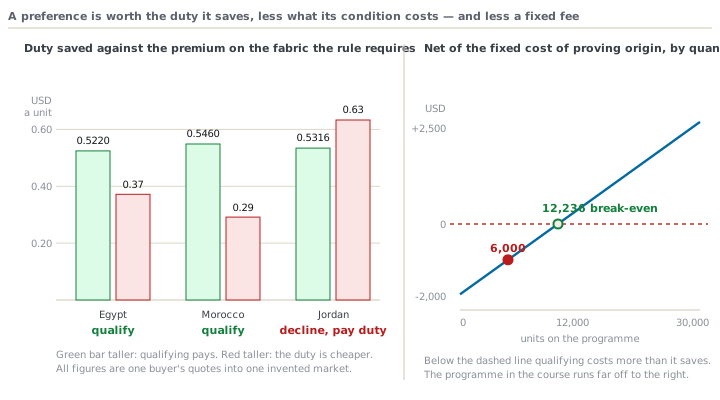
The same preference, the same factory, the same fabric, and it is worth having on one order and not on another. Nothing about the agreement changed. The quantity did.
Three origins, three answers
Osbern also holds quotes from Kenitra Confection in Morocco and Dulayl Apparel in Jordan. All three of these origins have duty-free access into Lyddenmark. All three face the same choice, and they do not answer it the same way, because the cloth market each one stands in is different.
| Egypt | Morocco | Jordan | |
|---|---|---|---|
| Duty saved a unit | 0.5220 | 0.5460 | 0.5316 |
| Premium on the qualifying cloth | 0.37 | 0.29 | 0.63 |
| Landed, qualifying | 4.7305 | 4.8484 | 5.0737 |
| Landed, paying the duty | 4.8817 | 5.1039 | 4.9736 |
| Gain from qualifying | 0.1512 | 0.2555 | -0.1001 |
Dulayl should decline. Its access is real, its paperwork would be accepted, and using it makes the garment 0.1001 a unit dearer — before the 1,850. The right instruction to a factory in that position is not "get us the certificate". It is "quote us the cheap cloth and let us pay the duty", and it takes a merchandiser who has done this arithmetic to say it out loud.
Check yourselfMorocco's gain from qualifying is the largest of the three, yet Egypt is still the cheaper origin. How can both be true?Show the answer
Because the gain measures the distance between an origin's own two routes, and the ranking measures the distance between origins. Kenitra gains more by qualifying than Amriya does, because its qualifying cloth carries the smaller premium. It still lands dearer, because it started from a higher FOB and a longer haul. A preference improves an origin against itself. It only wins the order if the improvement is bigger than the gap it had to close.
Prompt · Is qualifying for this preference actually worth it?
When a factory says it can ship duty-free but only if you buy the fabric its agreement requires, and the fabric is dearer.
Act as a sourcing manager who treats a tariff preference as an option to be priced, not a benefit to be claimed. Tell me whether qualifying is worth its conditions on THIS order. Give the answer as arithmetic. The order: style [CODE], quantity [NUMBER], destination market [MARKET], candidate origin [COUNTRY], agreement claimed [NAME IT, OR SAY UNKNOWN]. The two routes: qualifying route — [FOB, THE INPUT THE RULE FORCES ME TO BUY, ITS COST PER UNIT OR PER KILOGRAM, CONSUMPTION PER GARMENT]; non-qualifying route — [FOB, THE CHEAPER INPUT, ITS COST, CONSUMPTION]. Also: freight and insurance per unit [AMOUNT], transit days [NUMBER], my cost of money [RATE], the duty rate applied if I do NOT qualify [RATE], and the one-off cost of obtaining and keeping the origin evidence for this programme [AMOUNT, INCLUDING SUPPLIER DECLARATIONS AND MY OWN TIME]. Do the following. First, build a landed cost per unit for each route separately. Second, give me the net gain or loss per unit from qualifying, and show it as duty saved minus the input premium, so I can see which side is bigger. Third, compute the break-even quantity at which the fixed evidence cost is exactly recovered, and tell me plainly whether my quantity clears it. Fourth, tell me what happens to the answer if the order halves, and if a repeat order runs at a quarter of this size. Fifth, if declining the preference and paying the duty is the cheaper route, say so in those words rather than hedging. Sixth, list what would invalidate the answer — an input price move, a rate change, a rule I may have misread — and say which of them I should check before placing. Do not name a duty rate or an origin threshold on your own authority: use the figures I gave you, and where I have not given one, say it is missing.
AI can make mistakes — check anything you act on.
Everything in this lesson is a fact about money. Whether a claim will actually be accepted — the evidence, the declarations, the procedure at the border — is a different subject, and course 26.4 owns it. The real preference maps for two large markets, with the conditions each of them writes, are courses 26.2 and 26.3.