Lessons · Lesson 4 of 6
The same four countries, two orders, two answers
A short fashion buy out of the same four factories, why the origin with the worst landed cost wins it, and the exact markdown depth at which the answer flips back.
Lesson 4 of 6 · 18 min
The other programme on Marek's desk
FW-812 is a women's printed viscose blouse. 24,000 units, one delivery, no repeat. It retails at 39.00, sells for eight weeks at that price, and is then marked down 40%, to 23.40, to clear.
The same four factories quoted it. The landed costs come out in the same order they did for the polo, which is reassuring and beside the point.
| Bangladesh | Vietnam | Egypt | Turkey | |
|---|---|---|---|---|
| FOB a unit | 6.15 | 6.40 | 6.95 | 7.60 |
| Freight and insurance | 0.24 | 0.27 | 0.13 | 0.09 |
| Duty a unit | 0.7668 | 0.8004 | 0 | 0 |
| Cash in transit a unit | 0.0488 | 0.0559 | 0.0157 | 0.0095 |
| Landed a unit | 7.2056 | 7.5263 | 7.0957 | 7.6995 |
| Order to warehouse, days | 119 | 126 | 98 | 77 |
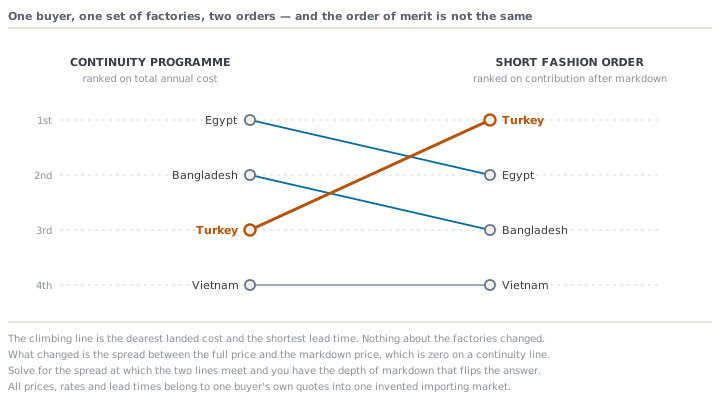
Egypt is cheapest again, by 0.6038 a unit against Turkey — 14,491.20 on the order. Turkey is the dearest landed cost of the four. Osbern placed FW-812 in Turkey, and it was right.
The column a selling window adds
A polo that sells every week for six years is bought against a demand you already know. A blouse that sells for eight weeks is bought against a forecast, and the forecast is made on the day you commit, which is a lead time before delivery.
Osbern commits FW-812 a lead time ahead, and the window opens a week after the goods reach the warehouse. So the commitment horizon — how far in advance the buy is fixed — is the lead time plus a week:
- Turkey: 12 weeks
- Egypt: 15 weeks
- Bangladesh: 18 weeks
- Vietnam: 19 weeks
Osbern has eleven blouse programmes of its own over four years to look at, and the pattern in them is blunt. The ones committed 12 weeks before the window sold 92% of the buy at full price. The ones committed 20 weeks before sold 71%. Read as a straight line, that is 2.625 points of full-price sale for every week of horizon.
That is Osbern's own record, on Osbern's own category. It is not a law and it will not be your slope. Your own sales history has the same number in it, and it is the single most useful number a merchandiser can pull out of a past season.
| Bangladesh | Vietnam | Egypt | Turkey | |
|---|---|---|---|---|
| Commitment horizon, weeks | 18 | 19 | 15 | 12 |
| Sold at full price | 76.25% | 73.625% | 84.125% | 92% |
| Revenue a unit | 35.2950 | 34.8855 | 36.5235 | 37.7520 |
| Landed a unit | 7.2056 | 7.5263 | 7.0957 | 7.6995 |
| Contribution a unit | 28.0894 | 27.3592 | 29.4278 | 30.0525 |
| Contribution on the order | 674,145.60 | 656,620.80 | 706,267.20 | 721,260.00 |
Turkey wins by 14,992.80, and it wins with the worst landed cost of the four.
Two terms, pulling opposite ways
The whole result is two numbers and a subtraction:
- Turkey's landed penalty against Egypt: 0.6038 a unit, or 14,491.20 on the order.
- Turkey's forecast advantage: three weeks less horizon, at 2.625 points a week, is 7.875 points more of the buy sold at full price. Each point is worth the gap between the two prices, which is 15.60. That is 1.2285 a unit, or 29,484.00 on the order.
The advantage is a little over twice the penalty. Turkey wins.
The continuity line is this calculation with the gap set to zero
Here is the part worth carrying out of the course. Solve for the gap between the two prices at which Egypt and Turkey are exactly equal.
Turkey needs its 7.875 points to be worth 0.6038 a unit, so one point has to be worth 7.6673. That makes the markdown price 31.3327, which is a markdown of 19.66%.
So: at a markdown deeper than 19.66%, Turkey wins this order. At anything shallower, Egypt does. With no markdown at all — a line that never marks down, which is exactly what BP-140 is — Egypt wins on the landed gap alone, which is the answer lesson 1 got.
The polo and the blouse are not two kinds of decision needing two kinds of judgement. They are one calculation at two values of one input, and that input is the money you lose when the forecast is wrong. That is why the answer can be calculated rather than argued about, and it is why "we source in country X" is not a sourcing strategy.
What a day is worth here
Lesson 3 priced a day of lead time on the polo at 0.001166 a unit. On FW-812 a week of horizon is 2.625 points at 15.60, which is 0.4095 a unit, or 9,828.00 across the order — 0.0585 a unit a day.
Just over fifty times. Same buyer, same treasury, same four factories, same month. It is the reason a merchandiser who negotiates four days off a basic and shrugs at four weeks on a fashion buy has the effort exactly backwards.
Check yourselfBangladesh has the cheapest FOB on the blouse and finishes third. Which of the two terms did it lose on?Show the answer
Both, and that is the point of putting them side by side. Its landed cost is 0.1099 a unit above Egypt's, which costs it 2,637.60 on the order — real but survivable. What sinks it is the horizon: 18 weeks against Egypt's 15, worth 7.875 points of full-price sale, or 1.2285 a unit, 29,484.00 on the order. The FOB advantage it was picked for is 0.80 a unit, and duty, freight and three weeks of forecast eat all of it.
Lesson 5 takes the polo programme and splits it between two origins, for a good reason, by two people who each did their own job correctly.