Lessons · Lesson 1 of 6
What actually decides where an order goes
Four candidate countries, one polo programme, and the four columns that turn a quote into a real cost — with the cheapest quote finishing second.
Lesson 1 of 6 · 20 min
The list everybody sends round
On 14 January a spreadsheet reached Marek Quenby, sourcing merchandiser at Osbern Stores. It carried four quotations, and the cheapest was highlighted in yellow. Osbern is a clothing retailer in Lyddenmark. The style is BP-140, a men's piqué polo it has sold every week for six years: 240,000 units a year, in four drops of 60,000.
All four quotations are FOB at the origin's own port. FOB is the factory's price with the goods loaded on the ship. The price stops there. Everything after it is yours to pay.
- Rupsha Knit Composite, Bangladesh — 4.10
- Ha Trung Garment, Vietnam — 4.28
- Amriya Apparel, Egypt — 4.62
- Bergama Konfeksiyon, Turkey — 5.05
The yellow cell was Bangladesh. Bangladesh is the wrong answer. Not because the quote is untrue — it is a good quote from a good factory. It is wrong because a quote is one column of a comparison that has four columns, and the other three are not in Marek's spreadsheet.
A quote is one column of four
A landed cost is what one unit really costs you once it is standing in your own warehouse. It has four columns, and every one of them is a real payment somebody makes.
- The FOB itself. Two quotes only compare if both stop at the same place. That is what an Incoterm settles: the standard rule that says where the seller's price ends and yours begins. Course 8.3 owns this; check it before you compare anything.
- Freight and insurance to your warehouse. This does not rise when the FOB rises. It rises with volume and distance, and a polo fills the same carton space whoever made it.
- Duty. A percentage of a value the importing market defines. Lyddenmark works it out on the FOB plus freight and insurance, so the freight sits inside the duty base and a long haul is taxed twice. Not every market does this. Some charge duty on the FOB alone. Which one applies to you is a fact to record, not to assume.
- The cost of the cash tied up in transit. Osbern pays its factories on shipment. From the day a container leaves the origin to the day it reaches the warehouse, that money is Osbern's and it is doing nothing. Osbern's treasury charges any programme 9.0% a year for money it holds.
| Bangladesh | Vietnam | Egypt | Turkey | |
|---|---|---|---|---|
| FOB a unit | 4.10 | 4.28 | 4.62 | 5.05 |
| Freight and insurance | 0.19 | 0.22 | 0.10 | 0.07 |
| Customs value | 4.29 | 4.50 | 4.72 | 5.12 |
| Rate on Lyddenmark's schedule | 12.0% | 12.0% | duty-free | duty-free |
| Duty a unit | 0.5148 | 0.5400 | 0 | 0 |
| Cash in transit a unit | 0.0328 | 0.0377 | 0.0105 | 0.0063 |
| Landed a unit | 4.8376 | 5.0777 | 4.7305 | 5.1263 |
| Order to warehouse, days | 119 | 126 | 98 | 77 |
Everything here is carried to four decimal places. That looks fussy until you notice that 0.0001 on this programme is 24.00 a year. Round to the cent and you throw the whole cash column away.
The ranking is not the ranking
Sort the four quotes and you get Bangladesh, Vietnam, Egypt, Turkey. Sort the four landed costs and you get Egypt, Bangladesh, Vietnam, Turkey.
The cheapest quote is second. The third-cheapest quote is first.
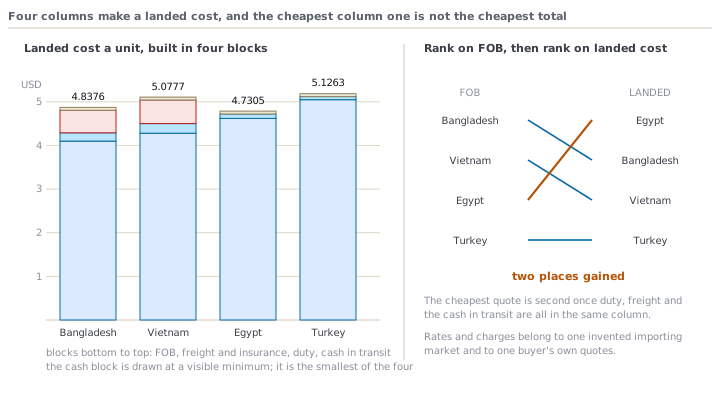
Over a year, Egypt costs 1,135,320.00 and Bangladesh 1,161,024.00. The difference is 0.1071 a unit and 25,704.00 a year, and it exists entirely because Bangladesh pays duty and Egypt does not. Bangladesh's duty bill alone is 123,552.00 a year — about half of what the whole freight and insurance budget for the programme costs.
None of this is subtle once it is written down. It is invisible only while the comparison has one column.
Check yourselfTurkey has the highest FOB, the lowest freight and no duty. Why does it still finish last on landed cost?Show the answer
Because the duty-free access it shares with Egypt is worth the same to both of them — nothing, since neither pays duty. Turkey's FOB is 0.43 a unit above Egypt's, while its freight and cash advantage together is worth about 0.04. A preference only pays for a gap it is bigger than. Turkey's case is not made on landed cost at all. It is made on the calendar, and lesson 4 makes it.
The column that is not in the table
Read the last row of the table again. Order to warehouse: 119, 126, 98, 77 days.
Nothing above that row knows those numbers exist. Duty does not care how long a container floats. The cash-in-transit column charges for the transit days only, and transit is one part of a lead time that also holds fabric, cutting, sewing, finishing and a booking. Yet the difference between 77 days and 126 days is the difference between committing a buy in March and committing it in February. It is also the difference between holding six weeks of cover stock and holding ten.
So the honest shape of the comparison is this: four columns of money, and one column of calendar deliberately kept out of them. Fold the calendar into the money too early and you get a single number that hides the trade-off you are actually making. Keep it out and you have two answers to reconcile. That is harder, and it is correct.
Lesson 3 prices the calendar for this polo. Lesson 4 prices it for a blouse, and gets a different answer out of the same four factories.
Prompt · Compare my candidate origins on landed cost and calendar
The week a programme is being placed and somebody has sent round a list of FOB quotes with the cheapest highlighted.
Act as a sourcing analyst who does not accept an FOB comparison. Compare candidate origins for ONE order all the way to a landed cost and a calendar. The order: buyer [BUYER], style [CODE], product [DESCRIBE], annual or total quantity [NUMBER], delivery pattern [ONE DELIVERY, OR N DROPS OF M], destination market [MARKET], my cost of money as an annual percentage [RATE]. For each candidate origin give me: [COUNTRY, FACTORY, FOB, THE INCOTERM THE FOB IS QUOTED ON, FREIGHT AND INSURANCE PER UNIT TO MY WAREHOUSE, THE DUTY RATE MY MARKET APPLIES TO THIS CATEGORY FROM THAT ORIGIN, WHETHER A PREFERENCE APPLIES AND UNDER WHICH AGREEMENT, PORT-TO-WAREHOUSE TRANSIT DAYS, TOTAL ORDER-TO-WAREHOUSE LEAD DAYS]. Do the following. First, build a landed cost per unit in four separate columns — ex-works or FOB, freight and insurance, duty computed on the customs value my market actually uses, and the cost of the cash tied up in transit — and carry it to four decimal places, saying what a hundredth of a cent is worth on my quantity. Second, print the ranking on FOB and the ranking on landed cost side by side and name every origin whose position changes between them. Third, state the calendar separately: lead time, transit time, and the earliest and latest date each origin could deliver. Do NOT fold the calendar into the landed cost. Fourth, tell me which single input each origin's position is most sensitive to, and how far that input would have to move for the ranking to change. Fifth, list what you could not compute and say so as unknown rather than assuming a value. Show every calculation.
AI can make mistakes — check anything you act on.
Two of the four origins here pay no duty into Lyddenmark, and it is tempting to read that as a property of those countries. It is not. It is a property of an arrangement between each of them and one importing market. It comes with conditions the factory has to satisfy, and the conditions cost money. Lesson 2 puts a price on them, and finds one origin where the cheaper decision is to refuse the preference outright.