Lessons · Lesson 1 of 6
Many doors into one market
See that the United States is reached through several separate preferential arrangements, that they do not ask the same question, and that the prize is identical at every door while the price of collecting it is not.
Lesson 1 of 6 · 20 min
One style, three countries, one border
Ardsleigh Brands imports clothing into Portland, Oregon. For one autumn season it ordered 96,000 pieces of a single style: ARD-512, a men's short-sleeve knitted cotton polo. It split the work across three factories on three continents.
Each price below is FOB. FOB means free on board: the price of the goods loaded on the ship at the port of export, before freight and before duty.
- Hasbani Garments, in the industrial estate outside Amman, Jordan — 36,000 pieces on PO ABR-7740, at FOB USD 6.85.
- Ombaya Apparel, Athi River, Kenya — 30,000 pieces on PO ABR-7741, at FOB USD 6.42.
- Valdecillo Textil, Villanueva, Honduras — 30,000 pieces on PO ABR-7742, at FOB USD 7.10.
Same tech pack, same fabric specification, same shade standard, same buyer, same border. Curtis Aynsley placed all three orders. He spent most of a quarter narrowing the gap between the cheapest quotation and the dearest. He got it down to USD 0.68 a piece.
The duty on this style, if it is paid, is USD 1.13 a piece. Duty is the tax the importing country charges at its border.
That comparison is why this course exists. The decision Aynsley worked on for a quarter is worth 0.68 a piece. The decision nobody in his team had a written process for is worth 1.13 a piece, which is 1.66 times as much. And the duty is not negotiated with anybody. It is either owed or it is not. Which of the two it is was settled by facts fixed before the first cone of yarn was spun.
The market is a destination, not an origin
Most people meet this subject through one country's arrangement: the one their own factory uses. Then they quietly assume it applies everywhere. That is the most expensive habit in the whole topic. The United States is not reached through one door. It is reached through several separate agreements and programmes, made at different times, with different partners, for different reasons.
This course calls any of them an arrangement, or an instrument. Both words mean the same thing here: a treaty or a law that lets your goods in at a lower duty.
Broadly they fall into two families.
Reciprocal free trade agreements. These are negotiated between the United States and one or more partner governments, and they bind both sides. Apparel from Canada and Mexico enters under the agreement covering North America. Apparel from several Central American countries and the Dominican Republic enters under the regional agreement covering them. There are bilateral agreements with Jordan, Morocco, Israel, Korea, Colombia, Peru, Panama, Chile, Singapore, Australia, Oman and Bahrain. Each of these is a treaty with its own text.
Unilateral preference programmes. These are enacted by the United States alone. Apparel from eligible countries in sub-Saharan Africa enters under a programme of this kind. So does apparel from Haiti, under programmes written for it. Nobody negotiated these the way a treaty is negotiated. They are laws passed by one country's legislature. Lesson 6 is about what that means for a sourcing plan.
At least one arrangement does not fit either box. Goods made in designated qualifying industrial zones in Jordan and in Egypt may enter under the agreement with Israel, on conditions written for that arrangement. It exists because trade policy is sometimes foreign policy. It is a useful reminder that these instruments are political objects, not natural laws.
Where the conditions are actually written
Here is the practical fact that saves the most time. Nobody is taught it.
You cannot read a preference out of the rate column. The United States tariff schedule is the book that lists every kind of goods and the duty charged on it. Beside the reduced rate for a programme it prints a symbol, and the symbol is only a pointer. It points at a general note at the front of the schedule, before any goods appear at all. That note is where the conditions of the programme live: which countries it reaches, what the goods have to satisfy, what has to be true about the producer, and what has to be claimed.
So the order of reading is the opposite of the one that feels natural. The instinct is to find your code, look along the row, and see a good number. The right order is this. Find the general note for the programme you think applies. Read whether your goods and your country are inside it. Only then look at what it is worth. A rate you have not earned is not information.
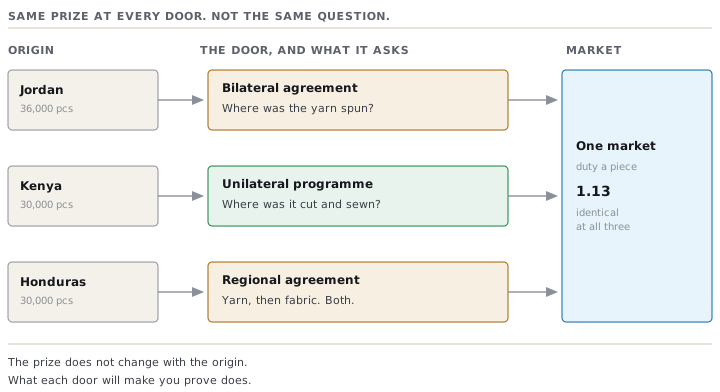
The prize is the same at every door. The price of collecting it is not.
Now put the three factories side by side. The duty belongs to the style and the market, not to the origin. So the preference is worth exactly the same per piece wherever the goods are made.
| Hasbani, Jordan | Ombaya, Kenya | Valdecillo, Honduras | |
|---|---|---|---|
| Pieces | 36,000 | 30,000 | 30,000 |
| FOB a piece | 6.85 | 6.42 | 7.10 |
| Ocean freight and insurance a piece | 0.34 | 0.41 | 0.19 |
| Duty a piece if the claim fails | 1.13 | 1.13 | 1.13 |
| Preference at stake | 40,680.00 | 33,900.00 | 33,900.00 |
Across the season the preference is worth USD 108,480.00. For scale, the whole ocean freight and insurance bill on the three shipments is USD 30,240.00. The thing nobody has a process for is worth 3.59 times the thing three people manage every week.
Now notice what the table does not vary. The prize is identical. What differs between these three factories is not what they can win. It is what each of them will be asked to prove, and whether it can. That is the whole subject, and it is why this course spends five lessons on evidence and one on rules.
Check yourselfTwo of your competitors ship the same garment to the same American buyer duty free. You are quoted the same way and you are told your goods do not qualify. Does that mean somebody is wrong?Show the answer
No. They may ship from countries covered by different arrangements, with different product rules, and all three statements can be true at once. Preferential origin is not a property of a garment. It is the answer to a question asked by one specific instrument. The same polo, made the same way, can qualify under one arrangement and fail under another, with nothing about the garment changing. Before you argue, find out which arrangement each of you enters under.
What the claim actually is, and who makes it
One more piece of the shape, before lesson 2 goes into the rules.
The preference is claimed by the importer, on the entry. An entry is the customs declaration filed when the goods arrive. The claim is not made by the factory, or the freight forwarder, or the mill. Ardsleigh makes the claim. Ardsleigh owes the money if the claim is wrong. Ardsleigh is the party the customs administration writes to.
But every fact the claim rests on is inside the factory, and most of them are inside the factory's suppliers. Ruth Delacote, Ardsleigh's import compliance manager, has never seen a cone of yarn. She is stating something about a spinning mill she cannot name, on the strength of a document signed by somebody she has never met.
The money sits with the party that holds none of the facts. That is the structural feature of this whole subject, and it explains behaviour that would otherwise look like paranoia. It is why buyers put origin warranties into vendor agreements. Course 8.5 covers that clause and who ends up carrying the loss. It is why compliance departments ask questions that sound like accusations. And it is why a factory that can hand over a complete origin file is selling something the factory next door is not.
Prompt · Find every door my goods could use, and what each would make me prove
When a buyer says your goods import duty free and nobody in the conversation can name the arrangement. Or when you are comparing factories in two countries and want to know what each claim would rest on.
Act as a trade preference analyst who has watched claims fail on evidence rather than on rules, and who never quotes a rate. The goods: [DESCRIBE THE GARMENT AS IT WILL BE IMPORTED]. Knitted or woven: [WHICH]. Fibre composition of the shell by weight: [PERCENTAGES]. Country where the garment is cut and assembled: [COUNTRY]. Country where the fabric is knitted or woven: [COUNTRY, OR UNKNOWN]. Country where the yarn is spun: [COUNTRY, OR UNKNOWN — say UNKNOWN if you have not asked the mill]. Importing market: the United States. Do the following in order. First, list every preferential arrangement under which goods made in my assembly country could enter that market. For each one, say whether it is a reciprocal agreement or a programme enacted by the importing country alone. Second, for each arrangement, tell me WHERE its conditions and its product rules are written and how I would find the row that covers my chapter — name the document and the part of it, not the rule itself. Third, for each arrangement, tell me what SHAPE of rule apparel of my kind is usually subject to under it — assembly only, fabric forward, yarn forward, fibre forward — and say plainly how confident you are and what would settle it. Fourth, for each arrangement, list the exceptions and relaxations whose CATEGORY exists in instruments of this kind: short supply or commercial availability, tariff preference levels, cumulation, de minimis tolerance, express permission to use third-country fabric, and provisions for fungible materials. Say which categories I should go and check for, not what they currently say. Fifth, and most important, for each arrangement produce the EVIDENCE LIST: which tier of my supply chain the rule reaches, whose document is therefore load-bearing, and what that document must state. Then tell me which of the facts I gave you as UNKNOWN would decide the answer, who holds each one, and the exact question I should send them. Do not state a duty rate, a threshold, a percentage, a quota volume, an expiry date or an article number, because those change and I will act on what you write. Where the answer depends on something you cannot know from what I have given you, say so and name the missing fact.
AI can make mistakes — check anything you act on.
What you should be able to do now
Take one live order shipping to the United States and write down three things. The name of the arrangement it enters under. Where in that arrangement the rule for your chapter is written. And the name of the person who claims the preference. If you cannot fill in all three from memory or from a file, you have found the gap while it is still free.
Lesson 2 is about what those rules actually ask, and why the answer usually sits one tier further up your supply chain than the invoice on your desk.