Lessons · Lesson 4 of 6
What a verification actually asks
Sit through an origin verification on a claim that may well be true, see the three questions it really asks, and find the point where the quantities close and the identity does not.
Lesson 4 of 6 · 19 min
The letter, and what it did not say
On 4 February of year three, Ruth Delacote received a letter. It was about five entries filed in the spring of year one, covering 36,000 pieces of ARD-512 from Hasbani Garments. It accused nobody of anything. It asked her to support the preference claimed on those entries. That letter is a verification: the customs administration checking, after the event, whether a claim it accepted was true.
Here is the first thing to understand about one. It is a normal event, not an accusation. The system is built this way on purpose. A container is cleared in hours, and a supply chain takes weeks to examine. So the claim is accepted at the border and tested afterwards. The moment of hardest scrutiny is not the day you ship. It is one to five years later, in an office, with somebody holding your invoices.
The methods vary by arrangement. They normally include a written request to the importer, a questionnaire sent straight to the exporter or the producer in the exporting country, and, where the arrangement allows it, a visit to the producer's premises. What does not vary is what is being tested. It is not the certificate.
The three questions, in the order they are asked
Strip away the covering letter, and every origin verification asks the same three things.
- Was the material the rule reaches actually originating? Under a yarn-forward rule that means the yarn, not the fabric.
- Is that material the material in these goods? Not equivalent material. Not material of the same kind. Not enough material. This material, in these garments, on these entries.
- Can you show both from records made at the time? A statement written now about what happened then is not a record. It is a memory with a letterhead.
Almost everybody prepares for the first question and is destroyed by the second.
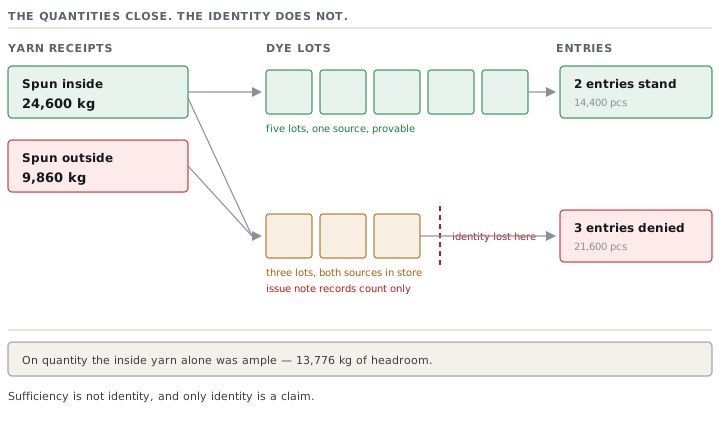
What Sabtah could show, and what it could not
Sabtah Knitting Mills answered the questionnaire fully and in good faith. Its records for the period were genuinely good.
Two words below need a meaning. A dye lot is one batch of fabric dyed together in one go. Originating means the material counts as coming from inside the covered territory, so the rule is satisfied by it.
Yarn receipts of this count and quality, in the period covering the order: 24,600 kilograms from Qatrana Spinning, inside the territory, and 9,860 kilograms from Hantai Spinning, outside it. Total 34,460 kilograms. Every receipt matched to an invoice, a date and a lot reference.
Fabric produced and delivered to Hasbani for this order: 9,432 kilograms, across 9 deliveries, dyed in 8 lots of a nominal 1,200 kilograms — 9,600 kilograms dyed against 9,432 delivered, a finishing and inspection loss of 1.75% that matched the mill's normal figure.
Now do the quantity test, which is the one everybody does first. Qatrana's yarn on its own could have made about 23,208 kilograms of fabric. The order needed 9,432. That leaves 13,776 kilograms of headroom. On quantity the claim is not merely satisfied. It is satisfied twice over.
And it made no difference, because the second question is not about quantity.
Sabtah's yarn store issues by count and quality, not by supplier. When Faris Naber issues yarn against a knitting order, his issue note records the count, the quality and the weight. It does not record which receipt the cones came from. For every purpose the mill has ever had, yarn of that count and quality is yarn of that count and quality.
So of the 8 dye lots behind this order, Sabtah could show that 5 were run in weeks when the store held Qatrana yarn only. Its own goods-in ledger proves that, and the administration accepted it. For the other 3, both suppliers' yarn was in the store, and no record in the building says which cones went into which lot.
Those three lots fed the fabric cut for entries 2, 4 and 5: 21,600 pieces, 60.0% of the order.
Two departments, one cause, opposite verdicts
Here is the part of this story that no process document would ever have caught.
For three seasons Ardsleigh's quality team has praised Sabtah for the best shade consistency of any mill in the vendor base. Its deliveries match each other across months in a way that is genuinely unusual, and it is the reason Hasbani keeps winning the style.
Sabtah gets that result by blending yarn receipts together through the dyehouse. It deliberately feeds each dye lot from more than one receipt. Variation between yarn lots is then averaged across the run, instead of showing up as a step between one delivery and the next. It is skilled work and it is exactly right. A mill that ran each receipt as its own lot would produce a shade record Ardsleigh's quality team would reject.
So one practice produced the best shade record in the vendor base and the worst origin record. The two facts sat in two different departments with no reason to speak to each other. Nobody did anything wrong, and there was no version of this where somebody was simply more careful. The fix is not effort. It is a record that did not exist.
The record that did not exist
There were two ways to have that record, and both are ordinary.
Keep the two yarns apart. Hold originating and non-originating yarn separately through the store and the dyehouse, and record which lot came from which. This costs real money at the mill, because it means more lot changes and smaller dye lots. Sabtah prices it at USD 0.018 a kilogram of fabric, which on this order is USD 169.78.
Use an inventory-management method. Many arrangements have a provision for fungible materials. Fungible means interchangeable: you cannot tell one unit from another once they are mixed. Where originating and non-originating materials of the same kind are physically mixed, the producer may account for them by a recognised inventory method instead of keeping them apart. Averaging and first-in-first-out are commonly permitted, and so are others. Whether your arrangement has such a provision, which methods it allows and on what conditions, is written in its own text.
The second is far cheaper, and it carries one hard condition that decides everything in lesson 5. It must be chosen in advance and applied consistently, with the records kept as you go. An inventory method chosen in June cannot describe a dye lot run the previous March. It is not a document you produce when the letter arrives. It is a way of keeping the store's book, adopted before the goods are made.
Check yourselfYour mill tells you there was more than enough originating yarn in stock to have made your fabric, and it can prove the quantities. Is that an answer?Show the answer
No, and it is worth being exact about why. It answers a question about capacity, which nobody asked. The rule attaches to the material in these goods. So the claim needs identity, not sufficiency: a link from a yarn receipt to a dye lot to a roll to a cut to an entry. Where the material really is interchangeable and mixed, the recognised way to bridge that gap is an inventory-management method, if your arrangement provides one. It has to be chosen before the goods are made, not offered afterwards.
What you should be able to do now
Ask your fabric mill one question, and listen carefully to the answer: which of your records tells me which yarn receipt fed a given dye lot? If the answer is that the issue note records count and quality only, you have found the same break Sabtah had. And you have found it while there is still time to choose a method or run a separate batch.
Lesson 5 is the bill.