Lessons · Lesson 2 of 6
The rule reaches back past the thing you buy
Understand the yarn-forward idea as a shape rather than a number, see why the load-bearing fact sits in a transaction you are not a party to, and watch two factories with identical supply chains get opposite answers.
Lesson 2 of 6 · 20 min
Two factories, one supply chain, two answers
Hasbani Garments and Ombaya Apparel do the same things in the same order.
Both buy knitted cotton fabric from a mill in their own country. Both of those mills knit and dye in their own country. And both of those mills buy a large part of their yarn from spinners outside the region. Hasbani's mill is Sabtah Knitting Mills, and its outside spinner is Hantai Spinning.
Physically the two chains are the same chain. Yarn in from far away, fabric made locally, garment cut and sewn locally, container to the United States.
Ombaya's claim stands. Hasbani's claim collapses.
Nothing about the garments explains that. The explanation is that the two arrangements were written by different people, at different times, for different purposes. They do not ask the same question.
The shape most United States arrangements use
You will hear one phrase constantly: yarn-forward. Understand it as a shape, not as a rule you can quote.
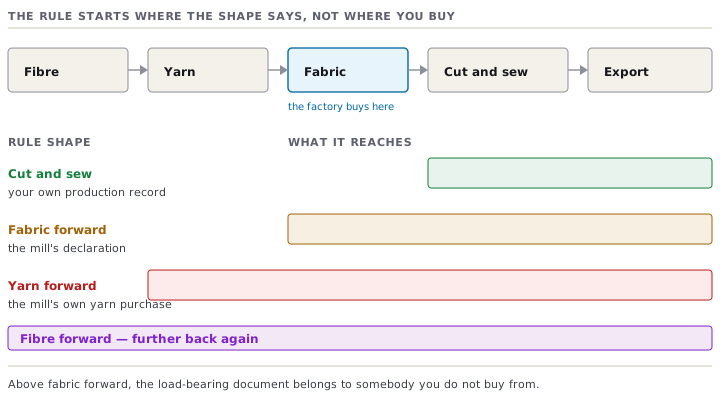
A yarn-forward rule says that everything from the yarn stage onwards must happen inside the covered territory. The yarn must be formed there. The fabric must be formed from that yarn there. And the garment must be cut and assembled there. Three stages, not one. And the first of the three is two tiers above the thing a garment factory actually buys.
It is not the only shape in use. Three others turn up regularly:
- Fibre-forward, which pushes the requirement one stage further back. It brings the making of the fibre into the territory as well. It is rarer, and it is severe.
- Fabric-forward, which asks that the fabric be formed in the territory and says nothing about where the yarn came from.
- Cut and sew, which asks only that the garment be assembled in the territory. Where you meet this, it is usually a deliberate exception written for one product or one country, not the general rule.
Which shape applies to your goods, under your arrangement, is written in that arrangement's own annex of product rules. An annex is the schedule at the back that lists the rule for each kind of goods. You find your row by your chapter, and — this is the part people skip — often by your specific heading rather than the whole chapter. A chapter is a broad family of goods in the tariff; a heading is a narrower line inside that family. So the classification work is not optional. Two garments in one shipment can sit under two different rows of the same annex.
What Ombaya has that Hasbani has not
Ombaya ships under a unilateral programme with a relaxation of the kind just described. An eligible beneficiary may use fabric formed outside the region. So under that instrument, where Ombaya's knitter buys its yarn is simply not a question anybody asks. Grace Mwendwa can answer the origin question completely, in two sentences about where she cuts and sews.
Hasbani ships under a reciprocal agreement whose rule for its chapter is yarn-forward. The same two sentences answer nothing at all. The question Hasbani has to answer is about a transaction it is not a party to: Sabtah's yarn purchase.
Read that again, because it is the hinge of the whole course. Hasbani buys fabric. The rule asks about yarn. The yarn was bought by somebody else, from somebody else, on a contract Hasbani has never seen, at a price Hasbani is not entitled to know.
| Hasbani, Jordan | Ombaya, Kenya | |
|---|---|---|
| Yarn spun | Outside the territory | Outside the territory |
| Fabric knitted and dyed | In the territory | In the territory |
| Garment cut and assembled | In the territory | In the territory |
| Rule shape for this chapter | Yarn-forward | Relaxed for this beneficiary |
| Does the yarn question arise | Yes | No |
| Preference at stake | 40,680.00 | 33,900.00 |
The same fact, imported yarn, is worth USD 33,900.00 of nothing at all at one door, and USD 40,680.00 of exposure at the other.
The mistake nobody made
Now the part that is worth more than the rules.
In February, Curtis Aynsley visited Ombaya. He came away with a clear and correct understanding: for this style, at this factory, the yarn source does not matter. He said so in a trip report, and he was right.
In April he placed the Jordan order, and the fabric conversation went the way fabric conversations go. Hasbani offered Sabtah, a mill it had used for four years, with a shade record Ardsleigh's quality team liked. Nobody asked where Sabtah's yarn came from. In the most recent conversation anybody could remember about yarn origin, the answer had been that it did not matter.
Nobody was careless. Aynsley learned a true fact and applied it to a different instrument. The merchandiser did not ask a question that had already been answered. Hasbani did not volunteer information nobody had requested. Sabtah answered every question it was asked, accurately. Rana Kilani, Hasbani's export documentation manager, issued the origin paperwork exactly as she had for four years.
A rule learned at one door became an assumption at another. That is the commonest way a preference is lost. It is almost never visible at the time, because nothing goes wrong. The goods ship, the entry clears, the money arrives, and the mistake sits quietly in a filing cabinet for two years.
Check yourselfYour buyer's compliance team asks where your fabric is knitted. You answer truthfully that it is knitted in your own country, and they come back asking about yarn. Why is the second question not a formality?Show the answer
Because under a yarn-forward rule, forming the fabric in the territory is necessary but not sufficient. The rule reaches back one further stage, to where the yarn was spun, and that stage is controlled by your mill rather than by you. A truthful answer about the fabric answers a fabric-forward rule completely, and a yarn-forward rule only halfway. That is the most dangerous kind of answer there is. It is correct, so nobody challenges it, and it leaves the load-bearing fact unexamined.
What a merchandiser should take away
Three things, and they cost nothing to adopt.
- Name the arrangement before you discuss the rule. A sentence beginning "the rule for polos is" is wrong before it finishes. There is no such thing as the rule for polos.
- Find the stage the rule starts at. Then find out who at your supplier controls that stage. Under a yarn-forward rule, that party is your fabric mill's purchasing office, and you have probably never spoken to it.
- Treat a change of mill as an origin event, not a price event. Course 8.5 works through an order that lost its preference because a fabric substitution was approved on price and lead time alone. That is the same failure, one tier lower down.
Lesson 3 is about the document that is supposed to close this gap: the declaration your mill gives you about its own inputs. And about why it is so often a true sentence that answers the wrong question.