Lessons · Lesson 4 of 6
You sign it, so you own it
Understand what changed when an authority's certificate was replaced by the exporter's own statement, who may lawfully make that statement, and what it costs when the wrong party makes it.
Lesson 4 of 6 · 18 min
The stamp that stopped happening
For most of the history of preferential trade, a claim was carried by a certificate. The exporter applied to an authority in the exporting country and produced its evidence. The authority issued a movement certificate, stamped and signed — the EUR.1 is the one most people in this trade have seen. The certificate travelled with the goods, and the importer handed it in.
Something official happened before the goods sailed. Somebody with a stamp looked.
The European Union's newer instruments do not work that way. The exporter registers: it obtains a number and appears on a list the importing side can consult. Then it makes the origin claim itself, as a short statement on origin typed onto its own commercial invoice or another commercial document. Nobody issues anything. Nobody looks before the goods move. In the middle sit the older declarations made by an approved exporter, which is the same idea one step earlier: a permission to self-certify, granted once, used thereafter without reference to anybody.
There is a third arrangement in some of the newest agreements. It is worth knowing about, because it changes the conversation with your buyer. The importer may make the claim on its own knowledge of how the goods were produced, with no statement from the exporter at all. The evidence then has to be in the importer's hands, not the exporter's. That is a very different negotiation about who gets to see a mill's supplier list.
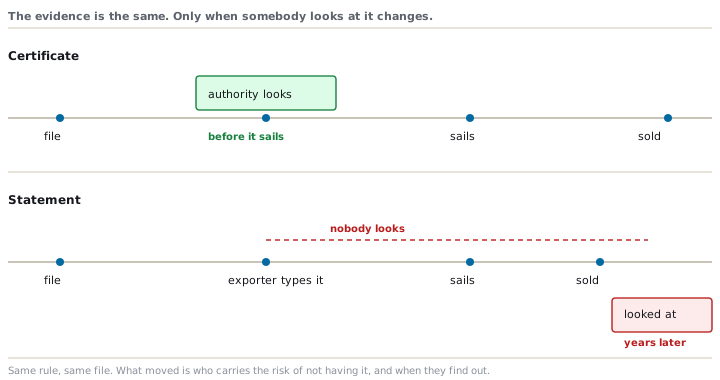
What actually changed, and what did not
The mistake is to read self-certification as a relaxation. Read both sides of the drawing again.
What did not change: the evidence. The garment must meet exactly the same rule. The file behind it — the supplier's declarations, the bills of materials, the proof of where the cloth was woven — is exactly as demanding as it ever was. Nothing about the underlying test was made easier.
What changed is who carries the risk of not having it, and when they find out.
Under a certificate, an incomplete file is normally discovered at the moment of application, by somebody whose job is to look, before a single carton is on a vessel. The cost of being wrong is a delayed shipment and an argument in your own city, in your own language, this week.
Under a statement, an incomplete file is discovered long after the goods are sold, if at all. It is discovered by an authority in the importing country, working through the importer. The cost of being wrong is a retroactive recovery on volumes you can no longer price for, exactly as lesson 3 showed. The system removed the person who used to catch you early.
That is a fair bargain when the exporter has a real origin file and a real process. It is a poor one when the exporter has a shipping clerk and a checklist. Which of those two you are is now a decision your own factory makes, and nobody outside it will ever check until it is expensive.
Who may make the statement
This is where Bruinsma lost money on the Bangladeshi route. The mechanism is so ordinary that it is worth walking through slowly.
Bruinsma does not buy from Shonar Apparels directly. It buys through Cheung Sai Trading, a buying agent in Hong Kong that consolidates several of Bruinsma's Asian suppliers. The commercial invoice Bruinsma pays against is issued by Cheung Sai. That is a normal arrangement and there is nothing improper about it.
On two of the four Bangladeshi consignments, the origin statement was typed onto Cheung Sai's invoice by Cheung Sai's documentation clerk, who had copied the wording from a previous file.
Consider what that statement asserts, and who is in a position to assert it. It says the goods originate in a beneficiary country under the scheme's rules. The facts behind it are: where the cloth came from, what was done in the factory, and what records support both. Cheung Sai did none of that work. It holds none of those records. It is not the registered exporter, and it is not established in the beneficiary country at all. It has certified something it cannot know.
A statement on origin belongs to the party that did the work and holds the records. Whether a third-country invoice can carry it at all, and on what conditions, is one of the details that differ between agreements and schemes. That is precisely why it must be read rather than assumed. What is never in doubt is that copying the wording onto a trader's invoice does not transfer anybody's knowledge along with it.
The two consignments were 10,500 shirts at a customs value of EUR 6.60:
| Consignments certified by the registered exporter | Consignments certified by the agent | |
|---|---|---|
| Shirts | 10,500 | 10,500 |
| Customs value a shirt | 6.60 | 6.60 |
| Duty a shirt | 0.00 | 0.76560 |
| Duty on the consignments | 0.00 | 8,038.80 |
EUR 8,038.80 on two consignments, on goods that genuinely originated in Bangladesh and genuinely met the rule, because the wrong company typed the sentence. Lesson 6 is about how much of that is recoverable, and what has to be true on the day for it to be.
Check yourselfYour agent offers to handle all origin statements for you, so your shipping office has one less thing to do. What do you say?Show the answer
That the offer is backwards. The statement is an assertion about facts that live in your factory and your fabric file. The liability that follows it follows the party that made it and the party that relied on it, not the party that typed it. Ask instead for the opposite division: your factory makes the statement, on its own document, under its own registration, and the agent handles everything else. If your agreement or scheme genuinely permits a third-party document to carry the statement, get that in writing from your buyer's customs adviser first, naming the route.
Everything about proving a claim years later — what a verification asks for, how it runs, and what a failed one costs — is course 26.2's territory, and it is worth reading directly after this lesson. The two courses meet exactly here. This one is about the moment you commit. That one is about the moment you are asked to stand behind it.