Lessons · Lesson 3 of 6
The declaration that was true when it was written
Follow a claim that broke three tiers away from anybody who could see it, and price what a change of supplier costs when it is found after the goods are sold.
Lesson 3 of 6 · 20 min
Six correct decisions and a bill
On 9 November, Doornik was reconciling Bruinsma's fabric evidence for the Egyptian route. She found a document that did not say what she expected. Kayalar Dokuma's invoices to Zahran from late May carried a mill reference she did not recognise. She asked one question by email. The answer was completely straightforward, and it was offered without any sense that it mattered.
Kayalar had stopped weaving the poplin on 14 May. A long domestic contract had taken its own looms. Rather than lose Zahran, it bought the identical construction, finished, from a mill outside the preferential group, and sold it on under its own name at its own price.
Nobody hid anything. Now look at the six decisions that produced the bill, and find the wrong one.
- Kayalar protected its customer's delivery by buying in rather than delaying. Any mill would.
- Kayalar charged the same price and did not treat a sourcing change as something a customer needed to be told about. In every other respect it was not.
- Zahran's fabric technologist approved the roll against the approved standard. It was the same construction and the same shade, and it passed.
- Zahran's merchandiser confirmed to Antwerp that nothing had changed on the tech pack. Nothing had. A tech pack is the specification sheet the buyer and the factory both work from.
- Zahran's shipping clerk made the origin statement on each export invoice, exactly as the procedure said, relying on the supplier's declaration in the fabric file.
- Bruinsma claimed the preference, on evidence that was complete, current and in the file.
The supplier's declaration in that file had been issued by Kayalar in January. It was a long-term declaration: one document covering a period of deliveries, rather than one per consignment. That is how mills and their customers avoid producing a piece of paper nine times a season. It said the poplin originated in Turkey.
It was true on the day it was written. It stopped being true on 14 May, and nothing in the trade's normal machinery announces that.
Where the break was, and why nobody was looking there
Draw the chain. Bruinsma buys from Zahran. Zahran buys from Kayalar. Kayalar buys yarn — or in this case cloth — from somebody else.
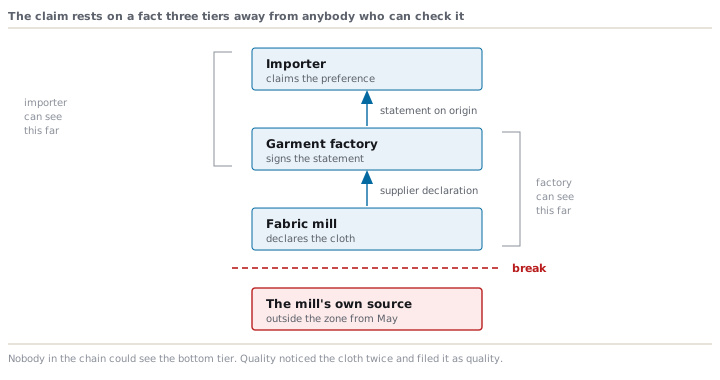
Now mark the visibility. Bruinsma sees Zahran's invoice and the origin statement on it. Zahran sees Kayalar's invoice and the declaration in the file. Nobody in the chain can see tier three, and the claim depends on it entirely. That is not a lapse. It is the geometry of the arrangement. A declaration is an assertion by one company about facts inside another, and the further up the chain the fact lives, the fewer people can check it.
There is a second thing worth noticing, and it is the reason this lesson exists.
The change did show up in Bruinsma's systems. On the September and October quality reports, the same fabric was flagged twice with a note about a slightly different hand. Both notes were inside tolerance. Both were logged. Both were closed by the quality team as a minor observation on a stable supplier.
One event produced a quality note and a duty liability, and only the quality note had anybody's name against it. The quality department was watching the goods, which is its job. No department was watching the origin, because origin looks like paperwork and paperwork is not a department. If you take one habit out of this course, make it this one. A change of hand, a change of shade behaviour, a change of shrinkage on a fabric that is supposed to be identical, is also a question about where it was made.
What it cost
Zahran's 21,000 shirts shipped in five consignments. The cloth woven before 14 May covered the first two. The remaining three consignments — 10,500 shirts — were cut from cloth that was not originating in the preferential zone. The claim on them was not supportable.
| Shipments 1 and 2 | Shipments 3, 4 and 5 | |
|---|---|---|
| Shirts | 10,500 | 10,500 |
| Cloth woven inside the zone | Yes | No |
| Customs value a shirt | 7.38 | 7.38 |
| Duty a shirt | 0.00 | 0.85608 |
| Duty on the consignments | 0.00 | 8,988.84 |
EUR 8,988.84, and here is the part that makes it hurt. Those shirts were sold. Bruinsma set a retail price in February on a landed cost that carried no duty. By November most of the 10,500 were on customers' backs, and none of the money could be recovered from anybody downstream. The purchase was FOB, so the duty was Bruinsma's cost and not Zahran's.
Bruinsma's gross margin on those 10,500 shirts was EUR 25,620.00. The duty is 35.1% of it. A programme that made money made a third less of it on those shipments, for a reason that had nothing to do with the price, the quality, the delivery or the sell-through.
What follows — the correction of the entries, the recovery of the duty by the authority, and what it costs to be found out rather than to come forward — is course 26.2's subject, and this course hands it over there deliberately. What belongs here is the prevention, and it is embarrassingly cheap.
The two lines that would have stopped it
One line on the fabric purchase order. Notify us in writing before any change in the mill at which this cloth is woven, or in the country it is woven in. It costs nothing. It is not a compliance clause. It converts an invisible fact into an email. Kayalar would have sent that email in May without a second thought, because it had no reason not to.
One field on the goods-received note. A long-term declaration is a photograph, and the moment it records is the day it was signed. What it cannot do is notice. So the second check does not belong on the declaration at all. It belongs on the delivery: one field beside the roll number, reading mill and country of weaving, as stated on this delivery, filled in by the person unloading and read against the declaration in the file. Escalate the day the two disagree. On this order the two would have disagreed on 14 May, and the field costs a line on a form somebody is already filling in.
Neither line is an argument for abandoning long-term declarations. They are useful, and most mills will not want to go back to one document a consignment. Both are arguments for knowing which of the declarations in your file is load-bearing, and treating that one differently, which is lesson 6.
Course 26.2 owns the other half of this subject and is worth reading beside this lesson: what a mill's declaration has to say to be usable at all, and what it costs to take one at the time of delivery rather than reconstruct it two years later. This lesson is about a declaration that said the right thing, was taken at the right time, and stopped being true.
Check yourselfYour mill tells you it has changed nothing: same specification, same price, same delivery, same invoice. Why is that not an answer to the origin question?Show the answer
Because none of those five things is the fact the claim rests on. The rule turns on where the cloth was made, and a mill can change that while holding every commercial term constant — by buying in, by moving production to a second site, by having a converter make it. The mill is not being evasive. It is answering the question it was asked, which was a commercial one. Ask the origin question in its own words: at which mill, in which country, was this cloth woven, and has that changed since your last declaration.
Prompt · Find the one declaration in my file that decides the claim
When your origin file is a folder of supplier declarations that all look equally important, and you want to know which one you would lose the claim over.
Act as a preferential origin specialist reviewing a factory's own evidence file. Sort it by consequence rather than by date. My product: [GARMENT], made in [COUNTRY], shipped to [DESTINATION], under [AGREEMENT OR SCHEME, OR UNKNOWN]. The origin rule as my buyer's adviser has summarised it: [PASTE IT, OR SAY UNKNOWN]. The declarations I hold, one to a line: [ITEM, THE SUPPLIER WHO ISSUED IT, THE COUNTRY THE ITEM IS MADE IN, THE DATE IT WAS ISSUED, THE PERIOD IT COVERS, AND WHETHER IT IS PER CONSIGNMENT OR LONG TERM]. Do the following. First, split my list into declarations that could on their own break the claim and declarations that could not, and give the one-sentence reason for each. Second, for each load-bearing declaration, tell me what fact it actually asserts, and write the question I should ask the supplier to confirm that the fact is still true today — phrased about the mill and the country rather than about the specification or the price, because a supplier answering about specification will honestly tell me nothing has changed. Third, list the events that would silently make a valid declaration untrue without anybody being at fault: a supplier buying in rather than making, a move to a second site, a converter, a change of the material one tier further up. Fourth, propose a rhythm for each load-bearing declaration — per consignment or per period — with a named check and a trigger that re-opens it. Fifth, draft one sentence I can add to my fabric purchase order requiring written notice before any change in the mill or the country the cloth is made in. Do not invent an expiry period, a tolerance or a rate; where you need one, tell me to read it in my own agreement and say exactly what to look for.
AI can make mistakes — check anything you act on.
The chain broke at a tier nobody could see. The next lesson is about the other half of the same exposure: the signature at the bottom of the export invoice, made by a person who cannot see tier three either, and what it commits the person who makes it to.