Lessons · Lesson 2 of 6
Cumulation: whose work counts as yours
Work out which other countries' processing may count towards your origin, why a friendly partner often cannot help, and what the answer is worth on one fabric decision.
Lesson 2 of 6 · 19 min
The clause that decides more orders than any other
Every preferential agreement contains a rule saying what your garment must have had done to it in your country. Most agreements also contain a second rule, a page or two further on. It says whose work outside your country you may count as though it had been done inside it. That second rule is cumulation. On a fabric-heavy product like a shirt, it decides more claims than the first one does.
It exists because the first rule, applied literally, would be absurd. If a Moroccan shirt maker had to weave its own cloth to qualify, an agreement covering a region of specialised producers would exclude almost all of them. So the agreements let the region's work add up. The argument is always about how much adds up, and whose.
Three shapes are in common use. They are not variations on one idea. They answer different questions.
Bilateral cumulation. Material originating in the partner you are shipping to counts as originating in your country. A Moroccan shirt made from cloth woven in Portugal is the standard case. The cloth is European Union material, and under the agreement between the two sides it counts as Moroccan for the purpose of qualifying the shirt. Almost every agreement has this. It is the least useful shape, because it only ever reaches one extra country.
Diagonal cumulation. Material originating in a third country counts, provided that third country is inside the same group and plays by the same rules. This is the shape that makes Egypt viable: Turkish cloth counting as Egyptian for a shirt shipped to the European Union. It is enormously powerful, and it has a precondition people miss. That precondition is the next section.
Full cumulation. Not the material, the work. Under full cumulation you may add up the processing carried out anywhere in the zone, whether or not the intermediate product ever qualified as originating in its own right. That distinction sounds academic until you meet an order that turns on it, which is what the second half of this lesson is.
Which of the three you have is not a matter of judgement. It is written in the agreement you are shipping under, and revised agreements have changed it. Read it. Do not assume it from what was true two seasons ago.
Diagonal cumulation is a property of the agreements, not of the countries
Here is the mistake, and competent people make it every season.
Doornik was asked in March whether Zahran, in Egypt, could buy its poplin from Hanseo Textile in Korea. Hanseo had quoted EUR 1.34 a metre against the Turkish mill's EUR 1.47. The buying team's reasoning was clean. Korea has a free-trade agreement with the European Union. Egypt has an association agreement with the European Union. Everyone is inside the tent, so the cloth must count.
It does not count, and the reason is structural rather than political. Diagonal cumulation is not conferred by each country's relationship with the destination. It needs a triangle. Every pair in the triangle has to have an agreement with each other, and those agreements have to carry the same origin rules. The three pairs are: you and the destination, the material's country and the destination, and you and the material's country. Two countries that are each close to the same buyer, and have no arrangement with each other, cannot cumulate. The third leg is missing, and there is nothing to argue about.
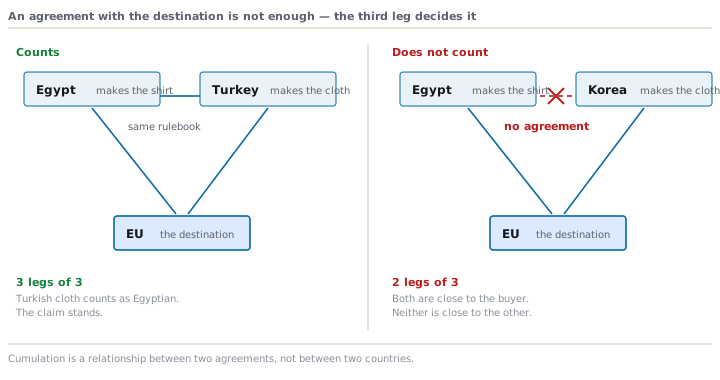
That is why the pan-Euro-Mediterranean group exists at all. Its whole purpose is to replace a web of separate origin protocols, sitting in separate agreements, with one shared text. Then the third leg exists everywhere inside the group, and the rules on it are identical. Cumulation between two countries in that group is possible because they read the same rulebook, not because they get on.
Now the comparison that makes it concrete. Hanseo quoted the same cloth to two of Bruinsma's factories in the same week.
- At Truong Phat in Vietnam, the saving against the local mill's EUR 1.41 is EUR 0.07 a metre. At 1.62 metres a shirt that is EUR 0.1134 a shirt, or EUR 2,381.40 on 21,000 pieces. And it is available, because the agreement Vietnam ships under names Korea specifically as a source of fabric that may be used.
- At Zahran in Egypt, the saving against the Turkish mill is EUR 0.13 a metre, or EUR 0.2106 a shirt: EUR 4,422.60 on 21,000 pieces. And it is not available at any price, because taking it would cost EUR 17,977.68 of duty.
Two factories. One roll of cloth. One is a saving and the other is a trap. The difference is not in the cloth, the mill, the price or the quality. It is in the text of two agreements, written by different people at different times.
The finishing trip: where diagonal and full pull apart
Zahran can weave. It has a small shed of its own. In April its production director made a proposal that was, on every metric a factory measures, obviously right.
Instead of buying finished poplin from Kayalar Dokuma in Denizli at EUR 1.47 a metre, weave the greige at Ismailia at EUR 1.01, send it to Kayalar for dyeing and finishing at EUR 0.31, and bring it back. Greige is cloth straight off the loom, before it is dyed or finished. Freight both ways is EUR 0.06 a metre. Total EUR 1.38 a metre. And Kayalar's finishing is the reason Zahran buys from them in the first place, so the hand and the shade are identical either way.
| Buy finished cloth from Turkey | Weave at home, finish in Turkey | |
|---|---|---|
| Cloth cost a metre | 1.47 | 1.38 |
| Cloth cost a shirt at 1.62 metres | 2.3814 | 2.2356 |
| Saving a shirt | — | 0.1458 |
| Saving on 21,000 shirts | — | 3,061.80 |
| Qualifies under diagonal cumulation | Yes | No |
| Qualifies under full cumulation | Yes | Yes |
Look at what the weave at home, finish in Turkey column actually is. Under diagonal cumulation you may count originating material from a partner. The cloth that comes back from Turkey is not originating material of Turkey, because Turkey only dyed and finished it. And it is no longer a product of Egypt either, because it left. So the Egyptian factory is holding non-originating cloth, has done only the making-up, and fails a rule that asks for the cloth to be made in the zone.
Under full cumulation the same three operations are read together: weaving in Egypt, finishing in Turkey, making-up in Egypt, all inside the zone. Nothing has to originate anywhere on its own. The shirt qualifies.
Same cloth, same trucks, same invoices, same two countries — and two opposite answers, decided by which kind of cumulation the agreement gives you.
On this route the answer was diagonal. A saving of EUR 3,061.80 would have cost EUR 17,977.68 in duty, which is 5.87 times the saving. And the loss would have landed on Bruinsma rather than on Zahran, because the shirts were sold FOB.
Check yourselfA production director tells you the finishing trip cannot affect origin, because both countries are inside the same preferential group and nothing leaves the group. What is wrong with that?Show the answer
Being inside the group is necessary, and it is not sufficient. Under diagonal cumulation the group lets you count a partner's originating material. It does not let you count a partner's processing on something that is not originating. The cloth that comes back has been woven in one member and finished in another, and it does not qualify as either one's originating product. So it enters the garment as non-originating material. Only full cumulation adds operations together like that, and whether you have full cumulation is a question with a written answer in your own agreement.
Prompt · Draw my cumulation triangle before I take the quote
The morning a mill in a third country quotes you a better price, and somebody says it must be fine because everyone has an agreement with the buyer's market.
Act as a preferential origin specialist. You have watched competent people lose a claim by assuming that two countries close to the same buyer are close to each other. Do not give me a legal opinion. Build me a map I can check in ten minutes. My route: goods [DESCRIBE THE GARMENT AS IT WILL BE EXPORTED], made in [COUNTRY OF MANUFACTURE], shipped to [DESTINATION MARKET], under [NAME THE AGREEMENT OR SCHEME IF YOU KNOW IT, OR SAY UNKNOWN]. The fabric: made in [COUNTRY], by [MILL, IF KNOWN]. Other materials I am unsure about: [LIST THEM WITH THE COUNTRY EACH IS MADE IN]. Do the following, in order. First, state the triangle explicitly: the three pairs that must each have an agreement with each other, and for each pair say what I need to confirm and where I would look for it. Second, tell me which of the three shapes of cumulation would have to be available for my fabric to count — the partner I am shipping to, a third country in the same group, or the adding-up of operations regardless of whether any intermediate product originates on its own — and explain in one sentence each what would be true if I had it. Third, list the facts you had to assume rather than read, and for each one name the document that would settle it and the company that holds it. Fourth, write me three questions in plain commercial language that I can send to the mill today, phrased so a sales manager can answer them without involving a lawyer. Do NOT tell me the duty rate, the tolerance percentage, or any threshold. Do not quote an article number. If you cannot complete a step on what I have given you, say which step and what is missing, rather than guessing.
AI can make mistakes — check anything you act on.
Cumulation is the clause that turns failing orders into passing ones. Lesson 3 is about the way it fails: quietly, three tiers away, on a fact nobody in either company thought was a fact about them.