Lessons · Lesson 1 of 6
The border you clear before the buyer's
See the export side of an order as a set of permissions, each with an owner and a duration, and learn the five questions that get you any country's procedure.
Lesson 1 of 6 · 18 min
One order, three plants, one week
Calderhalt Outdoor is a mid-market outdoor and workwear chain in Vestreland. In February it places purchase order CAL-3374 with the Nasira Group: 31,500 men's cotton canvas overshirts, style OS-621, one construction, five sizes, at USD 14.60 a piece FOB. FOB — free on board — means the price covers the goods loaded on the ship at the origin port, and no further. The order is USD 459,900.00 of goods. Nasira's own cost sheet leaves USD 1.34 a piece, so USD 42,210.00 of margin.
Nasira makes it in three plants, in three countries:
- Nasira Ilvane, in Ilvane, Adrasene — 14,100 pieces
- Nasira Barmoth, in Barmoth, Kelmara — 8,400 pieces
- Nasira Sarnaq, in Sarnaq, Ovruna — 9,000 pieces
Same style, same buyer, same fabric supplier, same freight forwarder — Duvret Forwarding — and the same ship week in May. One planner in Ilvane wrote one calendar and copied it to all three plants. That is what a well-run group does.
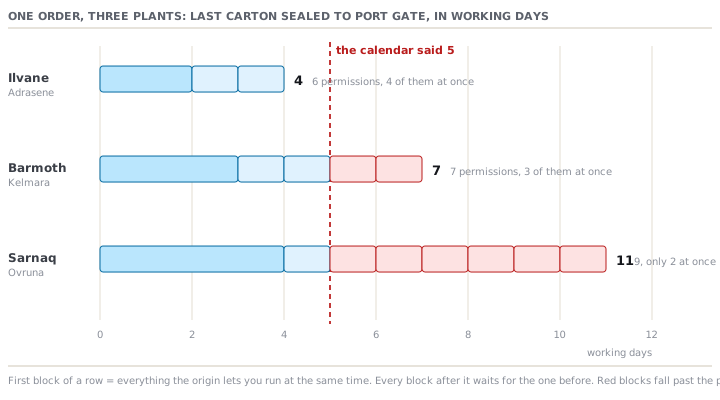
The three consignments reached the port gate four, seven and eleven working days after the last carton was sealed. A consignment is one lot of goods shipped together under one set of documents. The calendar said five.
The box that is not on anybody's calendar
Course 12.3 takes an already-loaded container and follows it from the vessel to a warehouse floor at the other end. This course is about everything that has to happen before that container is allowed to leave, in the country where it was made. It is a border too. It belongs to your own state, not the buyer's. And it is the one border the factory can actually do something about.
Most merchandising calendars have no box for it at all. They have sewing ends, then ship, and everyone assumes the space between is loading. It is not. Between the last carton and the ship sit a set of permissions. Each one has an owner, an input it cannot start without, and a duration.
Here is the export side of order CAL-3374, plant by plant. The count is working days, from the last carton sealed to the container accepted at the port gate.
| Plant | Permissions required | Can they run in parallel | Working days |
|---|---|---|---|
| Nasira Ilvane, Adrasene | 6 | Four of the six | 4 |
| Nasira Barmoth, Kelmara | 7 | Three of the seven | 7 |
| Nasira Sarnaq, Ovruna | 9 | Two of the nine | 11 |
Nothing in that table is about how fast a customs officer works. All three customs administrations released their entries within a day of being asked. The difference is how many separate permissions the country requires, and how many of them are allowed to run at the same time.
Where the extra days went at Sarnaq
Ovruna requires the export declaration to be lodged by a licensed customs broker, not by the exporter. That adds one handover. It also requires an export licence for the product category, one for each consignment, and you cannot apply for it until the final invoice exists. And Vestreland's consulate requires the certificate of origin to be legalised — stamped by the consulate to confirm it is genuine — which cannot begin until the chamber of commerce has issued the certificate.
Three of those steps run one after another by construction. Each one's input is the step before it. Urgency does not compress them. The second cannot be started early, and the third cannot be started at all.
Nasira Sarnaq missed the 14 May sailing. The service is weekly, so the next one was 21 May.
What the seven days cost
Calderhalt's distribution centre in Vestreland needed stock by 26 June for a 7 July floor set. To protect that date, Nasira flew 2,400 of the 9,000 pieces.
- Chargeable weight, on Duvret's own figure for this carton: 0.62 kg a piece, so 1,488.00 kg
- Air, all in: USD 4.15 a kilogramme, so USD 6,175.20
- What those 2,400 pieces would have cost by sea: USD 0.21 a piece, so USD 504.00
- Extra cost of the recovery: USD 5,671.20
The Sarnaq consignment carried 9,000 pieces at USD 1.34, which is USD 12,060.00 of margin. The recovery took 47.0% of it. That is USD 0.63 a piece across the whole consignment, on an order priced to earn USD 1.34.
Course 12.7 owns the arithmetic of what to fly, and why a light garment can be dear to fly. The point here is narrower, and it is the whole course in one line: nobody chose to spend that money in May. It was spent in February, when a planner wrote one export box and copied it three times.
Five questions that get you any origin's procedure
Export procedure is not one subject. It is a different subject in every country. It changes. No course can tell you what yours is today. What a course can give you is the shape of the question. Then a two-hour conversation with your own broker and your own customs administration produces a calendar instead of a shrug.
Ask these five, in this order, about your own country:
- Who may be the exporter? Which legal person is allowed to be named as exporter on the declaration, what register they must be on, and what number identifies them. Lesson 2.
- What permission must exist before the goods may leave, and when may you ask for it? The export declaration and its release. The earliest and the latest moment it can be lodged. And which facts it needs that only exist once the forwarder has booked the ship. Lesson 3.
- What must be inspected or certified on the way out? By whom, and what does each one need as its input. Lesson 4.
- What is different for goods that will come back? Samples, garments returned for rework, machinery going out for repair. Lesson 5.
- What will I be asked for afterwards? By whom, and for how long must I keep it. Lesson 6.
Answer those five for your own country and you have the export half of a calendar. Answer them for a country you are considering and you get something better. You get one of the real comparisons between placing an order in one country and another, which is what the rest of this track is about.
Where the answers actually are
Not from a course, and not from memory. From the bodies whose job it is:
- Your own customs administration, for the declaration, the release, the procedure codes and the registers. Members of the World Trade Organization have undertaken to publish this material and to run enquiry points that answer questions of exactly this kind. So asking for it in writing is a reasonable thing to do.
- The body that inspects or certifies exports in your country, where one exists. These are real institutions with real names, and they differ. Egypt has the General Organization for Export and Import Control. India has the Directorate General of Foreign Trade for exporter registration, and the Export Inspection Council for conformity certification. Bangladesh has the Export Promotion Bureau, and the Chief Controller of Imports and Exports for the export registration certificate. Turkey routes exports through the exporters' associations that sit under the Turkish Exporters Assembly. Vietnam has the General Department of Customs alongside the Vietnam Chamber of Commerce and Industry.
- Your chamber of commerce, for non-preferential certificates of origin — the ones that state where the goods were made without claiming a lower rate of duty — and for the extra chain of certification that some destination countries require on top of them.
- Your licensed broker, for what actually happens rather than what is written down. Ask specifically for their own record of how long each step took on your last twenty consignments.
Prompt · Map my own country's export procedure
Before you write an export box on a calendar, or before you compare two countries you might place an order in.
Act as an experienced export documentation manager who has worked in more than one country and knows that export procedure differs from country to country. I want a map of the export side for my own country, written as questions I can put to named bodies rather than as answers you invent. My facts: country of manufacture [COUNTRY], product [PRODUCT AND MATERIALS], destination market [COUNTRY], typical consignment [QUANTITY, CARTONS, CONTAINERS], mode [SEA OR AIR], my company's legal form and whether it is registered for tax in the country of manufacture [YES OR NO], who invoices the buyer [MY COMPANY OR ANOTHER ENTITY], whether I import any inputs under a duty-relief regime [YES OR NO], and who lodges my declarations [MY OWN STAFF OR A NAMED BROKER]. Do the following. First, list every permission, inspection, certificate and registration that is likely to sit between my last sealed carton and the container being accepted at the port gate, and mark each one as GOODS-SIDE, meaning it can change my invoice, or DOCUMENT-SIDE, meaning it only restates it. Second, for each one, name the KIND of body that owns it and tell me the exact question to ask them, in one sentence, in a form I could send by email. Third, tell me which items in the list can run at the same time and which cannot, and why. Fourth, give me the resulting elapsed working days as a range, and say plainly which of your assumptions the range depends on most. Fifth, list every figure you were tempted to state — a fee, a statutory deadline, a form number, a duty rate — and instead of stating it, tell me who to ask for it. Do not invent a rate, a deadline or a form number for my country under any circumstances; where you are not certain, say you are not certain and name the body that is.
AI can make mistakes — check anything you act on.
What this course does and does not cover
It covers the export side, in the country where the goods were made: who may export, the declaration and its release, the inspections and certificates between your gate and the ship, goods that leave temporarily, and the file that answers a question two years later.
It does not cover these, and each has its own course. The document set as a commercial and carriage matter is course 12.1. Classification and customs valuation is 12.2. Clearance at the destination is 12.3. Forwarders, carriers and brokers are 12.4. Duty relief on your imported inputs is 12.5. Marine cargo insurance is 12.8. Banking, export finance and incentive schemes are 26.5.
It also does not cover how to qualify for preferential access — a lower rate of duty at the destination. That is 26.2 and 26.3. Lesson 6 does cover how to prove, long afterwards, that you qualified.